Elementary Math Apps for Kids with ADHD
Early Childhood Education
Jul 17, 2026
Research-backed strategies for teaching elementary math to kids with ADHD—how visual, gamified, and adaptive apps improve focus, reduce overload, and boost skills.

Teaching math to kids with ADHD calls for special strategies. Because ADHD impacts working memory, attention, and flexibility, traditional methods like timed drills often do not work well. Studies show that interactive, game-like tools can help by meeting these problems. Apps made for ADHD learners use short lessons, visual supports, and quick feedback in order to keep kids interested and avoid overwhelming them.
Key Takeaways:
Challenges: ADHD affects working memory, attention, and abstract thinking, making math harder.
Solutions: Gamified apps with shorter sessions, visual aids, and adaptive tasks improve focus and understanding.
Good apps show how technology can support kids with ADHD by adapting math concepts to their needs and making learning more enjoyable.
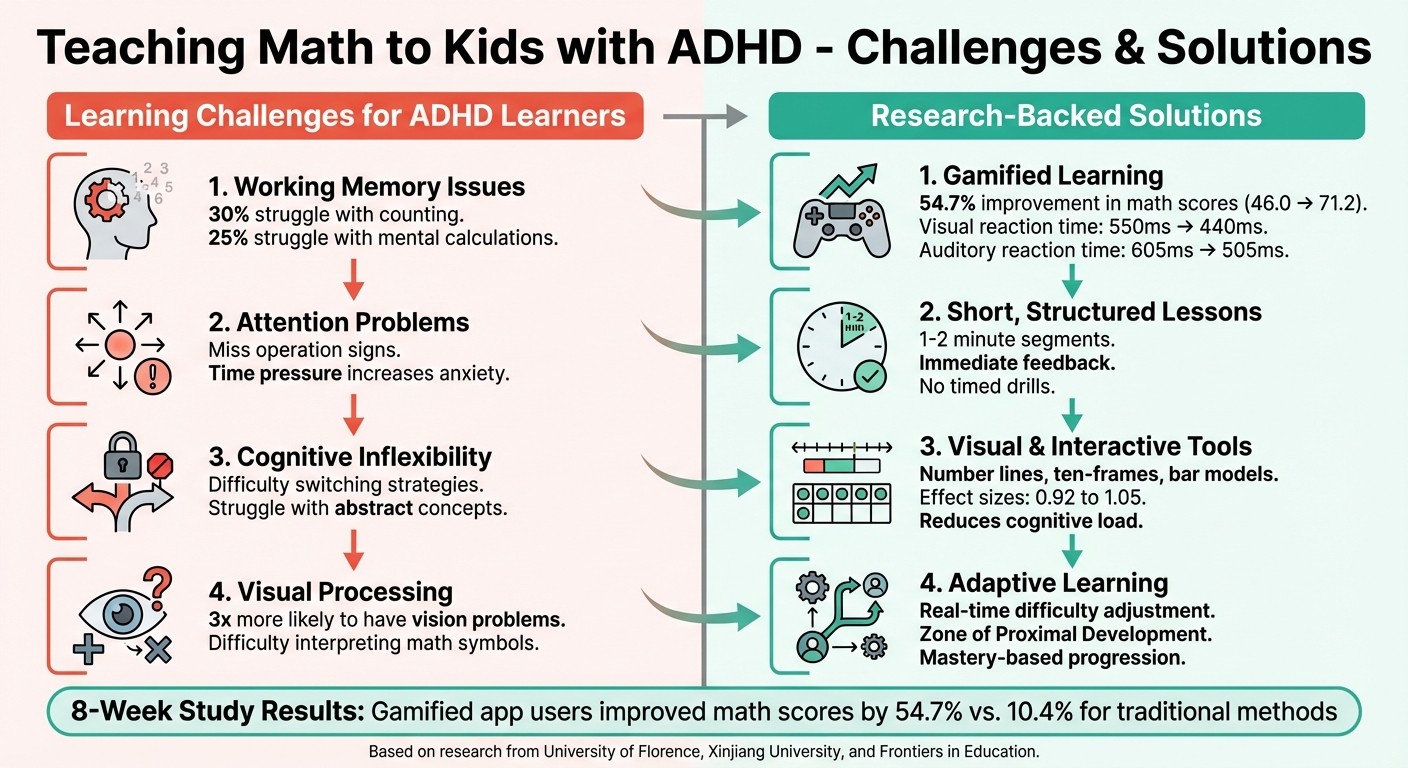
ADHD Math Learning Challenges vs Effective Teaching Solutions
Main Learning Challenges for Kids with ADHD in Elementary Math
Working Memory and Attention Problems
For children with ADHD, working memory - the ability to temporarily hold and use information - is often limited. This makes multi-step math problems, like long division or regrouping fractions, feel overwhelming [1][2]. To solve these, they need to juggle several pieces of information at once, which can be too much to handle.
Dawn Denberg, a parent and Co-creator of ModMath, shares her son's struggles:
Because of his working-memory challenges, by the time he gets to step two of any equation, he's not sure if the number he wrote down was a 4 or a 9.
The problem is not understanding math itself. It’s a cognitive hurdle: numbers can get misplaced, or steps can be forgotten midway through a calculation.
Attention problems make things even harder. Kids might miss operation signs or mix up addition and multiplication [2]. Adding time pressure, such as timed drills or countdown clocks, can cause anxiety and make it even harder for them to focus and do well. Parents often share similar stories: they tried to understand why their children were so reluctant to go to school, and eventually discovered that the whole problem came down to timed assignments.
Kids with ADHD can also avoid tasks that require long periods of effort, turning their attention to something easier or more familiar [1][3].
Beyond these memory and attention struggles, ADHD also affects a child's ability to adapt and switch strategies when needed.
Problems with Cognitive Flexibility
Children with ADHD often get stuck using one method to solve a problem, even if it’s inefficient. For example, a student who understands addition with physical objects may find the same problem difficult to solve when it’s presented as abstract symbols on paper. This mental rigidity makes it harder to adapt to new ways of thinking.
Trouble Understanding Abstract Math Concepts
Abstract math ideas - like place value, negative numbers, or fractions - pose a unique challenge for students with ADHD. These concepts require understanding logic that applies to intangible or non-physical things [2]. If a student can’t physically interact with the idea, it often remains unclear.
Visual processing issues can make things even harder. Jesse Willingham, Optometric Physician and Founder of Brighter Outlook Vision, and Connie McReynolds, Ph.D., Licensed Psychologist, point out that children with ADHD are three times more likely to have vision problems. These issues can make it tough to comprehend visual information, like math symbols or numbers, leaving abstract concepts feeling out of reach [2].
Together, these challenges – limited working memory, rigid thinking, and trouble with abstract ideas – shape how students with ADHD learn math. This shows why teaching methods need to be designed thoughtfully for them.
“I Can’t Focus!” When ADHD Impacts Your Child’s Math & Writing Performance
What Research Shows About Teaching Math to Kids with ADHD
Studies reveal that kids with ADHD often perform well when comparing numerical magnitudes (like identifying the larger of two numbers). However, they struggle with symbolic tasks such as counting, mental math, and recalling math facts. For instance, 30% of children with ADHD face severe difficulties in counting, while 25% struggle significantly with mental calculations [4].
Traditional math teaching methods, which often involve multi-step problems and time constraints, can overwhelm kids with ADHD. This frequently leads to performance issues and increased math anxiety [5]. Research reveals that these children tend to score lower in Working Memory and Processing Speed indices compared to their peers [4].
To address these issues, teaching strategies need to be adapted to better manage cognitive demands.
Why Gamified and Adaptive Learning Works
Gamified learning methods address the executive function difficulties that obstruct math progress in children with ADHD. In an 8-week randomized study involving 80 children (ages 6–12) diagnosed with ADHD, researchers JiaMin Dai, Ailifeire Wufue, and Hong Zhang tested the effects of a gamified math app. The app provided immediate feedback and level-based challenges. The results? Math scores in the experimental group jumped from 46.0 to 71.2 - a 54.7% improvement. Meanwhile, the control group, using non-gamified software, saw only a modest increase from 46.0 to 50.8 [6].
The study also showed that gamified learning improved attention. Visual reaction times decreased from 550 ms to 440 ms, and auditory reaction times dropped from 605 ms to 505 ms. These improvements persisted even after an 8-week follow-up [6].
Gamified tools work because they keep kids interested. Immediate feedback and rewards help keep motivation high, especially for kids who find it hard to wait for results. Adaptive algorithms make sure tasks are challenging enough to be interesting but not so hard that they become frustrating, keeping students in their Zone of Proximal Development [7]. As one study explains:
By leveraging multisensory stimuli such as visuals, sounds, and interactivity, gamified tools not only support improvements in attention but also enhance motivation through interactive engagement, instant feedback, and reward mechanisms. –
Frontiers in Education [6]
Why Visual and Interactive Methods Matter
Visual aids are not just helpful; they are essential for kids with ADHD. Tools like number lines, ten-frames, and bar models make problem-solving easier, especially for children with limited working memory. Research shows that students who use visual strategies frequently solve math problems more accurately than those who only use words or calculations.
A child might freeze when they see a problem like "8 + 7." But if they use a strategy instead of just trying to remember the answer—like counting on their fingers, using a number line, or drawing two ten-frames and filling in 8 squares on one and 7 on the other—the visual support can really help reduce stress. As they get more confident, they'll start to picture these strategies in their mind instead of needing physical tools. Over time, they'll move on to more abstract mental math.
Interactivity is also important. A study from Xinjiang University found that children who used apps with multisensory features and interactive feedback did better than their peers, with strong results [6]. The key is to use calm, focused activities, such as moving objects to solve a puzzle, instead of rewards that are too stimulating and might distract kids. Breaking lessons into short, manageable tasks of 1–2 minutes fits well with the attention spans of kids with ADHD and gives them frequent chances to succeed and build confidence [5].
These findings make a strong case for using adaptive, interactive tools to meet the learning needs of children with ADHD.
Effective Teaching Methods for Kids with ADHD
Teaching math to children with ADHD can be tough, but research has found strategies that meet their particular needs. The main idea is to use methods that fit their attention spans and working memory. So, what really helps? Here are three proven ways that make a difference.
Concise, Structured Lessons with Immediate Feedback
Breaking lessons into short, 1–2 minute parts matches the attention spans of kids with ADHD and helps prevent overload. These short sections give natural breaks, making it easier for students to stay interested without feeling overloaded.
Giving immediate feedback is also important. When a child finishes a problem, they should find out right away if they got it right. The key is to make feedback neutral and helpful, not negative.
Similarly, feedback should guide learning rather than discourage it. For example, avoid using “shaming” sounds or penalties like losing lives for mistakes.
Timed drills, on the other hand, can be counterproductive. Activities like "beat the clock" often increase anxiety and reduce performance for ADHD learners [1]. Instead, focus on accuracy and strategies that build confidence and understanding.
Personalized and Adaptive Learning
Personalized learning keeps students in their "Zone of Proximal Development" - a zone where tasks are challenging enough to keep them interested but not so hard that they want to give up [7]. Adaptive systems adjust in real time based on how a child is doing, making sure they understand one idea before moving to the next.
A 2019 study involving 988 kindergarten and first-grade students in Southern California illustrated the effectiveness of adaptive learning systems. Students using these systems showed significant progress, especially those who started with lower skill levels [7]. This mastery-based approach prevents gaps in learning, which may be especially discouraging for children with ADHD.
By building on prior successes, adaptive methods create a firm foundation for apps and tools designed specifically for ADHD learners.
Gamification and Multisensory Activities
Gamification isn’t simply about making math fun - it’s about maintaining attention through interactive and rewarding experiences. A controlled trial involving 40 children (ages 6–12) using a gamified app for 25–30 minutes daily over eight weeks showed dramatic improvements in math scores. The experimental group’s scores jumped from a baseline of 46.0 to 71.2, and these gains were still evident 16 weeks later [6].
However, not all gamified tools are created equal. The best options feature predictable gameplay without overwhelming elements like flashing lights or sudden sounds that can distract ADHD learners. Tools should also integrate visual aids like number lines and ten-frames as part of the game, not just as extras.
Feature | Benefit for ADHD Learners |
|---|---|
Immediate Feedback | Corrects errors instantly and prevents bad habits |
Visual Modeling | Eases working memory demands and clarifies concepts |
Adaptive Difficulty | Keeps tasks engaging without becoming frustrating |
Bite-Sized Levels | Matches short attention spans and offers frequent rewards |
These strategies work together to create a learning environment that fits how kids with ADHD think, helping them do well in math. By using structured lessons, personalized learning, and fun activities, teachers can help ADHD learners succeed in ways that really work for them.
Funexpected Math: An App Designed for ADHD Learners
Funexpected Math addresses the particular challenges that children with ADHD face, like limited working memory and trouble paying attention. By combining visual tools, short lessons, and smart technology, it makes math easier to access. Made for kids ages 3–7, the app includes over 10,000 tasks, 675 lessons and 50+ topics, all grounded in research-backed teaching methods.
Personalized Learning Paths and Adaptive Lessons
Funexpected Math uses an AI-powered system to give each child a learning experience that fits them. The app changes the difficulty of tasks as the child works, so they stay challenged but not overwhelmed. A digital tutor is available to give hints and ask guiding questions to keep kids interested.
Visual aids like number lines, ten frames, and object-based addition shift the focus from memory to hands-on learning, making concepts easier to grasp. The app also includes subitizing training, helping kids recognize small quantities at a glance - an effective way to reduce the mental strain often associated with arithmetic. These tools are particularly helpful for children with ADHD, who may find it hard to hold and manipulate information mentally.
Interactive and Gamified Content
The app keeps kids interested with interactive, game-like activities. Instead of using flashy or high-energy games, Funexpected Math chooses calm, visually appealing tasks that help kids focus. Activities such as moving, counting, and combining objects on the screen encourage both hands-on and visual learning, creating a relaxed space where children can try things out and learn without worrying about making mistakes.

Studying symmetry concept with Geoboard game in the Funexpected Math app
This method is effective. Studies show that an 8-week gamified program can greatly improve reaction times and attention in kids with ADHD. Children who use gamified math tools often do better in math than those who use traditional methods in mathematics [6]. The app’s content is thoughtfully organized by age, so younger kids (ages 3–4) get simple two-step instructions, while older kids (ages 6–7) work on visual-spatial and logic tasks.
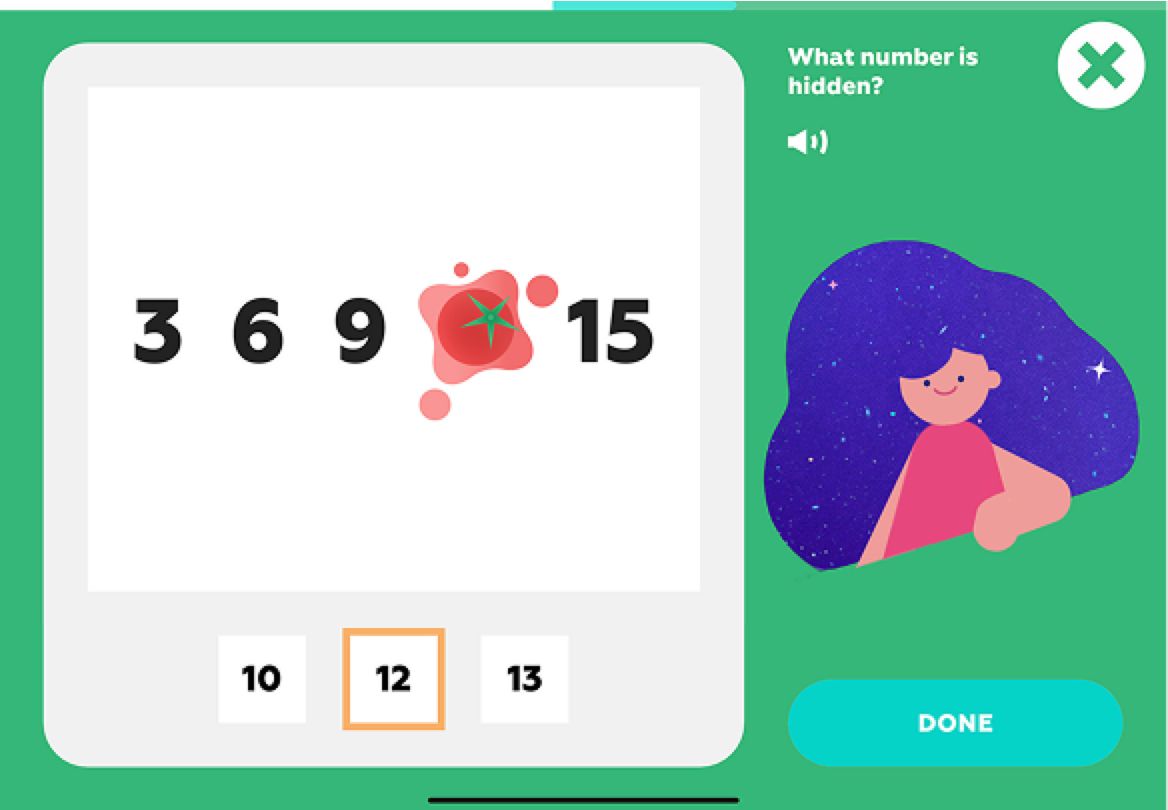
Number pattern task in the Funexpected Math app
Classroom Tools and Keeping Track of Progress
Funexpected Math also offers a set of tools for educators, making it easier to support ADHD learners in a classroom setting. Teachers can use features like easy rostering, detailed progress reports, and performance statistics to monitor individual student development. Available in 16 languages, the app makes a great help in teaching ELL students. It also adheres to COPPA and FERPA regulations, ensuring a safe and secure learning environment.
The app fits easily into classroom routines and works with any curriculum. It shows which concepts students have mastered and where they need more help, so teachers can give support that matches each child’s needs. For kids with ADHD, this focused help can make a big difference.
Conclusion: Supporting ADHD Learners
Teaching math to kids with ADHD takes careful, research-based strategies. These students do best with visual tools, flexible pacing, and calm, captivating activities that fit their focus patterns. Studies show that gamified math apps can greatly improve performance for kids with ADHD, and these benefits last over time [6]. This mix of science and smart design leads to better educational tools.
Here are a few simple things you can do at home:
Keep practice brief: 1 to 2 minutes or up to 10 minutes is enough. There's no need for long sessions.
Use hands-on tools like blocks, counting sticks, or ten-frames. Encourage your child to draw their own ten-frames or even picture them in their mind while you're out for a walk. This helps them gradually move from concrete objects to abstract thinking.
Don't rush through an entire worksheet. Instead of timing a set of problems, try checking how long it takes your child to solve just one. As they get more confident, you'll probably notice that time naturally goes down, and it's a good way to track progress.
Give feedback right away, while the problem-solving process is still fresh in your child's mind.
Funexpected Math puts these ideas into practice. Its adaptive system changes the difficulty as kids work, so tasks stay challenging but not too hard. Visual aids like number lines and ten frames make tough ideas easier to understand and lower the mental effort for young learners. The app’s calm design skips things like timer countdowns or flashy rewards that can cause stress, and instead gives gentle feedback and short lessons that fit shorter attention spans.
With over 10,000 tasks, Funexpected Math is organized by age and developmental stage, making it suitable for a wide range of learners. Teachers and parents can track progress using built-in classroom tools, which identify exact areas where children need extra support. This flexibility makes the app ideal for both home and school use, all while adhering to industry standards.
The main point is simple: learning that is gamified, broken into small parts, adaptive, and uses visuals works well for kids with ADHD. Funexpected Math combines all these features, giving children ages 3–7 a structured but flexible way to build math skills and confidence through fun, manageable lessons.
FAQs
How can math apps designed like games help kids with ADHD learn better?
Math apps with game-like designs transform learning into an engaging experience for kids with ADHD. By converting abstract math concepts into interactive, bite-sized challenges, these apps make it easier for children to stay focused. Studies have found that game-based learning not only boosts attention but also improves math skills, often delivering noticeable progress within just a few weeks.
These tools tackle common ADHD hurdles by breaking lessons into smaller, more feasible steps, which helps reduce mental fatigue. Features like instant visual feedback keep kids motivated, while clean, uncluttered interfaces create a calming environment that minimizes distractions. By offering a personalized and rewarding approach, these apps help build confidence and make it easier for children to apply their math skills in everyday situations.
What should I look for in a math app designed for kids with ADHD?
When choosing a math app for a child with ADHD, it's important to focus on features that encourage concentration, minimize stress, and adapt to their particular needs. Start by looking for apps with simple, clutter-free visuals that avoid flashy animations or loud sound effects, which can be distracting. Tasks should be broken into small, achievable steps to help kids experience quick successes without overloading their working memory.
Opt for apps that provide immediate, clear feedback so children can understand and learn from their mistakes right away. An app with adaptive difficulty is another must - it adjusts to the child's skill level, making sure the challenges remain engaging but not overwhelming. Tools that allow parents or teachers to track progress are a helpful addition, as they make it easier to monitor improvement and set meaningful goals.
Lastly, prioritize apps that include customization options, such as disabling ads, adjusting timers, or including visual aids like number lines. Gamified rewards should be structured to motivate without feeling chaotic. Together, these features create a learning environment that’s both supportive and engaging for children with ADHD.
Why are visual aids helpful for teaching math to children with ADHD?
Visual aids can be a breakthrough for children with ADHD, as they help simplify the often challenging task of processing abstract numbers and symbols. Tools like number lines, blocks, or animated patterns allow kids to visualize the structure of a math problem. This makes it easier to follow each step without losing focus - something many learners with ADHD struggle with. Studies also indicate that children with ADHD tend to have weaker visual working memory, so these aids aren't just helpful - they're essential for their understanding.
Beyond supporting memory, visual aids can also ease anxiety and prevent sensory overload. Clear and straightforward graphics create a calm, predictable learning space, keeping kids engaged without overloading them. By transforming abstract concepts into hands-on, interactive visuals, these tools make math not only more manageable but also more enjoyable for children with ADHD.
Related Blog Posts
Transform Math Learning for Kids
Explore Funexpected's interactive math program designed for children aged 3-7. Build math fluency, logic, and problem-solving skills through engaging, hands-on activities and a personalized digital tutor.