The Best Math Tutoring Services and Options for Children Aged 5-11
Elementary Education
Jul 13, 2026
Compare apps, tutors, centers, and enrichment programs for kids 5–11 to choose catch-up or challenge by age, format, parent time, and price.

In this guide, we cover two different paths: ‘catch-up’ or ‘more challenge’.
We’ll compare 9 math options for ages 5–11 based on the things parents care about most: goals, age fit, format, parent time, and price. That matters because these programs solve different problems. An app that works for a 5-year-old who needs to prepare for gifted tests may be a poor match for an 11-year-old who needs to catch up with the school program.
Here’s the article in one quick list:
Choose an app if you want low-cost, flexible practice.
Choose a personaltutor (live or remote) if your child needs concepts explained step by step.
Choose a mathcenter if your child needs to catch up and does better with routine and face-to-face accountability.
Choose an advanced program if your child is bored, ahead, and needs more challenge.
Quick Comparison
Option | Best use | Suitable for Ages | Format | Parent effort | Price range |
|---|---|---|---|---|---|
Funexpected Math | Early practice or extra challenge | 5–8 | App for iOS and Android | Low | $10.99/month or $64.99/year |
Synthesis Tutor | K–5 catch-up practice | 5–11 | App for iPads; Browser version | Low to medium | $29/month or $119/year |
Tutor Doctor | Live one-on-one help | 5–11 | Online or in-home | Medium | Custom pricing |
Varsity Tutors | Live tutoring with built-in tools | 5–11 | Online | Medium | About $81–$100+/hour |
Mathnasium | Skill-gap work | 5–11 | In-person center | Medium | About $200–$450/month |
Kumon | Catch-up, repetition, and fluency | 5–11 | Center + daily worksheets | High | About $150–$200/month |
AoPS Online | Challenging math for advanced kids | 8–11 | Online classes | Medium to high | Course-based pricing |
Russian School of Math | Fast-paced advanced math | 5–11 | Center or online | High | About $224–$700/month |
Bottom line: The question is not “Which program is best?” The question is “What problem am I trying to solve?” This article helps parents match each option to the child in front of them, not to a brand name.
Now onto the details.
“Closing the Gaps“ Track
Tutoring Apps
Ages 5-8 – Funexpected Math
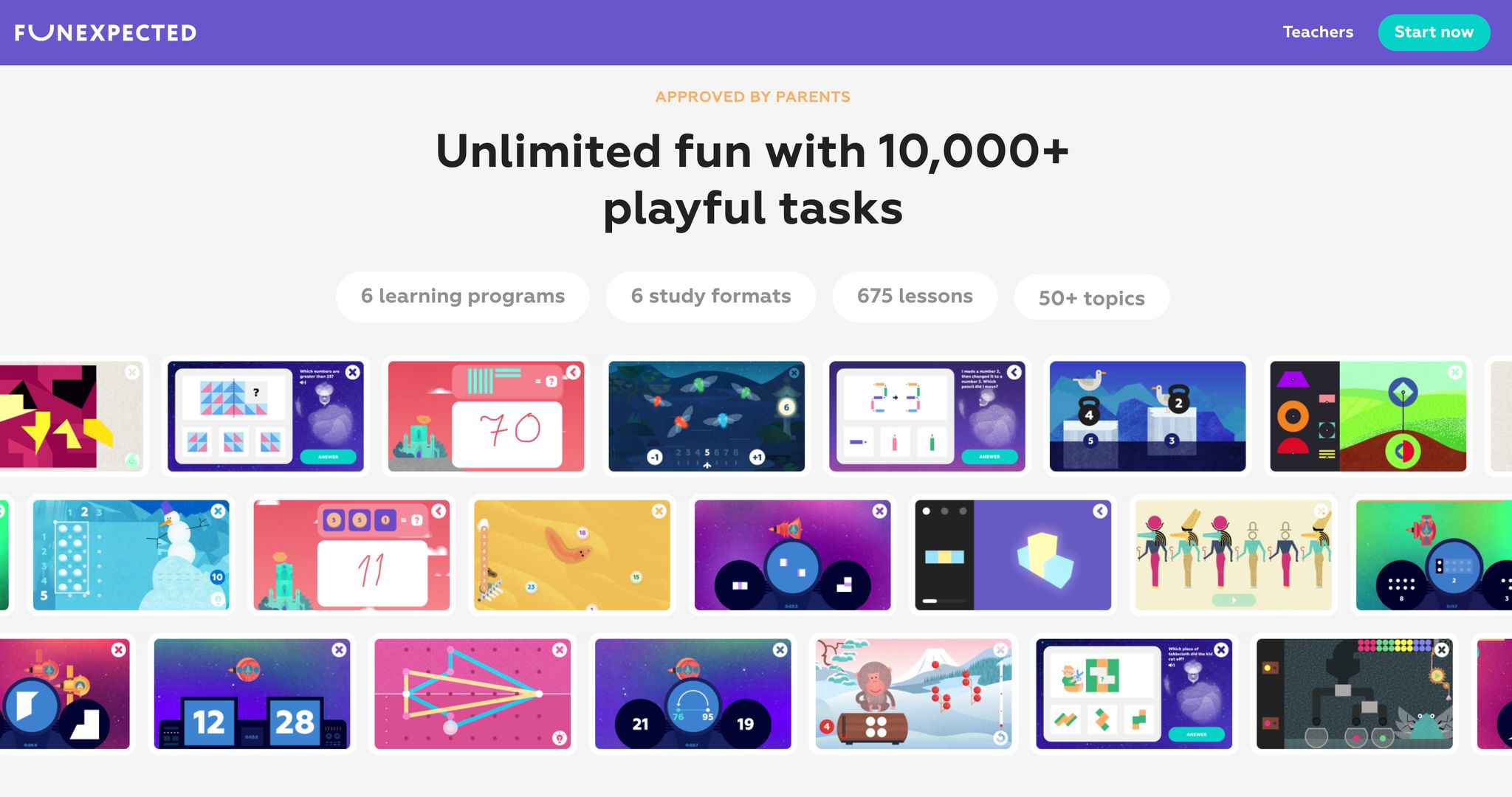
Because of its personalized learning programs, the app is equally beneficial for both children who struggle with math and those who excel at it. If your child needs help closing gaps, Funexpected Math works best as short, guided practice at home.
The key feature of Funexpected Math is Aika, a talking digital tutor. She tailors the program to each child, scaffolds learning, asks guiding questions instead of serving up answers, introduces math terms, and provides hints when needed.

Aika, a friendly digital tutor inside the Funexpected Math app
The app is designed to foster math understanding, not rote memorization. Besides basic numeracy, it covers geometry, logic, and even algorithms. It’s a strong fit for younger kids who need a confidence boost.
Age and Level Match
Funexpected Math is best for ages 3–8, though some older kids may also use it for enrichment.
Age Range | What Kids Work On |
|---|---|
5–6 years | Advanced addition/subtraction, operations with 2-digit numbers, analyzing 2D and 3D shapes, basic logical reasoning |
7–8 years | Understanding place value, visualizing multiplication and fractions, reading maps and projections, interpreting graphs, exercising fluency for problem-solving |
Instruction Format
The app uses an interactive, story-based format with hands-on tasks. The AI tutor adjusts difficulty in real time, based on a kid’s performance [1].
There’s no placement test. You just enter your child’s age, and the system adjusts based on how they do [2]. Parents can track progress through the dashboard.
The suggested pace is 2-4 sessions per week, with each session lasting about 15–20 minutes [2]. That setup works well for busy households because sessions are short and easy to fit into the week.
Cost and Commitment
Funexpected Math includes a 7-day free trial [2]. After that, it moves to a paid subscription priced at $10.99/month or $64.99/year. One subscription covers the whole family, works on multiple devices, and lets you create profiles for several children.
Ages 8-11 – Synthesis Tutor

Synthesis Tutor is a fully AI-driven K–5 math app. It covers core topics like fractions, multi-digit division, and early algebraic thinking for ages 8–11. If you're weighing app-based math help at home, this one tends to work best for kids who can sit down and practice on their own.
Best Fit by Goal
This app is best for extra practice alongside school math. It makes sense for parents who want a low-maintenance way to build practice and reasoning skills without setting up live sessions or a heavy routine.
Age and Level Match
Synthesis Tutor covers K–5 math and uses voice narration, which means kids who aren’t fluent readers yet can still use it on their own [3]. That can make a big difference for younger learners. Its scope stops at K–5.
Instruction Format
The AI tutor uses a conversational, Socratic style with visual manipulatives and real-time difficulty adjustment [3]. In plain English, the app doesn’t just mark answers right or wrong - it tries to guide kids step by step and shift the level as they work. Parents are advised to watch the first couple of sessions to make sure speech recognition works correctly[4].
Cost and Commitment
Synthesis Tutor offers a 7-day free trial. A plan that works for the whole family costs $29 per month or $119 per year [5].
If your child needs live explanation instead of app-based AI tutor practice, the next section moves to tutoring services.
Online and/or In-Person Tutoring Services
Tutor Doctor

Tutor Doctor provides one-on-one math tutoring for students of all ages and grade levels, including primary-aged children in counting, operations, fractions, and early algebra. [6]. That makes it a strong pick for families who need live teaching, not just more drills or screen time.
Best Fit by Goal
Tutor Doctor works well for children who need to build confidence, close skill gaps, strengthen core maths foundations, or have concepts explained step by step at a steady pace. [7].
Age and Level Match
Tutor Doctor begins with a consultation and assessment process to better understand each student’s needs, learning style, and goals. For ages 8 and up, it may also look at memory and processing speed. The company says it has completed more than 4.6 million tutoring sessions [8].
Instruction Format
Parents can choose in-home sessions for hands-on help or online tutoring for convenience. Tutors are matched to each child, and parents get progress reports after every session [9].
Cost and Commitment
Tutor Doctor does not list set prices. Rates are customized after a free initial consultation that includes a parent meeting and an assessment [9]. Reviews are strong; however, the best results often come when the child is matched with the right tutor.
If you want another live tutoring option, the next section looks at Varsity Tutors.
Varsity Tutors
Varsity Tutors is a good pick if you want live instruction with built-in structure. It’s a live online tutoring platform that combines one-on-one math sessions, recorded lessons, and built-in practice tools [10].
Best Fit by Goal
For the closing-gaps track, this option works best when a child needs both live teaching and follow-up practice. Its Learning Lab uses adaptive assessments to spot missing skills before tutoring starts. After that, it adds practice problems for extra work between sessions [11].
Age and Level Match
The service covers the full 5–11 age range. That said, it tends to fit ages 8–11 better than ages 5–7 because the main setup is structured one-on-one instruction. Tutors are matched based on learning style and personality, which can help the sessions feel like a better fit from the start [10].
Instruction Format
Sessions include video, a shared whiteboard, and recorded lessons. Every one-on-one session is recorded, so parents can go back and review what happened later [11].
Cost and Commitment
Varsity Tutors sits on the higher end for price. Hourly rates usually run from $81 to $100+, with package pricing like this [12]:
Package | Total Cost | Per-Hour Rate |
|---|---|---|
12-hour plan | $1,104 | $92/hour |
24-hour plan | $2,040 | $85/hour |
36-hour plan | $2,916 | $81/hour |
There’s also a dedicated K–5 tutoring package listed at about $1,500 [11].
On Trustpilot, Varsity Tutors has a 4.2/5 rating. The main issues parents mention are uneven tutor quality and renewal terms that aren’t always clear [12].
Parents who want in-person structure should compare center-based programs next.
In-Person Centers
Mathnasium
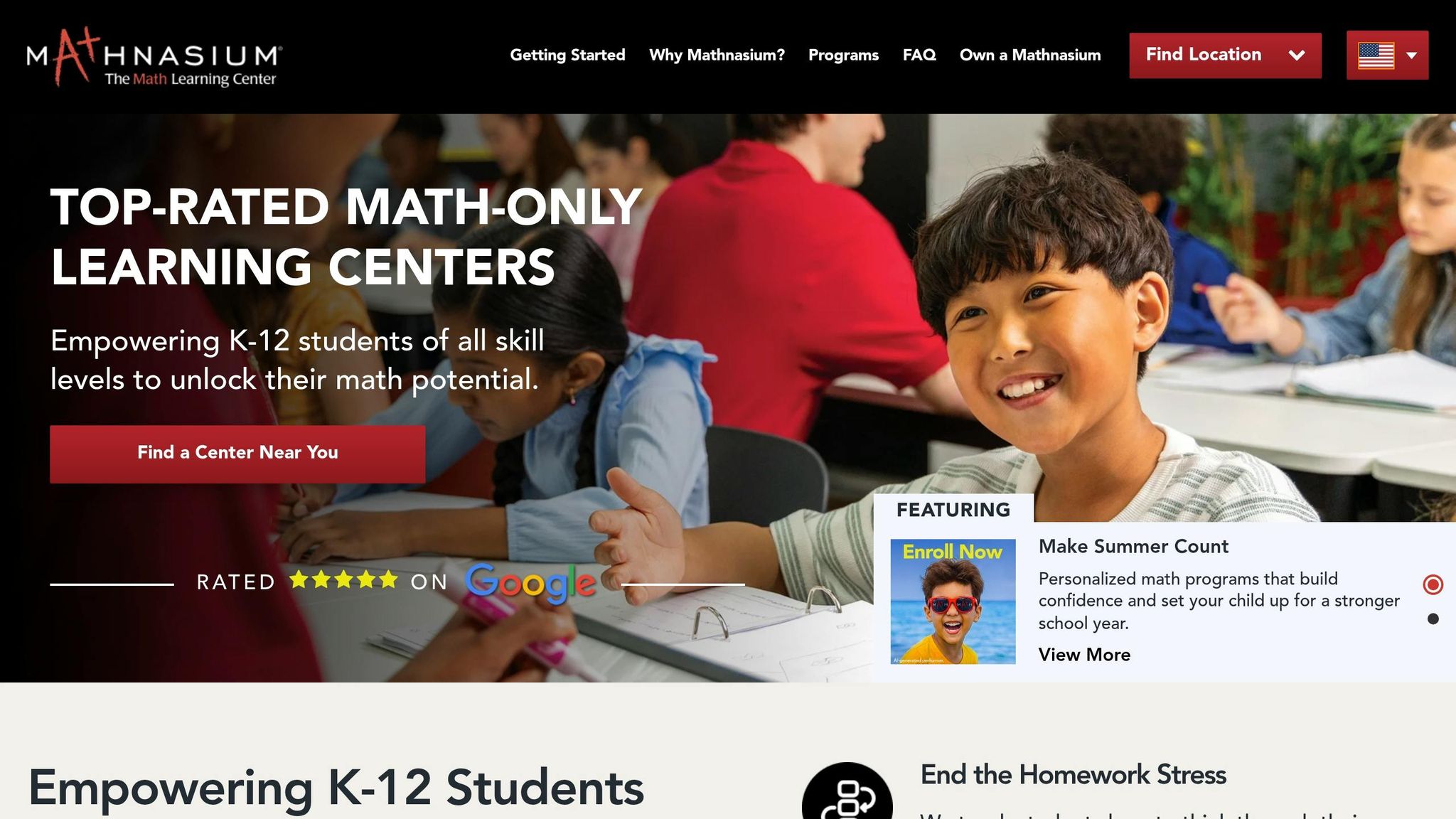
Mathnasium is a math-only learning center with nearly 1,100 centers across the United States [13]. It uses a diagnostic, plan-based approach to identify skill gaps and address them over time.
Best Fit by Goal
Mathnasium begins with a diagnostic assessment to map out a child’s strengths and weak spots. From there, the Mathnasium Method uses mental, verbal, visual, tactile, and written practice, along with homework help during each session [14].
That mix matters. Some kids need to see a math idea before it clicks. Others need to say it out loud or work it with their hands. Mathnasium leans into that kind of repetition from multiple angles rather than just handing out more worksheets.
Independent studies report test-score gains in 20 sessions or fewer [13].
Age and Level Match
Mathnasium can be a good fit for children ages 5–11. For younger children, it offers an Early Childhood program for ages 5–6 that focuses on building a base before school math gets more formal [15].
For older elementary students, ages 7–11, the focus shifts more toward filling specific gaps while keeping pace with current classwork [13]. So if a child is doing fine in some areas but keeps getting stuck on subtraction, fractions, or word problems, that targeted setup may help.
Instruction Format
Sessions are kept small, with one instructor for every three to six students [16]. Elementary students usually attend 60-minute sessions two to three times per week [14].
Mathnasium also does not assign its own homework, which keeps the at-home workload fairly light [13]. For a lot of families, that’s a relief. The work happens in the center, and the practice stays tied to the session.
Cost and Commitment
Monthly membership usually runs about $200 to $300, though some locations charge $250 to $450 per month [16]. That comes out to about $37.50 per session. There’s also a flat enrollment fee at the start [13].
Because Mathnasium is a franchise, the experience can vary from one location to another. It’s smart to visit the center, ask how sessions are run, and read local reviews before signing up [16].
Parents who want a different center model can consider the Kumon option.
Kumon

Kumon has 1,000+ U.S. locations and uses a worksheet-based system built around independent practice and fluency, not live teaching [17].
Best Fit by Goal
Kumon is primarily designed to build math fluency through repetition. It follows its own sequence, so students move from arithmetic to fractions based on the program’s path, not their school’s pacing [16].
Age and Level Match
Kumon works with students from kindergarten through 12th grade [17]. Most students begin below their current grade level so they can master each step before moving ahead. To advance, they need to hit time and accuracy goals [17]. This setup tends to work best for kids who are self-motivated and okay working on their own.
Instruction Format
Students usually go to a center twice a week for about 30 minutes per session [16]. On the other days, they complete daily worksheet packets at home [17]. Parents are expected to supervise and grade that work every day, so this program requires consistent parent involvement. Staff checks finished work, but they usually don’t teach concepts directly [17].
Cost and Commitment
Monthly tuition is usually $150 to $200 per subject, plus a one-time registration fee of $50 to $80 and a materials fee of about $30 [18]. Some centers offer lower monthly pricing for longer commitments, such as $155 per month with a 6-month contract or $150 per month with a 12-month contract.
Trustpilot scores vary by franchise, but they’re often around 4.0 to 4.1 out of 5. Since quality can differ by location, it’s smart to ask about staff experience and turnover before signing up [17].
If your child needs deeper problem-solving instead of fluency drills, the next section looks at advanced enrichment.
“Enrichment and Gifted“ Track
Funexpected Math
Thanks to its personalized learning programs, Funexpected Math is perfectly suitable for children usually called “early finishers“ in school.
A parent can adjust the amount of challenge by switching their child’s learning program to a more advanced one. The unique curriculum covers all essential school topics and goes far beyond them to olympiad-style tasks. The app's primary goal here is to deepen a child’s understanding of math concepts.
By mastering spatial reasoning, logic, and algorithms, a child gets universal problem-solving skills.

Exercising logical reasoning skills in the Funexpected Math app
Also, Funexpected Math offers many tasks similar to those typically found in gifted tests. So if your goal is to prepare your child for a gifted test, Funexpected Math is a great tool for exercising.
If you want to learn more about how the app caters to gifted kids, see this article.
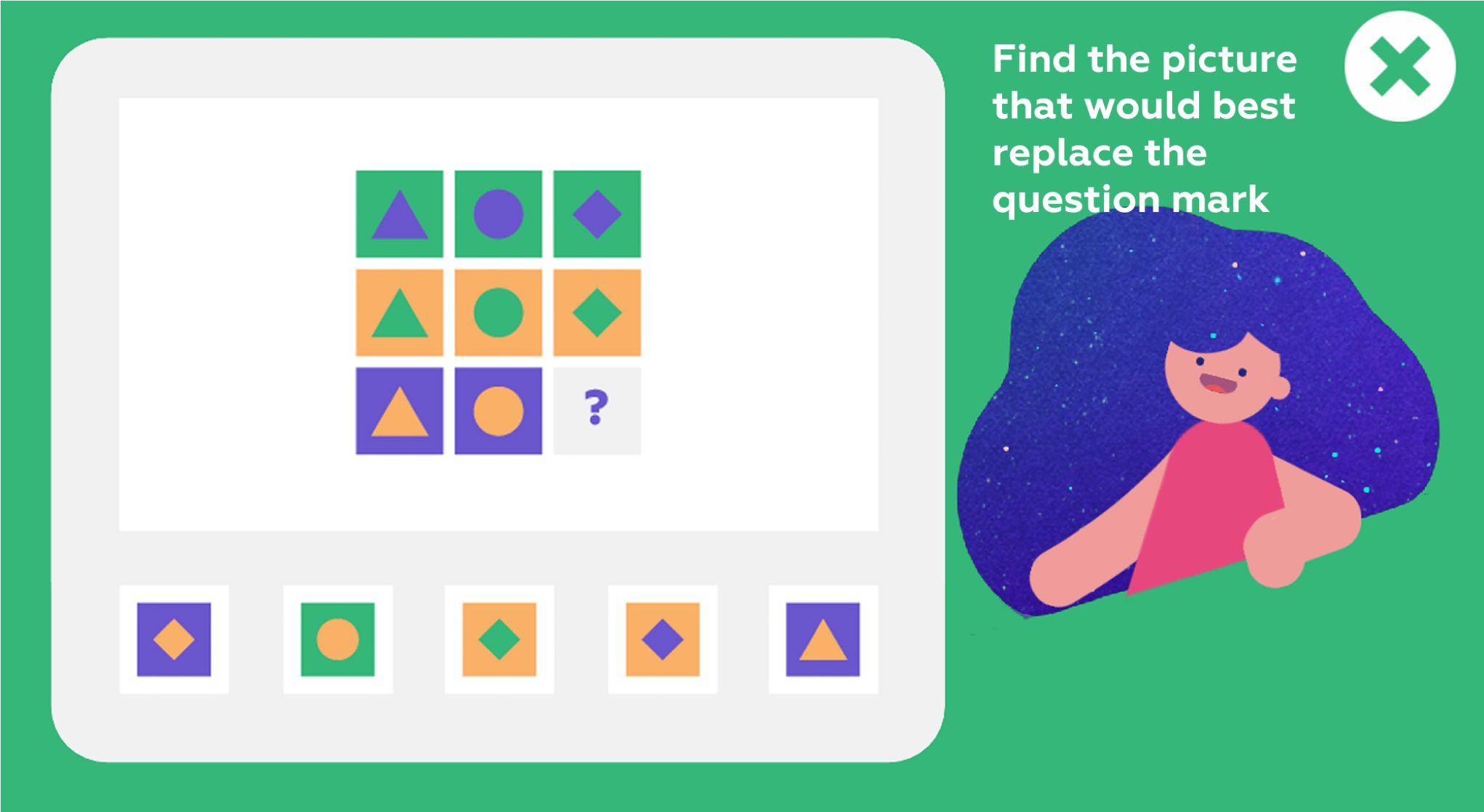
A task in the Funexpected Math app, similar to gifted tests content
AoPS Online

Best Fit by Goal
AoPS Online is built for kids who are already past grade-level math and want a tougher kind of challenge. This is not about catching up on basics. It’s for mathematically advanced students who want deep problem solving and harder questions, not grade-level remediation.
Age and Level Match
AoPS is aimed at students in grades 5–12. It includes kids ages 10–11 from the range that we cover in this article [20]. Before signing up, a student should usually have finished a standard elementary math program through about grade 5 or 6. AoPS also gives families free "Are you ready?" diagnostic tests for each course, and it makes sense to have your child take one first [20]. That free readiness test can help you pick the right starting point instead of guessing.
Instruction Format
The classes are online and text-based, not video-based. Students work on problems before the concept is explained, which is a very different feel from most school math programs. Homework is usually auto-graded [21].
For some kids, that setup clicks right away. Self-driven students often do well with it. But for visual learners, or kids who need more step-by-step help from a teacher, it can be a hard adjustment [20].
Cost and Commitment
The pricing is course-based, usually $400–$600 per course. The workload is no joke. Students usually spend 45+ minutes on homework each day, and most intro courses run for 12 to 16 weeks [20]. For the right student, that can be a demanding path with a big payoff.
Russian School of Math
Best Fit by Goal
RSM fits the enrichment path for kids who are already doing well in math and want a much tougher program. The curriculum leans hard into mathematical reasoning, early algebra, and competition-style problem solving, not grade-level catch-up [22].
"Russian School of Math is a rigorous K-12 curriculum that is taught in an in-person or online class and is known for helping students reach advanced math performance." - Jessica Kaminski, Math Tutor [23]
This program tends to work best for students who are independent, organized, and honestly enjoy hard math. It’s less about extra practice and more about pushing ahead. If you’re weighing it against other advanced programs, the big things to check are pace, format, and homework load.
Age and Level Match
RSM serves students from kindergarten through grade 12, and placement comes from a written diagnostic rather than grade level alone [22]. That matters because the program moves fast. For example, an RSM 5th grader is often working on pre-algebra [21].
Class time is long, too. Kindergarten and grade 1 classes run 1.5 hours, while grades 2–6 meet for 2 hours [23]. That setup can be a good match for kids who can stay focused for a long stretch and keep up with a brisk pace. For younger children, though, that amount of seat time can feel like a lot.
Instruction Format
RSM uses a small-group, classroom-style format at in-person centers, and it also offers online classes . Teaching is instructor-led, with a strong focus on logic, reasoning, and early access to harder concepts [23].
"The focal points of this approach are reason and logic, with early introduction of complex concepts." - Russian School of Math [23]
Parents should also plan for a solid amount of homework at home [21]. This is not a light-touch program.
Cost and Commitment
Grade Level | Lesson Length | Cost per Lesson | Monthly Cost (Est.) |
|---|---|---|---|
Kindergarten & Grade 1 | 1.5 hours | $56 | $224 [27] |
Grades 2–6 | 2 hours | $67 | $268 [27] |
NYC area | Weekly class | Varies | $400–$700 [24] |
Monthly cost often goes past $500, and both pricing and teaching quality can vary by location [24]. For many families, that makes RSM a serious time-and-money commitment.
How These Options Compare on the Factors That Matter Most
Start with one question: does your child need remediation or enrichment? The table below puts the main differences in one place.
Option | Track | Ages | Format | Best For | Typical Commitment | Approx. Price Model |
|---|---|---|---|---|---|---|
Funexpected Math | Remediation/ | 5–8 | App | Early math, logic, and spatial skills | Flexible/self-paced | About $10.99/mo or $64.99/yr |
Synthesis Tutor | Remediation | 8–11 | App for iPad; Browser version | Foundational gaps and problem-solving | Self-paced | $29/mo or $119/yr |
Tutor Doctor | Remediation | 5-11 | Online and in-person | One-on-one math tutoring | Flexible | Custom Pricing |
Varsity Tutors | Mixed | 5–11 | Online/In-home | Flexible subject support | Flexible | $80–$100/hr |
Mathnasium | Remediation | 5–11 | Center | Math anxiety and conceptual gaps | 2–3x/week (60–90 min) | $200–$450/mo |
Kumon | Remediation | 5–11 | Center + daily worksheets | Arithmetic fluency and drill | 2x/week + daily home | $150–$200/mo + $50–$80 registration |
AoPS Online | Enrichment/ | 10-11+ | Online | Advanced math and problem-solving | 45+ minutes each day, 12-16 weeks | Course-based pricing |
Russian School of Math | Enrichment/ | 5–11+ | Center/Online | Advanced reasoning and early algebra | Weekly class (1.5–2 hrs) + homework | $224–$268+/mo |
Format has a big effect on how much parent time this will take. App-based choices are the most hands-off. Kumon is pretty much the other extreme, since parents usually supervise and grade worksheets every day [25].
Center-based programs also come with travel time. In many cases, that means about 40–80 minutes of commuting each week [26]. Live online tutoring skips that part completely, which can make a big difference if your schedule is already packed.
Age matters too. Remediation options cover the full 5–11 range. Enrichment programs like AoPS Online and Russian School of Math tend to fit ages 8–11 better, since kids at that stage are more ready for abstract problem-solving and more independent work.
Then there’s price. And the gap is pretty wide. App-based tools are the lowest-cost way to get started. Center-based programs usually cost $200–$450 per month before assessment fees. Live tutoring through Varsity Tutors can run $80–$100 per hour, with a minimum upfront purchase of $1,140 before the first session [27].
That’s a huge range. Which is why the best choice usually isn’t the most popular one. It’s the one that fits your child’s needs, your schedule, and your budget.
Pros and Cons of Each Type of Math Support
Use this section to match the format to the need: apps for low-cost practice, tutors for live help, centers for structure, and enrichment for challenge. The table below gives a quick side-by-side view. The notes after it break down the trade-offs.
Option | Track | Main Pros | Main Cons | Best Family Fit |
|---|---|---|---|---|
Tutoring Apps (Funexpected Math, Synthesis Tutor) | Closing the Gaps / Enrichment & Gifted | Affordable, flexible, and gamified | No live human interaction; requires self-motivation | Families wanting low-cost practice or enrichment without scheduling pressure |
Online or In-Person Tutoring Services (Tutor Doctor, Varsity Tutors) | Closing the Gaps | One-on-one attention; personalized pace; builds confidence | Higher cost; quality can vary by tutor; Varsity requires $1,140 minimum upfront [28] | Kids with specific gaps, math anxiety, or who need a consistent adult mentor |
Physical Centers (Mathnasium, Kumon) | Closing the Gaps | In-person accountability; structured environment away from home | Commute time; rigid schedules; group-based centers are not one-on-one | Families who need a dedicated structured learning outside the home |
Enrichment Programs (AoPS Online, Russian School of Math) | Enrichment & Gifted | Deep logic focus; high-level challenge; competition-style problem solving | Rigorous and fast-paced; can frustrate kids who aren't ready | Gifted learners who are bored with standard school curriculum |
Here’s the simple version: each option solves a different problem.
Apps are usually the easiest place to start. They cost less, fit into a busy week, and can make practice feel less like homework. But they fall short for kids who only do well with a live explanation, not just feedback [19].
Tutors are often the best fit when a child is stuck and needs someone to slow down, explain things in a different way, and stay with the problem until it clicks. That one-on-one support can help with skill gaps and confidence. The downside is price, and the fact that tutor quality can vary. In the case of Varsity Tutors, families also need to account for the $1,140 minimum upfront [27].
Physical centers help when home just isn't the right setting for math work. Some kids focus better when they leave the house and work in a space built for learning. That structure can help a lot. Still, the trade-off is time on the road, set schedules, and, in many cases, less personal attention than private tutoring.
For enrichment-track families, the main trade-off is cost and intensity. Rigorous enrichment suits children who enjoy sustained challenge and independent work. Programs like AoPS Online and Russian School of Math can be a strong match for kids who want deep problem solving, not just more worksheets. But if a child isn't ready for that pace, the experience can feel discouraging fast.
Next, use these trade-offs to choose the format that matches your child's age, goal, and attention style.
Which Option Is Most Likely to Fit Your Child?
Start with one simple question: Does your child need to catch up, or do they need more of a challenge? That usually points you in the right direction.
Here’s a quick way to trim your shortlist.
Your child's situation | Best place to start | Why |
|---|---|---|
5–8-year-old with shaky math foundations | Funexpected Math | Built for early learners who need gentle, engaging practice. |
8–11-year-old needing targeted catch-up | Synthesis Tutor, Mathnasium | Best for targeted catch-up. |
Screen-motivated child | Funexpected Math (ages 5–8), Synthesis Tutor (ages 8–11) | Best for screen-friendly practice. |
Family needing live online help | Tutor Doctor, Varsity Tutors | Best for flexible live help. |
Highly advanced child | AoPS Online, Russian School of Math | Best for advanced learners. |
If two choices still seem neck and neck, start with a placement test. Programs like Mathnasium use structured assessments to show exactly where a child’s understanding starts to break down before sessions begin [28].
If your child doesn’t have an obvious match, go with the lowest-commitment option first. Then watch what happens. Are they engaged? Do they stick with it? That early response can tell you a lot before you spend more time or money.
FAQs
What type of math support works best for my child’s age and learning style?
The best kind of math support depends on your child’s age, how they learn, and what they need help with.
For younger children, app-based platforms like Funexpected Math can help build number sense and logical thinking through playful activities that adjust as they go.
For school-aged children, 1-on-1 tutoring can help with learning gaps or math anxiety. Enrichment programs are often a better fit for kids who need more of a challenge. And if your child does well with routine, centers built around repeated practice like Kumon may also be a good match.
How much parent involvement should I expect from each option?
Parent involvement depends a lot on the format.
Apps like Funexpected Math or Synthesis Tutor are mostly hands-off. Parents usually just track progress and cheer their child on.
Centers are more mixed. Kumon often asks for steady daily work at home, which means parents stay closely involved. Mathnasium and Sylvan handle more supervision in the center, but parents may still need to follow up.
Marketplace tutoring services usually put more on parents. That can include picking the tutor and making sure the instruction is on track.
Related Blog Posts
Transform Math Learning for Kids
Explore Funexpected's interactive math program designed for children aged 3-7. Build math fluency, logic, and problem-solving skills through engaging, hands-on activities and a personalized digital tutor.