Place Value for Small Kids: Common Mistakes and Practical Training Ideas
Early Childhood Education
May 1, 2026
Guide to place value: history of the decimal system, why base-10 feels natural, how number systems shape thinking, plus hands-on activities and a 5–6 yr checklist.

Place value is the way digits in a number get their meaning based on their position. For example, in 543, the "5" represents 500 because it's in the hundreds place. This concept is the foundation of our number system and is critical for understanding math operations like addition, subtraction, and beyond.
Key Points:
Decimal System: Uses 10 symbols (0-9) and assigns value based on position (e.g., 10s, 100s, etc.).
Why It Feels Natural: Likely tied to humans using 10 fingers for counting.
Role of Zero: Acts as a placeholder to maintain the structure of numbers (e.g., 104 vs. 14).
History: Originated in ancient India, spread globally through Arab scholars, and became the basis for modern math.
For Kids:
Teaching Tips:
Use hands-on tools like base-ten blocks, straws, or coins.
Focus on grouping by tens and understanding zero’s role.
Make learning fun with games like "Scoop & Group" or "Race to 20."
Checklist for Ages 5-6:
Can they group objects into tens and ones?
Do they understand zero as a placeholder?
Can they read and write numbers correctly?
Mastering place value early helps kids build strong math skills, avoid common errors, and prepare for advanced concepts. Hands-on practice and clear explanations make all the difference.
Place Value for Kids: Tens, Hundreds and Thousands
What Is Place Value in the Decimal System?
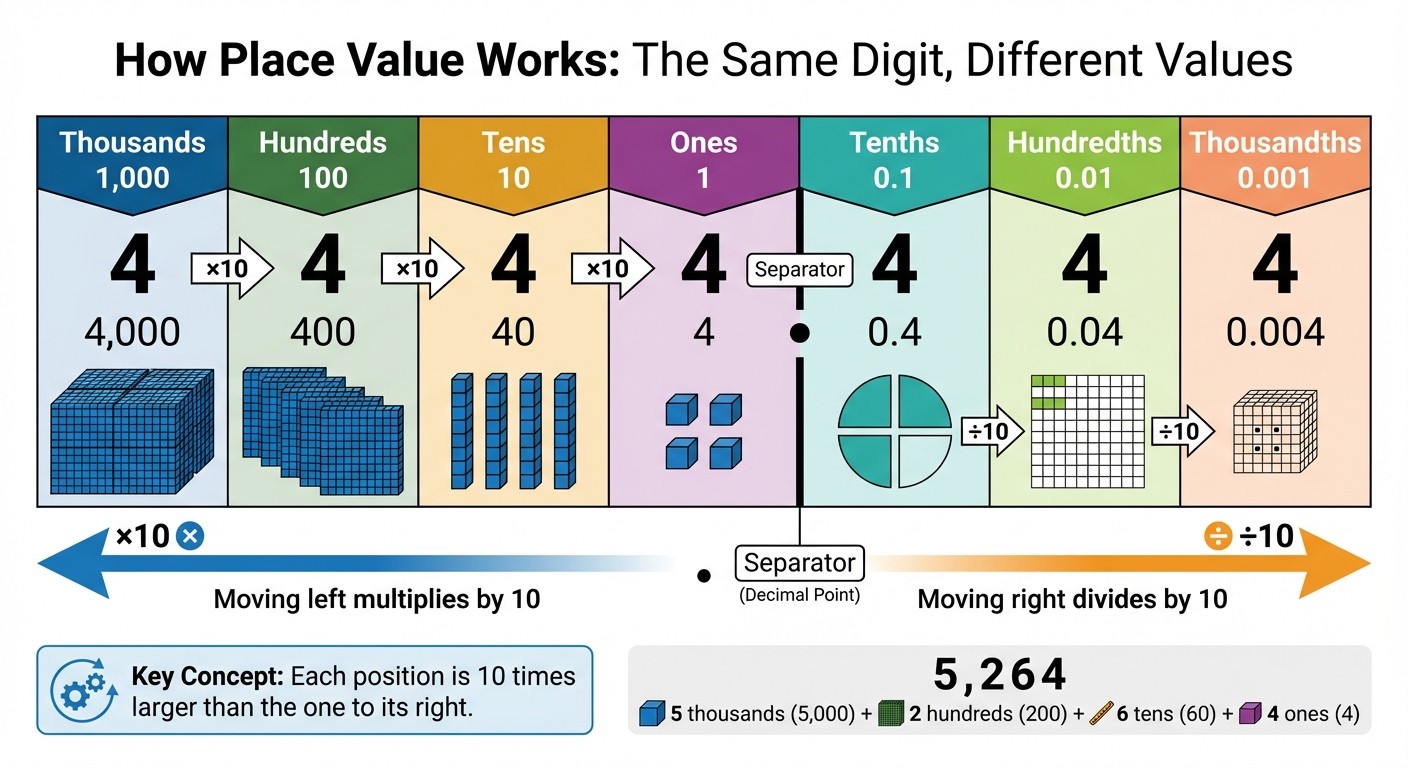
Place Value Chart: How Digit Position Changes Value in the Decimal System
Place value is a fundamental concept in understanding numbers and how they work. In the decimal system - also known as base-10 - a digit’s value is determined by its position within the number. This system uses just ten symbols (0, 1, 2, 3, 4, 5, 6, 7, 8, 9), known as Hindu-Arabic numerals, to represent all numbers. Interestingly, the term "digit" comes from the Latin word for finger, reflecting the use of ten fingers for counting.
Primary school teacher Sophie Bartlett explains it this way:
"Place value is the basis of our entire number system. It is the value of each digit in a number." [1]
The system works by assigning each position in a number a value based on powers of ten. Moving one place to the left multiplies the value by ten, while moving one place to the right divides it by ten. In the U.S., commas are used to separate groups of three digits, and a period is used as the decimal point.
How Place Value Works
The relationship between a digit's position and its value is key. Each place represents a specific power of ten, which determines the digit’s contribution to the overall number. For example, in the number 5,264, the digit 5 is in the thousands place, meaning it represents 5,000 - not just 5.
Here’s how the same digit changes value depending on its position:
Place Name | Value (U.S. Format) | Example (Digit 4) |
|---|---|---|
Thousands | 1,000 | 4,000 |
Hundreds | 100 | 400 |
Tens | 10 | 40 |
Ones | 1 | 4 |
. (Decimal Point) | Separator | . |
Tenths | 0.1 | 0.4 |
Hundredths | 0.01 | 0.04 |
Thousandths | 0.001 | 0.004 |
This structure helps clarify why numbers like 234 and 324 are entirely different, even though they use the same digits.
When teaching place value in whole numbers, it’s important to avoid saying "and" between parts of the number. For instance, in U.S. English, say "two hundred thirty-four" instead of "two hundred and thirty-four", as the word "and" is reserved for indicating the decimal point.
Next, let’s discuss the essential role zero plays in this system.
Why Zero Matters as a Placeholder
Zero is more than just a symbol for "nothing" - it’s a crucial placeholder that ensures digits stay in their correct positions. Without zero, numbers would lose their structure. For instance, the numbers 104 and 14 would be indistinguishable, and 100 would look the same as 1.
As Math.com explains:
"Zero 'holds the place' for a particular value, when no other digit goes in that position." [2]
Take the number 1,060,520,000 as an example. Each zero in this number serves to maintain the spacing, signaling that the number exceeds one billion. Removing those zeros would drastically alter its value. This is why zero is considered one of the most important innovations in mathematics.
"Without a symbol for nothing, our decimal number system wouldn't work." [2]
To help children grasp this concept, using expanded notation can be effective. For instance, writing 204 as 200 + 0 + 4 shows how the zero holds the tens place, even when no tens are present.
The History of the Decimal System
The decimal system we rely on today didn’t just appear out of nowhere. It’s the result of centuries of mathematical development, with its origins rooted in ancient India. Over time, it spread to the rest of the world through Arab scholars and eventually reached Europe, becoming the backbone of modern place value.
From Ancient India to Modern Math
The decimal system’s story begins in ancient India, where mathematicians laid its foundation. As early as 1500 to 500 BC, Vedic texts used a system called "named place-value notation", with specific terms for powers of ten like dasa (10), shatha (100), and sahasra (1,000) [3]. This approach set the stage for today’s numerical system.
By the 3rd century BC, Brahmi numerals emerged. These were non-positional symbols representing numbers like 1 to 9, as well as 10, 100, and 1,000 [4]. Over the centuries, these evolved into Gupta numerals (4th–6th century AD) and later Nagari numerals (7th century AD) [5].
A major leap came in 499 CE when Aryabhata described a positional system. By 594 AD, physical evidence, such as a donation charter from Dadda III, shows the decimal place-value system in active use [5].
The introduction of zero as a placeholder was transformative. It didn’t just organize positional notation - it also paved the way for modern arithmetic. Indian scholars also tackled enormous numbers. For instance, Hindu cosmology described the universe’s lifespan as 4.32 billion years, while Buddhist texts outlined numbers as large as 10^53 [4]. This need for efficiency further spurred the system’s development.
The decimal system spread globally through the contributions of Islamic scholars. Around 776 AD, an Indian scholar presented astronomical tables to Caliph al-Mansur in Baghdad, leading to their translation into Arabic [6]. In 825 AD, Persian mathematician Al-Khwarizmi wrote On the Calculation with Hindu Numerals, later translated into Latin as Algoritmi de numero Indorum. This work introduced the term "algorithm" [6].
In Europe, the system gained traction thanks to Leonardo of Pisa (Fibonacci). After studying in Béjaïa, Algeria, Fibonacci published Liber Abaci in 1202 AD, which popularized Hindu-Arabic numerals across the continent [3].
French mathematician Pierre-Simon Laplace praised this achievement, saying:
"It is India that gave us the ingenious method of expressing all numbers by the means of ten symbols, each symbol receiving a value of position, as well as an absolute value; a profound and important idea which appears so simple to us now that we ignore its true merit." [5]
How the Decimal System Differs from Other Number Systems
What sets the decimal system apart is its positional notation. Unlike Roman numerals, where "X" always equals 10 no matter its position, the decimal system assigns value based on placement. For example, the digit "2" can represent 2, 20, or 200 depending on where it appears [7].
Here’s how different systems represent the number 228:
System | Representation | Key Feature |
|---|---|---|
Decimal (Hindu-Arabic) | 228 | Positional; uses 10 symbols (0–9) |
Roman Numerals | CCXXVIII | Additive; requires multiple symbols |
Babylonian | Base-60 symbols | Positional but uses a complex base system |
The Babylonian system, which operated on a base-60 system, still influences us today in timekeeping (60 minutes per hour) and geometry (360 degrees in a circle) [8]. While it used positional notation, it lacked a true zero, relying instead on placeholder marks that didn’t function as actual numbers [7].
Roman numerals, on the other hand, made arithmetic cumbersome. Multiplication or division required tools like an abacus because the system wasn’t designed for easy written calculations [9]. The decimal system simplified these operations, making paper calculations possible.
The term for zero, shunya (void), entered Arabic as sifr, which later evolved into "cipher" and "zero" in English [10]. Mathematician G.B. Halsted highlighted its importance:
"The importance of the creation of the zero mark can never be exaggerated... No single mathematical creation has been more potent for the general on go of intelligence and power." [10]
The decimal system’s strength lies in its ability to represent any number using just ten symbols. Even ancient Greek mathematicians, despite their brilliance, never developed such a system [5]. Its simplicity, combined with positional notation and the invention of zero, forms the foundation of modern mathematics. This system continues to shape how we teach place value and arithmetic today, reinforcing its lasting impact.
Why the Decimal System Feels Natural to Humans
The decimal system resonates deeply with human nature. Its base-10 structure ties directly to our anatomy, shaping how early humans counted and how we continue to process numbers today.
How 10 Fingers Shaped Our Number System
Our ten fingers played a pivotal role in the development of the decimal system. Early humans used their fingers as counting tools, a practice that left its mark on language - after all, the word "digit" refers to both fingers and the numerals 0 through 9 [11]. This connection even extends to our brains. Research on finger gnosia highlights a link between the brain's regions responsible for recognizing fingers and those involved in understanding quantities [8].
Archaeological evidence, such as tally marks etched into bones and stones over 40,000 years ago, further underscores the importance of finger-based counting. While some cultures adopted different systems - like the Babylonians with base-60 or the Mayans with base-20 - the widespread use of base-10 reflects an experience shared by most humans [8]. The efficiency of positional notation, built on this foundation, has only enhanced its practicality for math and computation.
Why Positional Notation Makes Math Easier
The structure of the decimal system doesn't just feel intuitive - it also simplifies calculations. Positional notation assigns value to a digit based on its place. For example, the digit "2" could mean 2, 20, or 200, depending on its position [12].
This design is far more practical than older systems like Roman numerals. Representing 228 in Roman numerals (CCXXVIII) takes seven characters, while the decimal system achieves the same with just three digits. Performing arithmetic with Roman numerals is similarly cumbersome [13].
The strength of the decimal system lies in its simplicity. Using only ten symbols (0–9), it can represent any number. As the 18th-century mathematician Laplace noted:
"…The idea of expressing all quantities by nine figures whereby is imparted to them both an absolute value and one by position is so simple that this very simplicity is the very reason for our not being sufficiently aware how much admiration it deserves." [10]
The inclusion of zero is another key feature - it ensures the correct positioning of digits [13]. This combination of positional notation, a minimal symbol set, and the strategic use of zero strikes a perfect balance between human intuition and computational efficiency. Compared to binary, which requires more space to represent numbers (e.g., eleven as 1011), or systems with more symbols, the decimal system remains both practical and elegant.
How Number Systems Shape Thinking, Language, and Culture
Numbers are more than just tools for counting - they influence how we think, communicate, and solve problems. Number systems act as foundational frameworks, allowing us to represent vast quantities using a limited set of symbols (like 0–9) [14]. This structure not only organizes numerical information but also primes our minds for more complex mathematical concepts.
How Place Value Affects the Way We Think
Understanding place value represents a major mental milestone, shifting us from simple counting to abstract reasoning. For instance, when a child grasps that "10" is not just ten individual items but a single unit of a higher order, they unlock a deeper level of mathematical thought. This leap builds skills in abstraction and mental adaptability [15].

A task representing tens as units in the Funexpected Math app
Place value mastery allows children to break numbers into components (e.g., seeing 357 as 300 + 50 + 7). This ability lays the groundwork for skills like estimation, rounding, and higher-level mathematics [16]. It also encourages them to consider the scale of numbers rather than just their surface value, fostering logical reasoning that applies well beyond math.
Different number systems influence how we process information, too. Binary (base-2) is ideal for computers due to its simplicity, while the Babylonian base-60 system excels in handling fractions because 60 divides into many smaller units [17]. Each system shapes distinct cognitive processes. However, juggling multiple systems - like using decimal for volume and base-60 for time - can increase mental strain and lead to errors [18].
How Place Value Shapes Language and Culture
The way we conceptualize numbers also impacts language and cultural practices. As seen in cognitive development, the clarity of a numeral system influences how easily children learn math.
Languages with straightforward number words make place value more intuitive. For example, Mandarin adheres to a clear decimal structure, making it easier for children to grasp. In contrast, English includes irregular terms like "twelve" instead of "ten-two", while French retains base-20 elements, such as quatre-vingts (80, or "four twenties"), which can complicate learning [18].
"The degree to which numeral systems transparently reflect their bases has all sorts of implications... Languages with less transparent rules will take longer to learn, longer to process and can lead to more calculation and dictation errors." - Jean-Charles Pelland, Postdoctoral Researcher, University of Bergen [18]
The adoption of the decimal system has also fueled scientific advancements. Scientific notation, which uses powers of ten, enables efficient communication of extremely large or small numbers. For instance, Avogadro's Number is expressed as $6.022 \times 10^{23}$ rather than writing out 602,200,000,000,000,000,000,000 [19]. Additionally, the French Revolution played a pivotal role in spreading decimal-based metrication, standardizing weights, measures, and currency. This standardization boosted international trade and collaboration [7].
Core Concepts for Teaching Place Value to Young Children
Understanding place value is a key step in developing math skills, and these concepts help young learners build a strong foundation.
Start with positional value - the idea that a digit's place determines its value. For example, the 3 in 35 means 30, but in 325, it represents 300. Since this concept can feel abstract, hands-on activities are crucial for making it more concrete.
Next is unitizing, which involves grouping. For instance, combining ten ones to make one ten or ten tens to make one hundred. This concept is fundamental for understanding how to regroup in addition and subtraction.
It's also important to explain that teen numbers (11–19) aren't just random names. They follow a pattern: one ten plus some extra ones. For example, 12 is made up of 10 and 2. Recognizing this pattern helps children extend their understanding to larger numbers.
Another key idea is zero as a placeholder. Zero ensures the correct value of other digits. Without it, a number like 104 could easily be misread as 14. This concept helps children see how zeros maintain the structure of numbers.
Finally, introduce the base-ten pattern. Each column in our number system is ten times larger than the one to its right. So, multiplying by 10 shifts digits to the left, increasing their value tenfold.
This principle also ties into writing numbers in expanded form, like breaking 345 into 300 + 40 + 5. Understanding this makes multi-digit arithmetic much easier.
To teach these concepts, use practical tools and activities. Objects like base-ten blocks, bundled popsicle sticks, or ten-frames can help kids visualize these ideas. Place value mats labeled with columns (Ones, Tens, Hundreds) are another great way to keep digits organized. You can also connect place value to everyday examples - such as using pennies, dimes, and dollars to show the 10-to-1 relationship. These real-world connections make the learning process more relatable and fun.
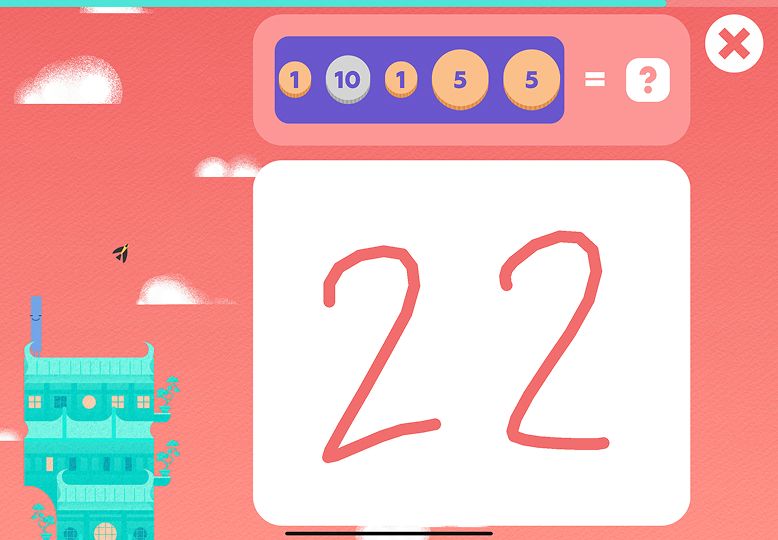
A task with various coins in the Funexpected Math app
With these core ideas in place, you're ready to explore hands-on activities that bring place value to life in the classroom.
Hands-On Activities for Teaching Place Value
When it comes to teaching place value, hands-on activities can make abstract concepts easier to grasp. These interactive exercises turn learning into a fun and tangible experience.
Games and Activities for Grouping by Tens
Help children understand grouping by tens using physical objects. Start with items they can bundle themselves, then move on to pregrouped tools like base-ten blocks.
One simple activity is Scoop & Group. Kids scoop a handful of small objects - like beans, buttons, or pasta - and organize them into groups of ten using markers or cups. Leftover items stay in the "ones" place. For example, if a child has 3 full cups and 7 extra beans, they’ve created 37.
Another fun option is Race to 20, which turns grouping into a competitive game. Players roll a die and add that many cubes to their tower. Once the tower reaches 10 cubes, they bundle it into a group and start a new one. The first to complete two groups of ten wins.
For a creative twist, try Cheerios with spaghetti. Stick uncooked spaghetti noodles into playdough and have kids thread 10 Cheerios onto each noodle. This makes a clear visual contrast between a single Cheerio and a group of ten.
Another engaging activity is Triangle Tens, where children arrange items in rows of 1, 2, 3, and 4 to form a triangle of ten. This setup encourages them to verify the total without counting each item individually.
These playful exercises naturally lead to using everyday objects for more practical practice.
Teaching Place Value with Household Items
Household items can provide a great way to reinforce place value concepts in a relatable and hands-on manner.
Straws and rubber bands are a classic tool. Each day, children add a straw to a "ones" container. Once they collect ten, they bundle them with a rubber band and move the bundle to the "tens" place. This daily activity helps solidify the concept over time.
Coins are another excellent teaching tool. Hand kids 10 pennies and let them trade them for a dime. This simple exchange shows how one object (a dime) can represent ten smaller units (pennies), tying math to real-world experiences.
For a more mechanical approach, try nuts and bolts. Have children screw 10 metal nuts onto a bolt to create a "ten rod." The physical act of threading each nut makes the process memorable, and the finished bolt serves as a tangible representation of ten.
Similarly, pipe cleaners and beads offer a creative way to practice. Thread 10 beads onto a pipe cleaner and twist the ends to make a "ring of ten." These rings can be counted by tens (10, 20, 30), while loose beads represent the ones.
"The more they see, hear, and feel the concept, the sooner it will click." - Mama Teaches [20]
Another idea is to make a place value organizer using a food storage container. Label compartments as "Tens" and "Ones" (or add "Hundreds" for older kids). Children can sort their manipulatives into these sections, helping them visualize how numbers are structured.
These activities transform everyday items into powerful learning tools, making place value both understandable and fun.
Common Place Value Mistakes Children Make
Confusion About Zero as a Placeholder
Zero can be a tricky concept for kids, as they often misunderstand its role as a placeholder. For instance, a child might read 105 as "fifteen" or write 304 as "34", ignoring the zero because it doesn’t represent a countable value.
"Zeros are especially tricky and often reveal gaps in students' understanding of how place value works." - Donna, Math Coach [21]
One helpful method is the empty house strategy. A place value mat can illustrate that, just like an empty room in a house, the tens column exists even if there’s nothing in it. Activities where kids place zeros in the correct positions before adding other digits can also clarify this concept. For example, this approach ensures numbers like 4,005 are read and written correctly [21].
Beyond zero, children may also struggle with transitioning from counting items individually to grouping them into tens.
Counting One by One Instead of Grouping
Another challenge is helping kids move from counting items one by one to recognizing groups of ten as a single unit. For example, a child might count 16 items as sixteen separate pieces instead of seeing it as "one ten and six ones." This shift to grouping is often one of the hardest steps in early math [22].
A study of 11-year-olds revealed that only 34% could correctly answer what number is 10 times 0.5, showing how early struggles with grouping can linger into later grades [23]. Using physical tools like bundled straws or Unifix cubes can help. These allow children to physically create a "ten" by bundling items together and then "unbundle" them back into ones, reinforcing the concept for both addition and subtraction.
Misunderstandings with grouping often lead to errors in reading and writing multi-digit numbers.
Problems Reading and Writing Multi-Digit Numbers
Children frequently misread numbers like 71 as "seventeen" or write "three hundred ninety-four" as 30094. These errors often happen because they rely on how numbers sound rather than understanding the importance of digit placement [24].
"Misconceptions... stem from a student's misunderstanding of the central concept. Misconceptions tend to be consistent; identifiable from mistakes made repeatedly in the course of a student's work." - Ashley Seehorn, Special Education Teacher [25]
To address this, tools like arrow cards and expanded notation can be very effective. Arrow cards break numbers into parts - such as 300, 40, and 5 - and allow kids to stack them together to form "345." Pulling the cards apart shows the value of each digit in its position. Pairing this with expanded notation (e.g., 385 = 300 + 80 + 5) and hands-on models reinforces the idea that a digit’s value depends on where it’s placed, not just the number itself [26].
Observation Checklist for 5-6 Year Olds: Place Value Development
Keep an eye on your child's grasp of place value during everyday activities. The following checklists can help you identify both areas of strength and potential challenges in their understanding of numbers. These milestones align with earlier activities and provide insight into their developmental progress.
Checklist: Can the Child Recognize Tens and Ones?
At this age, children should see ten as both a collection of objects and a single unit. For example, they should be able to group 14 objects into a bundle of ten and count the remaining four as individual ones.
What to observe: Watch if your child can group 10 objects as one unit and correctly count the leftover ones. When shown 14 on a ten-frame, do they describe it as "10 and 4"? Can they skip count by 10s up to at least 50?
Red flags: If your child counts numbers between 11 and 19 individually instead of grouping them, it might signal a lack of understanding. Similarly, if they interpret the "1" in 14 as just "one" (adding 1 + 4 = 5) instead of recognizing it as "one ten", this could indicate confusion. Another concern is if they can't explain why 20 is greater than 18 based on the number of tens.
Checklist: Does the Child Understand Zero as a Placeholder?
Zero plays a crucial role in understanding place value. For instance, when given 10 or 20 objects, children who grasp this concept will recognize that the "0" in these numbers represents "zero ones" or no leftovers outside the groups of ten.
What to observe: Does your child understand that 10 is different from 1 because of the zero? When asked to write "ten", do they correctly write "10" instead of "1"? Also, check if they recognize that zeros in numbers like 205 indicate the absence of ones or tens.
Red flags: If your child sees zero as "nothing" and ignores its position in numbers, this could point to a misunderstanding. For example, they might write "10" as "1" or confuse "205" with "25." Similarly, if they are shown the numbers "10" and "1" using blocks but produce the same quantity for both, it’s worth addressing.
Checklist: Can the Child Read and Write Numbers Correctly?
By six years old, children should start connecting how numbers are spoken with how they are written. You can test this by asking your child to write numbers like "fourteen" or "twenty-three" without any visual prompts. Then, have them read numbers such as 17, 30, and 42 aloud.
What to observe: Look for accuracy when they write teen numbers - do they avoid reversing digits? Can they skip count by 10s up to 100? Do they correctly identify which digit represents tens in a two-digit number? For example, when asked about "forty-two", can they explain it as 4 tens and 2 ones?
Red flags: Be alert if your child writes numbers like 71 as "17" or struggles to identify which digit represents tens. If they rely only on the second digit to compare numbers (e.g., thinking 19 is larger than 21 because 9 is bigger than 1), this may indicate a need for further practice. Similarly, difficulty breaking down numbers - such as explaining that 14 is 10 + 4 - can signal gaps in understanding.
"There are students whom I described as 'apparent experts'. They appear to understand place value, i.e: they can identify the value of the columns, read, write and order numbers, but when we ask them to rename numbers or compose or decompose numbers in a non-standard way they flounder." - Dr. Angela Rogers, Researcher and Creator of Zero Our Hero [27]
Conclusion: Building Strong Math Skills Through Place Value
Place value forms the backbone of our entire number system. Grasping how a digit’s position determines its value is a must to avoid stumbling blocks in more advanced math concepts [28]. For example, when a child knows that the "1" in 14 stands for one ten, not just one, they’re laying the groundwork for all future math learning.
This skill connects classroom lessons to practical problem-solving. Kids who understand place value develop a solid sense of numbers, allowing them to estimate, compare, and work with numbers confidently. It’s the difference between simply memorizing math facts and truly understanding how numbers work.
The earlier you start, the better. Place value skills grow gradually, and consistent, hands-on practice during these formative years is key. Use the checklists and activities shared earlier to reinforce these ideas at home.
Mistakes are part of the process. When a young child writes "71" instead of "17" or thinks zero means "nothing", they’re wrestling with the same challenges that early mathematicians faced when creating the decimal system. The hands-on strategies discussed earlier turn these errors into valuable learning moments.
"Place value is the main concept for almost all arithmetic. It changes learning from just memorizing steps to truly understanding the logic behind calculations." - Guru At Home [28]
FAQs
When is a child ready to learn place value?
Children typically begin grasping the concept of place value between the ages of 5 and 6, usually in kindergarten or first grade. At this age, they start to realize that a number's position indicates its value - for example, the '1' in 12 stands for ten. To support this learning, hands-on tools like ten-frames, base-10 blocks, and grouping objects are essential. These visual and tactile aids help children build a solid foundation before transitioning to more abstract ideas, reducing the chances of misunderstandings.
How do I teach tens and ones without worksheets?
Teaching tens and ones can be much more engaging when you ditch the worksheets and opt for hands-on activities. Start by grouping objects - like beans - into sets of ten using cups or trays, leaving the leftover ones aside. This way, kids can see and physically count the tens and the extras.
Another idea is to use linking cubes or counters. Have children group them into tens and separate the remaining ones. These visual and physical activities make it easier for kids to grasp the concept that a digit’s place in a number determines its value.
When should I worry about place value mistakes?
If a child consistently struggles to grasp how a digit's position determines its value - like believing the "2" in "20" is simply "2" - it's worth paying attention. Common warning signs include mistakes in reading, writing, or regrouping numbers. These persistent difficulties might point to deeper misunderstandings that could impact their ability to develop stronger math skills later on. Tackling these challenges early can help prevent long-term misconceptions and build a solid foundation for learning math.
Related Blog Posts
Transform Math Learning for Kids
Explore Funexpected's interactive math program designed for children aged 3-7. Build math fluency, logic, and problem-solving skills through engaging, hands-on activities and a personalized digital tutor.