Algorithmic Thinking for Kids: Why It is Important and How to Develop It at Home
Early Childhood Education
Apr 21, 2026
What algorithmic thinking is, why it matters for kids, what research shows, and simple games and household activities to build step-by-step problem-solving at home.

Algorithmic thinking is a way of solving problems by breaking them into smaller steps and creating clear instructions to find solutions. While it’s often associated with computers, kids use this skill in everyday activities like solving puzzles, organizing toys, or following a recipe.
Teaching algorithmic thinking helps kids develop problem-solving, logical reasoning, and planning skills. These abilities not only support academic success but also prepare children for future challenges in a world increasingly shaped by technology.
Here’s what you need to know:
What it is: Breaking tasks into steps, spotting patterns, and focusing on important details.
Why it matters: Builds critical thinking, improves organization, and prepares kids for subjects like math, science, and even future careers.
What research says: Studies show kids as young as 4 can use algorithmic thinking to solve problems, boosting skills like planning and reasoning.
How to develop it: Use games, chores, and everyday tasks to encourage step-by-step thinking, pattern recognition, and problem-solving.
You don’t need expensive tools or coding knowledge to get started. Simple activities like sorting laundry, playing with LEGOs, or planning a picnic can teach algorithmic thinking at home.
What Is Algorithmic Thinking?
Algorithmic Thinking and Computational Thinking
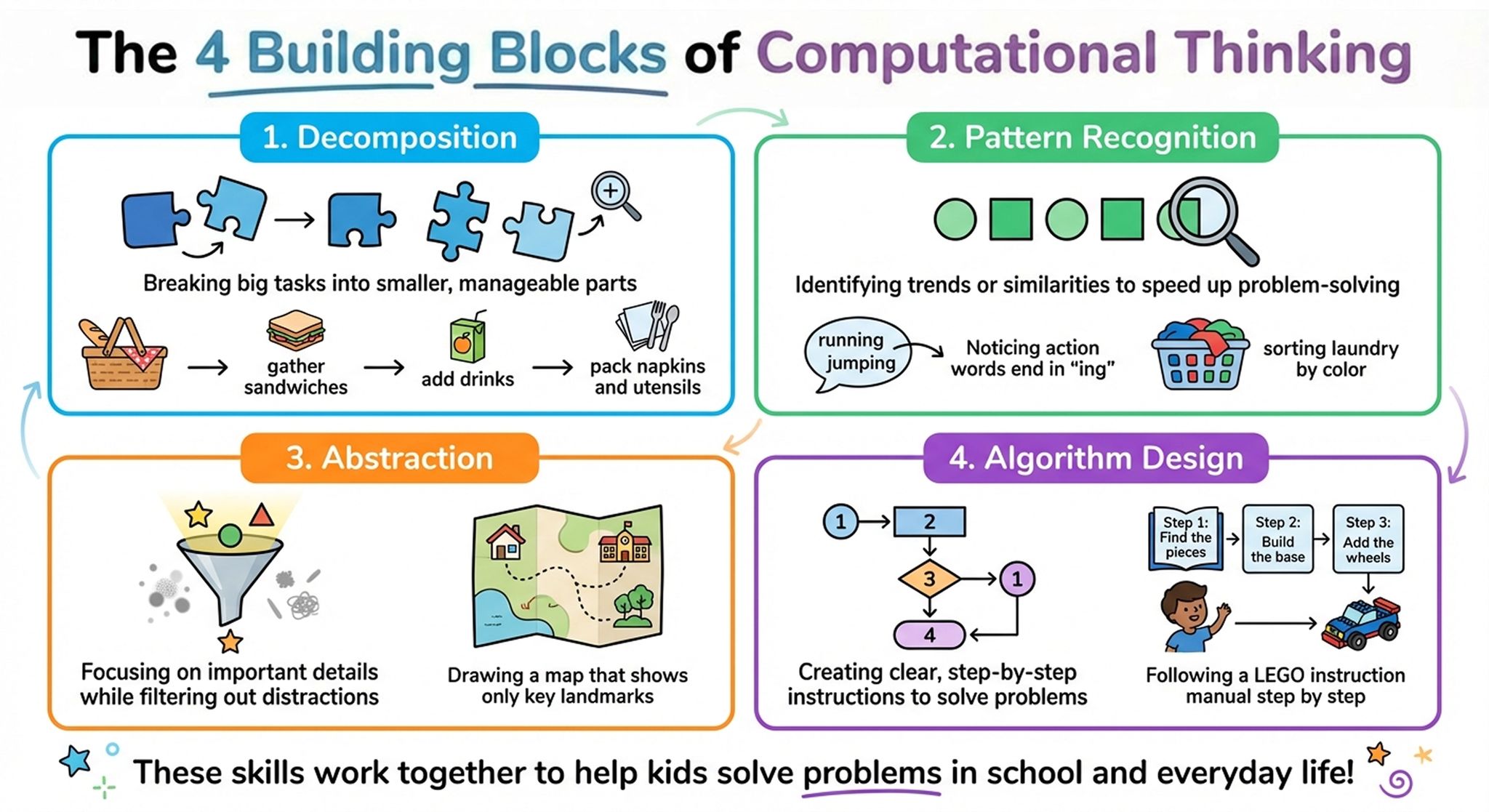
Algorithmic thinking plays a central role in the broader framework of computational thinking (CT). While computational thinking includes skills like decomposition, pattern recognition, and abstraction, algorithmic thinking focuses on the step-by-step process for solving problems. Think of it as the "how-to" guide, while computational thinking addresses the "what and why".
Core Components of Algorithmic Thinking for Kids
Algorithmic thinking involves breaking down complex tasks into a series of clear, logical steps. Think of it like planning a trip: you decide on the first step, the second, and so on until you reach your destination. While it's a cornerstone of computer science, this approach extends far beyond programming - it’s useful in math, science, and even everyday problem-solving tasks like organizing your day or planning a meal [1].
"Algorithmic thinking is not just limited to computer science and programming but can be applied to a wide range of fields, including mathematics, engineering, and business." - Kaitlyn Siu, Author and STEM Educator [1]
This process relies on a few key elements working together. Decomposition helps break a big task into smaller, manageable parts [2]. Pattern recognition allows kids to identify trends or similarities, speeding up problem-solving. Abstraction focuses on the important details, filtering out distractions [3]. Algorithm design is the ability to create step-by-step instructions and solution plans. Together, these skills create a structured way of tackling challenges - whether it’s assembling a puzzle or deciding how to pack a school bag. These principles are easy to spot in everyday life, as the examples below illustrate.
Everyday Examples of Algorithmic Thinking
Kids already use algorithmic thinking without even realizing it. Think about following a LEGO instruction manual - that’s sequencing in action, where they execute steps one by one. Sorting laundry by color? That’s classification and multi-key sorting [4]. Even brushing their teeth involves repetition and conditional logic (if there’s toothpaste, then brush) [5].
Packing a picnic bag is another great example. A child might break the task into smaller steps: gather sandwiches, add drinks, and then pack napkins and utensils. Organizing toys uses sorting techniques similar to how Google processes billions of searches daily. Navigating a maze at a restaurant? That’s pathfinding and optimization [4]. These examples show that algorithmic thinking isn’t some abstract concept - it’s part of everyday life. They also highlight how problems can be approached in multiple ways, fostering creativity and adaptability.
Multiple Solutions and Creative Thinking
One of the most valuable aspects of algorithmic thinking is understanding that many problems have more than one correct solution. Take organizing a bookshelf, for instance. A child could arrange books alphabetically, by size, or by combining two pre-sorted piles. Each method works, but some might be quicker or more efficient depending on the goal [6]. This flexibility encourages both logical reasoning and creativity, helping children think critically about the best approach to different challenges [3].
Why Algorithmic Thinking Matters for Child Development
Algorithmic thinking helps children develop skills they rely on every day, from completing homework to managing their routines.
By learning how to break problems into smaller parts, spot patterns, and plan step by step, kids gain confidence and independence that extend well beyond the classroom. Let’s dive into how these abilities enhance critical thinking, academic performance, and organization.
Developing Critical Thinking and Problem-Solving
Algorithmic thinking encourages children to approach challenges systematically rather than relying on guesswork. Breaking tasks into smaller, manageable steps - known as decomposition - makes even overwhelming problems feel achievable. For example, sorting tasks into categories before tackling them one by one helps children stay organized and focused [7]. Recognizing patterns enables them to predict outcomes, like identifying that many action words end in "ing" or finding quicker solutions to math problems.

Recognizing Patterns game in the Funexpected Math app
Abstraction, or filtering out unnecessary details, teaches them to zero in on what’s most important, such as drawing a map that highlights only key landmarks [7].
"Thinking like a computer scientist means more than being able to program a computer. It requires thinking at multiple levels of abstraction." - Jeannette Wing, Executive Vice President for Research at Columbia University [6]
This structured way of thinking prevents kids from jumping to conclusions. Instead, they learn to gather evidence and test their ideas, which are essential parts of critical thinking [7]. For instance, when a child experiments with arranging colored blocks into patterns and corrects mistakes along the way, they’re practicing analytical skills similar to those used by scientists and engineers [2].

Arranging colored beads into patterns in the Funexpected Math app
These skills lay the groundwork for future academic achievements and career success.
Preparing for Academic and Career Success
The critical thinking foundation built through computational and algorithmic thinking directly supports academic performance and career readiness. In subjects like math, science, and reading, it improves number sense, fosters logical reasoning, and helps break down complex ideas, such as story plots or scientific processes. These skills aren’t limited to the classroom - they help with problem-solving in everyday life too.
As technology continues to shape nearly every profession, the ability to understand logical processes gives kids an edge. Instead of just consuming technology, they can become creators and innovators. The skills they develop - like resilience when fixing mistakes, teamwork during group challenges, and clearly explaining their process - align with what employers seek. Fields such as computer science, robotics, data analysis, and machine learning rely heavily on the logical thinking that algorithmic skills provide, positioning children for success in high-demand careers.
Improving Organization and Planning Skills
Computational thinking (and algorithmic thinking as part of it) also strengthens children’s ability to organize and plan effectively, helping them approach daily tasks with less stress and more structure.
Understanding logical sequences, such as following a recipe step by step or putting on clothes one after another, shows them that order matters. This reduces confusion and makes new tasks feel less overwhelming.
"Algorithm design skills are associated with children's advanced ability to regulate, control and evaluate their own actions." - Joohi Lee, Professor, University of Texas at Arlington [8]
For example, breaking a morning routine into steps - packing a backpack, preparing lunch, and setting out clothes - turns abstract planning into clear, actionable tasks. This methodical approach not only builds self-regulation but also reduces decision fatigue, leaving children feeling more in control of their day.
What Research Says About Computational and Algorithmic Thinking
For years, many believed that structured problem-solving strategies were beyond the grasp of young children until they reached age 7. However, recent studies reveal that even 4-year-olds are capable of independently creating sorting algorithms to tackle complex problems [9]. This discovery is sparking a shift in how educators and parents approach early learning.
"Computational thinking is a fundamental skill for everyone, not just for computer scientists. To reading, writing, and arithmetic, we should add computational thinking to every child's analytical ability." – Jeannette Wing, Professor of Computer Science [10]
Algorithmic thinking doesn’t just boost problem-solving skills - it also sharpens executive functions like planning and response inhibition [11]. It enhances numerical comprehension, math skills, and even literacy.
Interestingly, these benefits emerge whether kids engage in digital activities or offline ones like puzzles and games [12].
How Structured Activities and Games Help
Research highlights how structured activities can nurture algorithmic skills. For instance, a 2021 study involving 667 first and second graders used a seven-week CAL curriculum featuring KIBO robots. The results? Students saw an average improvement of 0.94 points in computational thinking scores - equivalent to about six months of cognitive development - while a control group showed no such progress [11].

‘Ninja‘, an algorithmic game within the Funexpected Math app
Another study focused on a shorter, 8-hour coding intervention for 42 first graders. This program led to significant improvements in planning and response inhibition compared to a control group [11]. Similarly, in September 2025, researchers worked with 24 children aged 4 to 5 in six weekly guided play sessions. These sessions, tied to classroom topics like "Forest School", included activities such as sequencing picture codes and deconstructing equipment. The result? Noticeable gains in logical reasoning and the kids’ ability to verbally explain their problem-solving processes [12].
These structured approaches benefit children across all subjects, not just computer science. Activities like these encourage curiosity, creativity, resilience, and perseverance [10]. These findings set the stage for practical ways to nurture algorithmic thinking at home, which will be explored later.
How to Develop Algorithmic Thinking at Home
You don’t need fancy tools or coding classes to teach algorithmic thinking. Everyday tasks - like folding laundry or packing snacks - can turn into lessons on breaking down challenges into smaller, manageable steps. By weaving these ideas into your daily routine, you can help your child develop problem-solving skills without it feeling like formal learning.
Games and Puzzles That Build Thinking Skills
Turn car rides into a fun learning opportunity with "Backseat Code Driver." In this game, your child uses simple commands - Straight, Left, Right, Stop, and Go - to plan and follow a route. It’s a playful way to introduce the concept of giving precise instructions [13].
At home, try "Tell and Draw" at the kitchen table. One person acts as the "programmer", giving specific instructions, while the other plays the "robot" drawing an object like a hut. If the drawing turns out wrong, it highlights the importance of clear, step-by-step directions. Switching roles lets your child experience both sides of the process [14].
Another great activity is origami, which requires following a specific order of folds. Missing a step can disrupt the entire design, making it a hands-on way to show how sequences matter [14].
Breaking Tasks into Smaller Steps
You can bring this idea to life by turning household chores into thinking exercises. For example, when packing a picnic, involve your child in dividing the task. One person could count pretzels, another pack the fruit, and a third choose desserts. This process, known as decomposition, teaches how breaking a big task into smaller parts makes it easier to handle. Using words like "first", "second", "next", and "finally" reinforces the importance of sequence [2].
Another idea is to make unloading the dishwasher a strategy game. Ask your child to figure out the most efficient way to organize dishes. Should plates go on the top shelf or the bottom? Which items are used most often? This mirrors how programmers think about optimizing algorithms [13].
Activities for Pattern Recognition and Logic
Help your child practice sorting skills by starting with something simple, like separating clothes by color. Then, add another layer by grouping items by type. This two-step process introduces the concept of nested algorithms, where one task is embedded within another [14].
Introduce debugging challenges by creating a pattern (e.g., red, blue, red, blue, red, yellow) and asking your child to find and fix the error. This helps them recognize when something doesn’t follow a pattern and figure out how to correct it [2].
You can also combine storytelling with problem-solving. For example, if your child loves Little Red Riding Hood, create a navigation game where they use paper arrows to "code" a path for Red to reach Grandma’s house. Add obstacles like the wolf to make it more engaging. It’s a creative way to blend sequential thinking with a favorite story [14].
Working Together to Solve Problems
Team activities are a great way to build both social and problem-solving skills. When siblings or friends tackle a puzzle or build something together, they naturally discuss strategies, debate the best sequence of steps, and learn from each other.
For a fun group challenge, try building a tower or designing an obstacle course. These activities encourage planning, dividing tasks, and adapting to changes. They also show that there’s often more than one solution to a problem, teaching flexibility and resilience along the way.
Tools and Resources to Support Algorithmic Thinking
Digital tools can be a fantastic way to complement hands-on activities at home by offering interactive challenges that nurture algorithmic thinking. These tools turn screen time into an opportunity for active learning, helping kids practice logic, sequencing, and problem-solving. The key is finding resources that adjust to your child’s learning pace while keeping them engaged.
How Funexpected Math Teaches Algorithmic Thinking
Funexpected Math takes a creative approach to teaching algorithmic thinking. A digital tutor named Aika adapts the difficulty of tasks in real time, ensuring that kids stay in their learning sweet spot. This means young learners won’t feel overwhelmed by overly challenging tasks or lose interest with ones that are too simple.

Digital tutor Aika with an algorithms task in the Funexpected Math app
The app also introduces core algorithmic concepts through visual programming games. For example, activities like the ‘Ninja’ game or guiding a rover with block-based commands teach sequencing and logic in a way that doesn’t require typing or reading skills. This makes it ideal for pre-readers, who can focus entirely on solving problems without additional hurdles.

Guiding the rover with visual commands in the Funexpected Math
The curriculum grows with your child, covering six progressive programs. Three-year-olds begin with simple tasks like following two-step instructions and arranging events in order, while 7-year-olds dive into more advanced topics like flowcharts and conditional logic.
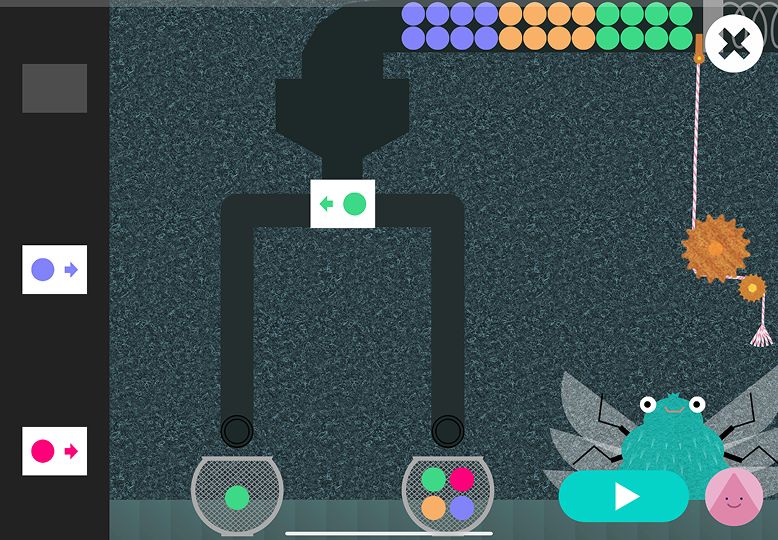
Introducing logical operators IF… ELSE by building a marble sorting machine
Along the way, kids explore concepts such as pattern recognition, the logical operators, and visual coding. These thoughtfully designed activities introduce algorithmic thinking in a way that’s engaging and developmentally appropriate.
Choosing Safe and Age-Appropriate Digital Tools
When selecting digital learning tools, safety should always come first. Look for apps that comply with COPPA and FERPA standards to ensure your child’s data is protected. Platforms designed for independent use should be ad-free and free of external links, keeping kids focused within a secure learning environment.
Age-appropriate design isn’t just about colorful graphics. The best tools engage multiple senses with visual and auditory cues, helping kids with different learning styles understand abstract ideas. Features like digital manipulatives - interactive objects that kids can move on screen - offer immediate feedback. For instance, if a child places a block in the wrong sequence, they can see the mistake right away and try again. This hands-on approach not only reinforces learning but also helps kids build resilience as they work through challenges.
Spotting Algorithmic Thinking in Daily Activities
Everyday routines often encourage algorithmic thinking without us even realizing it. The key is noticing these moments and using the right language and questions to strengthen this skill.
Examples from Daily Life
Algorithmic thinking shows up in simple tasks like following a recipe. Think about it: measuring ingredients, mixing them in a specific order, and baking at the right temperature all involve sequencing. If your child suggests doubling the ingredients to make more cookies in one batch, they’re showing algorithmic efficiency - finding a quicker way to achieve the goal [15].
Even daily chores like getting ready for school or tidying up a room are great examples. Breaking down these tasks into smaller steps - putting on socks before shoes, packing a backpack the night before, or cleaning by first picking up toys, then making the bed, and finally sorting laundry - requires logical sequencing.
Research supports these observations. In December 2025, Huiwen Alex Yang and the Kidd Lab at UC Berkeley published a study in Nature Human Behaviour that involved 123 children aged 4 to 10. The study asked kids to play a computer game where they sorted hidden "bunnylike creatures" by height using feedback clues. More than half of the participants, including 4-year-olds, independently discovered and applied advanced algorithms like "selection sort" and "shaker sort" without prior instruction [15]. This finding highlights what many parents already know: kids are naturally curious problem-solvers.
These everyday situations create opportunities to explore and refine logical thinking.
Questions That Encourage Logical Thinking
To build on these everyday routines, try asking questions that guide children toward logical problem-solving. Instead of giving instructions, ask, "What steps do we need to take?" or "What should we do first?" These questions encourage kids to think through the process on their own.
When something doesn’t go as planned - like a routine breaking down or a craft project going awry - ask, "What’s the problem?" and "How can we fix it?" This practice of identifying and solving issues mirrors debugging, a fundamental part of algorithmic thinking [2]. After completing a task, reflective questions like "What worked?", "What didn’t?", and "What could we try differently next time?" help kids analyze their approach and refine it [3].
For a fun twist, try introducing intentional "silly mistakes" into patterns or routines and ask your child to spot and fix them [2]. This playful activity sharpens their focus and reinforces problem-solving skills without making it feel like a formal lesson.
Conclusion
Algorithmic thinking serves as a bridge between everyday problem-solving and achieving success in academics and beyond. It's not just a skill for computer science - it's a structured approach to tackling problems. By using techniques like breaking tasks into smaller parts, spotting patterns, focusing on key details, and creating step-by-step solutions, children build critical thinking and perseverance.
Daily life provides plenty of opportunities to nurture this mindset. Simple questions like "What should we tackle first?" or "How can we solve this?" encourage kids to approach challenges methodically and with confidence.
Experts agree: algorithmic thinking is essential in today's digital world. However, the focus isn't on rushing kids into coding. Instead, it's about fostering the kind of thinking that supports them across all areas of learning and in life [1][3]. This gives parents practical ways to encourage these skills at home.
Celebrate those moments when your child demonstrates algorithmic thinking. Help them break problems into manageable steps - each little success lays the groundwork for bigger achievements ahead.
FAQs
What age should kids start learning algorithmic thinking?
Children as young as 3 can start developing algorithmic thinking through engaging, screen-free activities. Simple tasks like sequencing, recognizing patterns, and solving basic problems are not only fun but also help lay the groundwork for logical thinking - all without the need for computers.
Between the ages of 4 and 7, kids can dive deeper into algorithms through activities like storytelling, following routines, or creating simple instructions. These activities teach them how to break problems into manageable steps, a skill that plays a key role in critical thinking and sets the stage for success in STEM fields later on.
How can I tell if my child is using algorithmic thinking?
You might notice algorithmic thinking in your child when they approach tasks by breaking them into smaller, clear steps and following a logical order to complete them. For instance, if they organize their daily schedule or tackle problems one step at a time, that's a good sign of this skill. They might also show an interest in spotting patterns, fixing mistakes, or solving problems systematically - like identifying errors in a sequence or recognizing recurring patterns in everyday activities.
How do I teach algorithmic thinking without teaching coding?
Teaching algorithmic thinking can be fun and interactive by using hands-on activities that revolve around problem-solving, sequencing, and recognizing patterns. For instance, you can have kids practice giving or following step-by-step instructions for everyday tasks like packing a lunch or drawing a specific shape. Another idea is to challenge them to identify and correct mistakes in patterns or come up with instructions for assembling an object. These exercises introduce children to the idea of algorithms as step-by-step processes - no coding required!
Related Blog Posts
Transform Math Learning for Kids
Explore Funexpected's interactive math program designed for children aged 3-7. Build math fluency, logic, and problem-solving skills through engaging, hands-on activities and a personalized digital tutor.