How to Provide Help: Phrases and Hints that Build a Growth Mindset and Support Kids in Math Tasks
Early Childhood Education
Apr 14, 2026
Growth-mindset phrases, hint scripts that avoid giving answers, and effort-focused praise to help kids solve math and build confidence.

Want to help your child thrive in math? The right words and strategies can make all the difference. Here's how you can encourage a growth mindset, provide hints without giving away answers, and use effort-based praise to build confidence and problem-solving skills:
Growth Mindset Phrases: Use phrases like "You haven't mastered it yet" or "Great, mistakes help us learn!" to turn struggles into opportunities.
Effective Hints: Ask open-ended questions like "What do you understand so far?" to guide their thinking without solving the problem for them.
Effort-Focused Praise: Highlight their persistence and strategies instead of labeling them "smart", e.g., "I noticed you tried three different ways to solve that."
These approaches not only improve math skills but also teach resilience, critical thinking, and independence. Ready to dive deeper? Keep reading for practical examples and scripts you can use today.
Growth Mindset Importance Explained
Phrases That Build a Growth Mindset
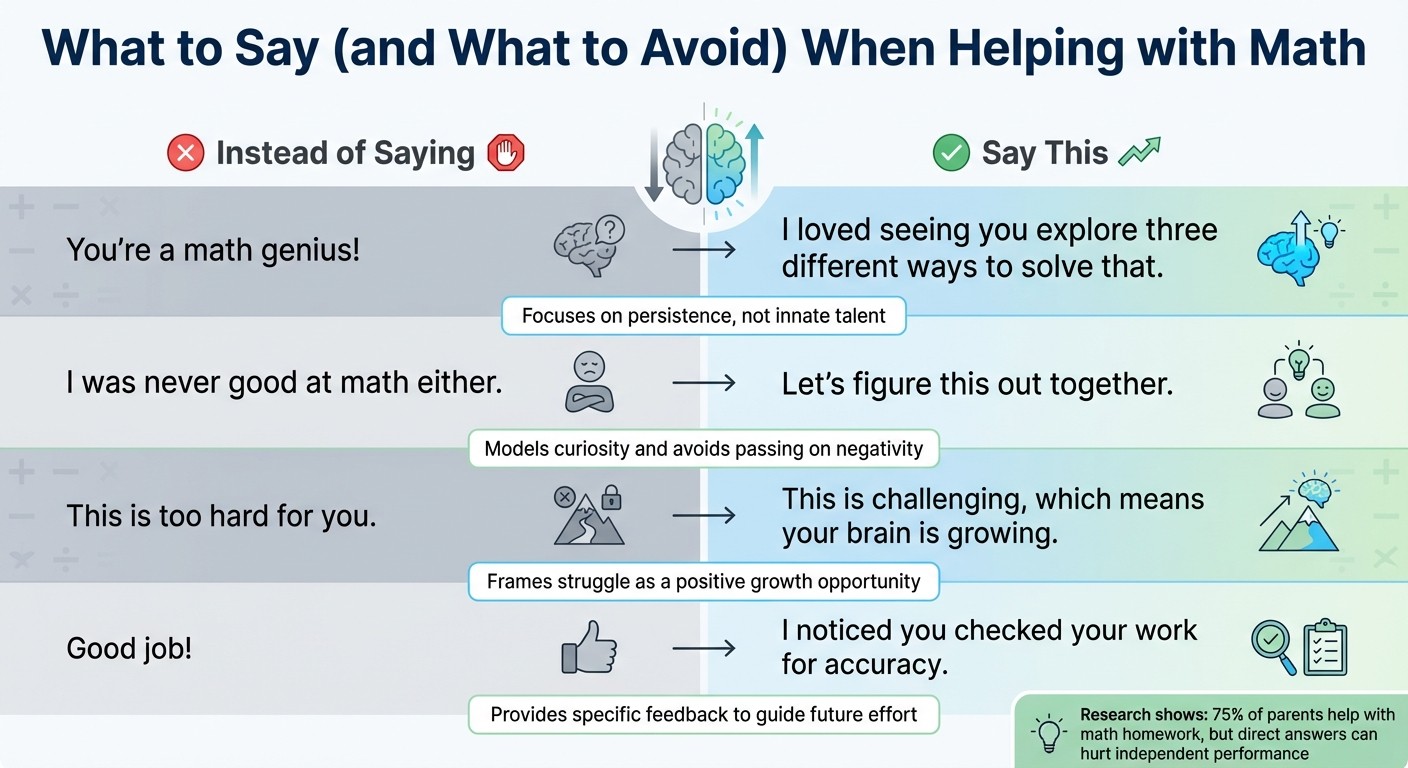
Examples of Fixed Mindset vs Growth Mindset Phrases for Math Homework Help
Using process-focused language can make a huge difference in fostering resilience and a growth mindset. For example, instead of saying, "You're so smart!" after your child completes a task, try saying, "You must have worked really hard!" This shifts the emphasis from innate ability to effort - something they can control and improve upon.
Examples: 7 Encouraging Phrases to Use
1. "You haven't mastered it yet."
Adding "yet" turns a fixed statement into one filled with possibility. If your child says, "I can't do fractions", respond with, "You can't do fractions yet, but you will with practice." It’s a small change with a big impact.
2. "This is challenging, which means your brain is growing stronger."
Linking struggle to brain growth helps kids see challenges as opportunities. It reinforces the idea that effort strengthens their brain, making difficulty a sign of progress, not failure.
3. "Mistakes are great, they are how we learn. What can we learn from this one?"
This phrase shifts the focus from avoiding mistakes to embracing and learning from them. When your child makes an error, encourage reflection and problem-solving rather than discouragement.
4. "I noticed you tried three different ways to solve that."
Highlighting specific strategies shows that persistence and creativity matter. It’s more effective than a generic "good job" because it pinpoints what led to success.
5. "It's about understanding, not speed. Take your time."
This phrase is especially helpful for kids who feel rushed or anxious about completing tasks quickly. It reminds them that deep understanding is more important than racing to finish.
6. "What can you try next?"
Instead of jumping in with the answer, this open question encourages independent problem-solving. It helps your child think critically and take ownership of their learning process.
7. "I love your solution; it's so creative!"
Celebrating their unique approach reinforces the idea that there are many ways to solve a problem and builds confidence in their ability to think outside the box.
Instead of Saying | Say This | Why It Works |
|---|---|---|
"You're a math genius!" | "I loved seeing you explore three different ways to solve that." | Focuses on persistence, not “innate talent” |
"I was never good at math either." | "Let's figure this out together." | Models curiosity and avoids passing on negativity |
"This is too hard for you." | "This is challenging, which means your brain is growing." | Frames struggle as a positive growth opportunity |
"Good job!" | "I noticed you checked your work for accuracy." | Provides specific feedback to guide future effort and focus on the problem-solving process |
When to Use These Phrases
The right timing can make these phrases even more impactful. For example, when your child says they can’t do something, respond with a "yet" phrase to turn their fixed mindset into a growth opportunity.
If they’re tackling something tough but achievable, it’s a great moment to say, "This is challenging, which means your brain is growing." Research suggests that the ideal balance for building confidence is a task with an 80% success rate - challenging enough to require effort but still within reach [1].
After your child completes a tough problem, resist saying, "You're so smart!" Instead, focus on their strategy and the solution process: "I saw how you drew a picture to understand the word problem" or "You really took your time to work through each step." This kind of process praise gives them a clear idea of what worked and how to replicate it.
During timed activities or tests at home, phrases like "It's about understanding, not speed" can help reduce anxiety. This is particularly helpful for neurodivergent children, who may often face negative feedback about focus and are at higher risk of developing a fixed mindset.
Next, we’ll look at how to give hints without revealing answers, pairing these growth-focused phrases with effective guidance.
How to Give Hints Without Spoiling the Answer
When your child is struggling with a problem, it’s tempting to jump in with the solution. But research shows that about 75% of parents help with math homework, and the more they "fix" problems, the poorer children perform on independent tests [2]. The key is to provide scaffolding - temporary support that helps guide their thinking while still allowing them to work through the challenge.
A Step-by-Step Method for Giving Hints
Start by asking open-ended questions like, "What do you understand about this problem so far, and what is it asking us to find?" This approach encourages your child to explain what they know and highlights where they may be stuck [2]. Follow up with questions like, "What information are we given?" to help them organize their thoughts.
For many children - 65%, to be exact - visual learning is especially effective [3]. Encourage them to draw a diagram or chart to represent the problem. Suggest circling key details or underlining words like "total", "difference", or "each" to focus their attention.
Next, connect the problem to past experiences by asking, "What math operations have you used in similar problems?" or "How did the teacher explain this in class?" If they’re still stuck, remember that experts recommend limiting time on a single tricky problem to 10–20 minutes to avoid frustration [4].
These questions help your child think independently and make it easier to transition into hints tailored to their needs.
6 Example Hint Scripts
Counting Problem: If they’re losing track while counting objects, suggest: "What if you grouped them into sets of five? Would that make it easier to count?"
Shape Recognition: For a puzzle piece that doesn’t fit, ask: "What happens if you turn the piece to a different angle?"[5]
Word Problem: If they’re stuck on a story problem, ask: "What information are you given, and what are you trying to find?"[2]
Forgotten Formula: If they can’t recall how to find the area, prompt with: "How did the teacher explain this in class?"[4]
Addition Strategy: For a problem like 27 + 35, suggest: "What if you broke these numbers into tens and ones?"
Pattern Recognition: If they can’t see the next number in a sequence, ask: "What’s changing between each number? Is it getting bigger or smaller, and by how much?"
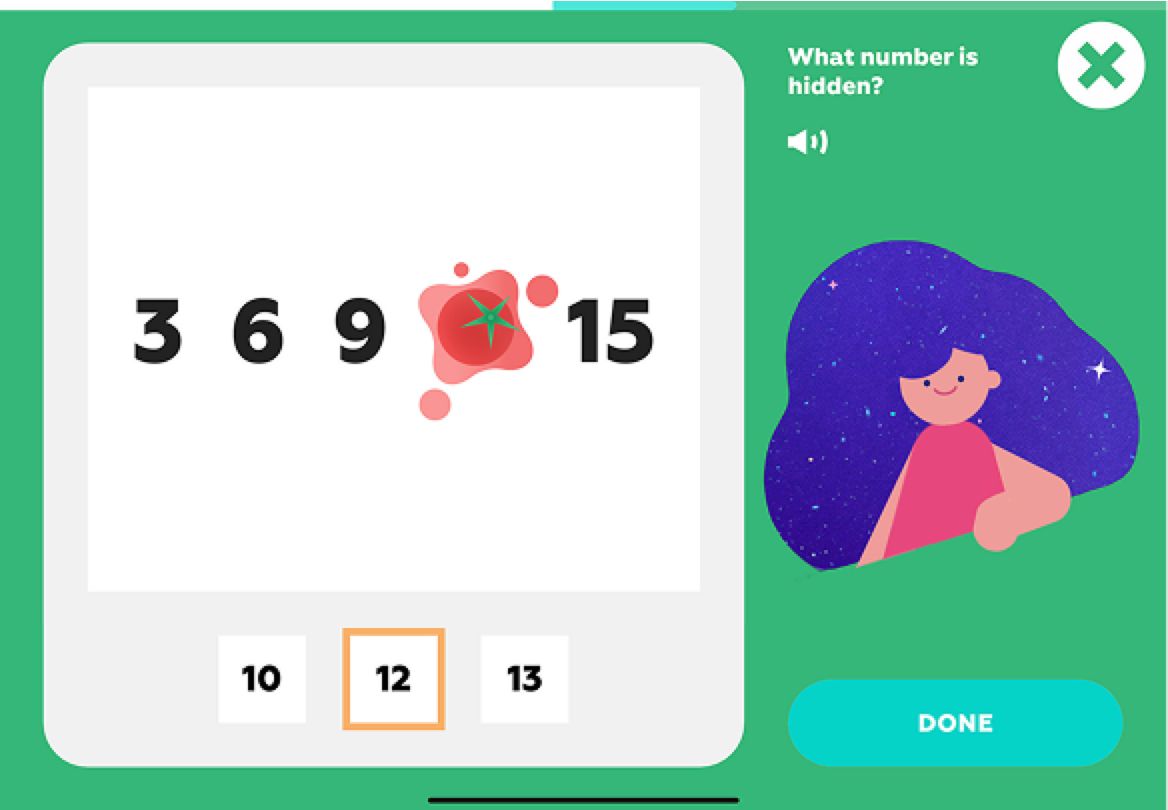
A pattern recognition task in the Funexpected Math app
Direct Answers vs. Growth-Oriented Hints
The real difference between helping and hindering lies in who’s doing the thinking. Growth-oriented hints encourage problem-solving, while direct answers can create dependency.
"We think we're helping when we show Johnny how to solve for x, but we're actually teaching him that he can't figure it out himself." – Musab Khan, online math tutor [2]
Scenario | Direct Answer Approach | Growth-Oriented Hint Approach | What It Achieves |
|---|---|---|---|
Child is stuck on a word problem | "The answer is 48." | "What information are you given, and what are you trying to find?" [2] | Builds independent problem-solving skills instead of creating dependency |
Child can't fit a puzzle piece | "It goes right here." | "Try turning the piece to a new angle." [5] | Encourages spatial reasoning rather than short-term completion |
Child forgets a formula | "You need to multiply length by width." | "How did the teacher say to do this problem in class?" [4] | Strengthens memory retrieval instead of bypassing the learning process |
Child says "I'm bad at math" | "No, you're not, you're smart." | "You haven't mastered it yet, but you will with practice." [6] | Develops a growth mindset rather than reinforcing fixed beliefs |
Another effective technique is role reversal. Ask your child to explain the problem or concept back to you. This not only reinforces their understanding but also helps them build confidence [7]. If they can explain it, they truly understand it.
Effort-Based Praise for Math Homework
Effort-based praise helps shape how a child views their abilities. Praising intelligence, like calling a child "smart", can sometimes backfire - kids may develop a fear of failure and shy away from challenges. Instead, focus on what they do rather than who they are. This aligns naturally with using growth-focused language during math homework.
5 Scripts for Praising Effort
Specific praise is far more effective than generic compliments. Instead of saying, "Good job", highlight exactly what you noticed. For example, try: "I saw how hard you worked on that problem. Your persistence paid off!" [6] or "I noticed you took time to think through the problem" [8]. If they overcome an error by trying a new approach, you might say: "Your persistence paid off. That shows great grit!" [9].
The word "yet" can be a game-changer. When your child says, "I can't do this", respond with, "You might not be able to do it yet, but with practice, you'll get there". Another great phrase is: "I love your solution to the problem; it’s so creative!" [10]. This not only acknowledges their effort but also highlights their unique approach, regardless of whether they got the answer right.
Timing is just as important as the words you use. Praise has the most impact when it happens during the learning process, not just at the end. Experts suggest offering about six praise statements every 15 minutes during learning activities, aiming for a ratio of four positive comments for every one correction [9]. Some studies even recommend a 10:1 ratio to truly build resilience [10]. But this doesn’t mean tossing out empty compliments - kids can tell when praise isn’t genuine. Instead, focus on real observations about their effort, strategies, or persistence. These kinds of comments naturally weave into interactive math activities, reinforcing a growth mindset during homework time.
Using Effort-Praise with Funexpected Math

Funexpected Math’s interactive lessons create perfect opportunities to apply these praise strategies. With over 10,000 tasks covering numeracy, logic, geometry and algorithms, there’s plenty to observe and comment on.
For instance, if your child thoughtfully uses the digital tutor’s hints, you could say: "I noticed you asked for help when you needed it - that’s smart thinking."
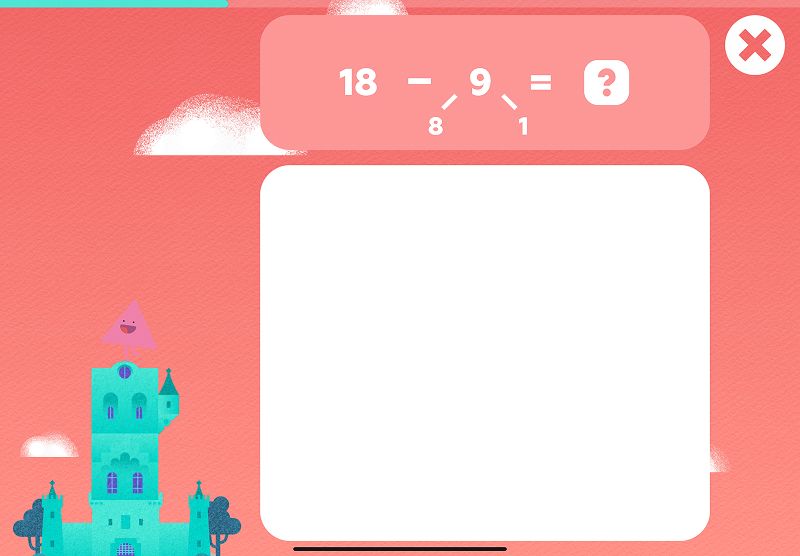
Presenting 9 as 8 and 1: A visual hint in a subtraction task in the Funexpected Math app
If they complete a tough lesson in one of the six learning programs, focus on their effort: "You stuck with that pattern problem even when it got tricky. That’s how your brain gets stronger."

A patterns game within the Funexpected Math app
The app’s hands-on activities, which span 50+ topics, offer endless chances to highlight problem-solving strategies. If your child experiments with different methods to solve a spatial reasoning puzzle, point it out: "You tried three different ways before finding the solution. That’s exactly what mathematicians do."
Since the app tracks progress across 675 lessons, you can also celebrate their growth over time: "Remember when addition was hard? Look how much you’ve practiced since then."
The app itself is also built on growth mindset principles. Its digital tutor, Aika, provides hints and guiding questions rather than handing out answers.

Aika, a talking digital tutor within the Funexpected Math app
The app’s adaptive AI ensures tasks remain challenging yet manageable, while talking buddies celebrate progress and offer emotional support during tough moments. The app also turns mistakes into opportunities to learn, using animations and gentle redirection to guide children.
Whether your child is 3 or 7, the app adjusts to their developmental stage. Younger children receive playful, encouraging guidance, while older kids benefit from strategic prompts that encourage self-correction.
Conclusion: Supporting Math Growth
The strategies discussed - using encouraging phrases, offering non-spoiling hints, and focusing on effort-based praise - work together to help children build confidence and resilience. By emphasizing the process over just getting the right answers, these approaches nurture problem-solving skills that extend beyond math. These same principles are at the heart of Funexpected Math's interactive design.
FAQs
How do I help without giving the answer?
To guide effectively without directly providing the answer, try offering supportive hints and asking open-ended questions like:
"What part do you feel confident about so far?"
"What approach have you tried already?"
Encourage them to think back to strategies or examples they’ve learned before. Remind them that making mistakes is a natural and valuable part of the learning process. Acknowledge their efforts along the way - this helps build their confidence and resilience, motivating them to keep pushing through challenges.
What do I say when my child says, “I’m bad at math”?
When your child says, “I’m bad at math,” it’s a great opportunity to encourage a growth mindset. You can respond with something like, “It’s okay if math feels tough right now. What’s important is that you’re putting in effort, and with practice, you’ll get better.” This helps shift the focus away from fixed labels like "bad" and instead emphasizes persistence and improvement. Highlighting their progress, no matter how small, can boost both their confidence and resilience in tackling math.
Related Blog Posts
Transform Math Learning for Kids
Explore Funexpected's interactive math program designed for children aged 3-7. Build math fluency, logic, and problem-solving skills through engaging, hands-on activities and a personalized digital tutor.