Beyond the Common Core: What Math Should Kids Learn in Preschool and Kindergarten?
Early Childhood Education
Apr 5, 2026
Essential math skills for preschoolers and kindergarteners—number sense, spatial thinking, patterns, measurement, and early coding—shown with hands-on activities.
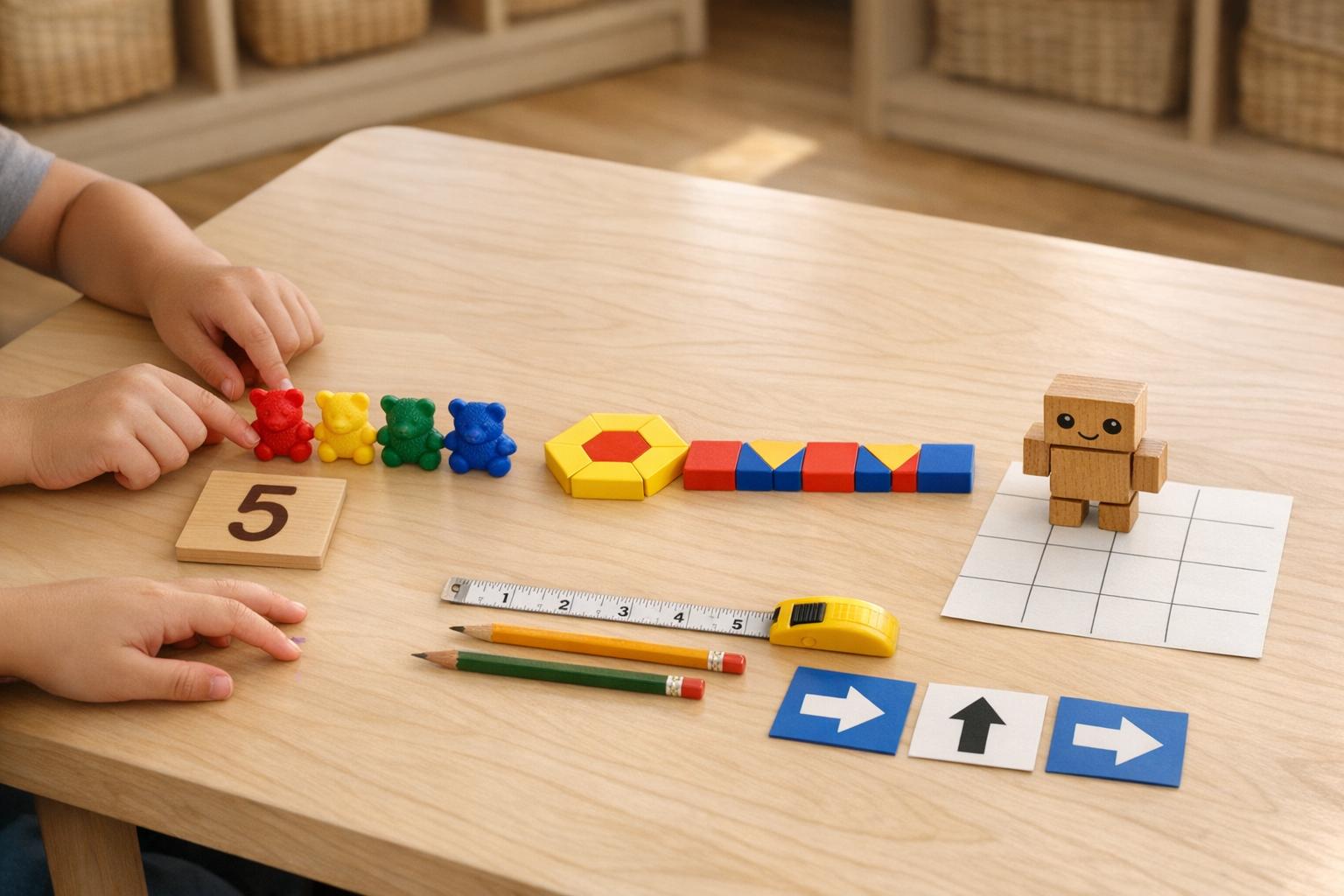
What math should kids really learn in preschool and kindergarten? It’s more than just counting and shapes. Research shows early math skills strongly predict later academic success - even more than reading[1] or social-emotional skills.
Key Math Skills for Preschoolers (Ages 3–4)
Numbers & Counting: Learning one-to-one correspondence and recognizing small groups (subitizing).
Shapes & Spatial Skills: Identifying basic shapes and using spatial terms like "under" or "next to."
Patterns: Recognizing and creating simple patterns (e.g., AB, AAB).
Measurement & Comparison: Comparing sizes, weights, and lengths using everyday objects.
Sequencing: Understanding the order of events and using terms like "first" and "last."
Key Math Skills for Kindergarteners (Ages 5–6)
Number Sense & Basic Operations: Counting to 100, informal addition and subtraction, and decomposing numbers.
Geometry & Spatial Thinking: Identifying, composing, and describing 2D and 3D shapes.
Patterns & Structure: Extending complex patterns (e.g., ABC, AABB) and sorting by multiple attributes.
Measurement & Data: Using tools for measurement and interpreting simple data charts.
Algorithmic Thinking: Learning sequencing, basic logic (e.g., "if-then"), and early coding concepts.
Why Early Math Matters
Studies confirm that math skills at school entry predict future performance across subjects. Early exposure to rich concepts like spatial reasoning, patterns, and logical thinking lays the groundwork for advanced topics like algebra and problem-solving.
Everyday activities - like counting snacks, building with blocks, or sorting laundry - are perfect for teaching these skills. The goal? Make math fun, less abstract, and part of daily life.
6 Big Goals for Preschool and Kindergarten Math
When we step beyond the standard requirements of Common Core, six key areas emerge as essential for laying a solid foundation in math. These skills set the stage for more advanced mathematical understanding later on.
Rich Number Sense
Researchers often refer to number sense as the "conceptual bedrock" of basic math skills [2]. But it’s not just about memorizing numbers or counting - it’s about truly understanding what numbers represent. For example, when a child instantly recognizes three cookies without counting them, they’re practicing subitizing, a crucial part of number sense. Similarly, when kids compare two groups of toys to see which has more without counting, they’re building an intuitive grasp of magnitude.
Interestingly, early math skills like counting and understanding relative sizes are better predictors of later academic success than language, attention, or social skills [3]. Kids who lack this natural feel for numbers often face challenges with arithmetic and measurement as they grow. That’s why the National Council of Teachers of Mathematics emphasizes focusing most of kindergarten math instruction on developing number sense [4].
This process takes time. For instance, after a 2- or 3-year-old learns the concept of "1", it can take around six months to fully grasp "2", and another three months to understand "3". Encouraging activities like comparing two sets of objects without counting can sharpen their intuitive understanding of numbers [2].
Next comes spatial awareness, which helps kids understand their environment and relationships between objects.
Spatial and Geometric Thinking
Spatial reasoning is all about understanding how objects fit together and relate to each other. This skill is crucial for geometry, problem-solving, and even everyday tasks like navigating spaces [5]. Activities like building with blocks, completing puzzles, or following directions like "place the ball under the chair" help develop spatial intelligence.

Basics of spatial reasoning in the Funexpected Math app (program “3-4, Basic“)
Simple obstacle courses that include directional commands can also strengthen this skill. By the time kids reach kindergarten, they should be able to break down complex shapes into simpler parts, which mirrors the problem-solving approach of breaking down big tasks into smaller steps [6][7].
Patterns and Structure
Recognizing patterns is how we make sense of the world. As the Illinois Early Learning Project puts it:
"Recognizing patterns in all aspects of life is necessary for humans to survive. It allows us to predict what might happen next." [8]
This ability to spot and extend patterns is the foundation for early algebraic thinking. Start with simple patterns like AB (red-blue-red-blue) using beads or blocks, then move on to more complex ones like AAB or ABC.
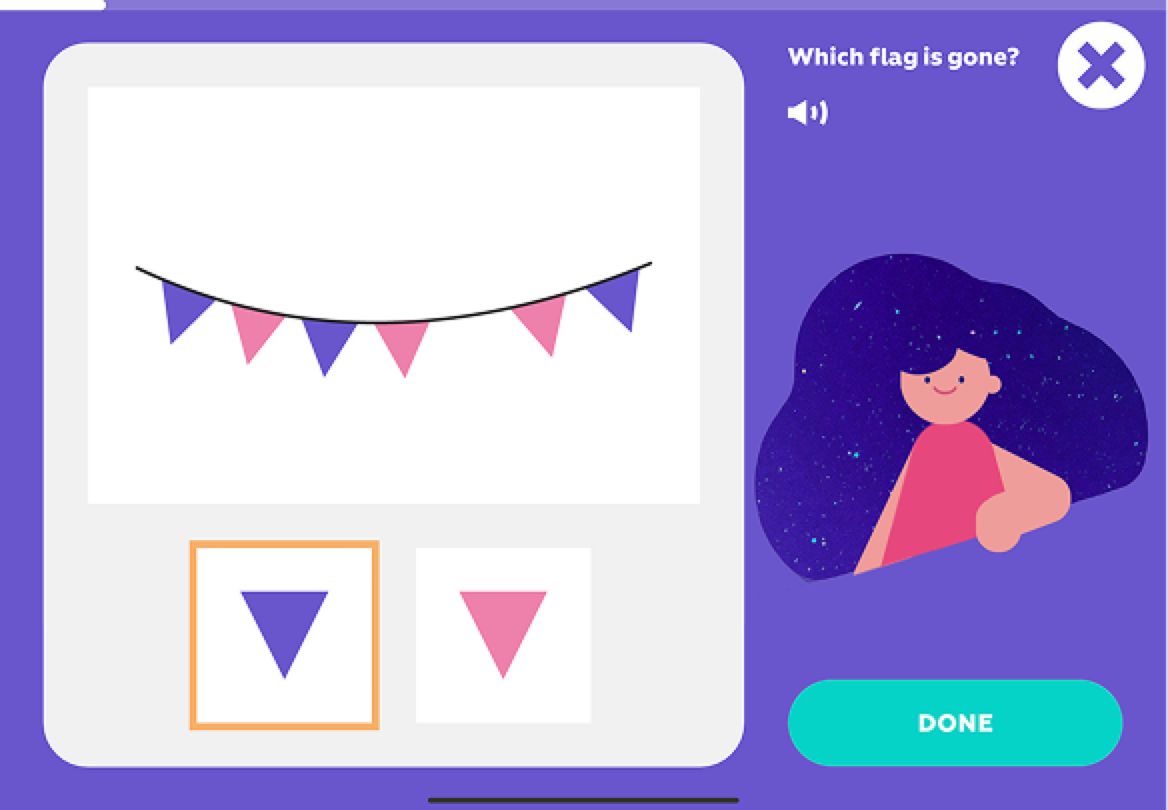
A task on patterns in the Funexpected Math app (program “3-4, Basic“)
By kindergarten, kids should identify the "core unit" of a repeating pattern and extend sequences [2].
Books with repetitive phrases can also help children recognize patterns in language. Music is another great tool - clapping rhythms, changing tempos, and melodies all reinforce the logical thinking needed for algebra later on [8]. Understanding patterns early on builds the framework for tackling logical problems in the future.
Measurement and Comparison
Learning to measure and compare develops logical thinking and helps kids understand relationships. Start by using nonstandard units like measuring a table with "shoes" or a book with "snap cubes" before introducing tools like rulers [6][7]. At three years old, kids can usually compare two objects side-by-side, while four-year-olds begin using multiple nonstandard units to measure a single object.
Activities like arranging objects from smallest to largest or lightest to heaviest - known as "seriation" - help kids grasp order and size relationships [6]. By age five, many children can compare or order up to five objects based on attributes like height or weight [7]. Everyday activities, such as baking, offer great opportunities to explore measurement concepts like volume and sequence [9]. Visual aids, like creating a simple "Favorite Fruits" chart, can also help kids understand comparisons like "more", "less", and "equal" [5].
These early measurement skills naturally flow into the concept of sequencing, which is critical for algorithmic thinking.
Algorithmic Thinking and Early Coding
Algorithmic thinking teaches kids the importance of doing things in a specific order - a concept that’s vital in both math and computer science. For example, when children count objects one by one or arrange items in a specific sequence, they’re learning that order matters [6].
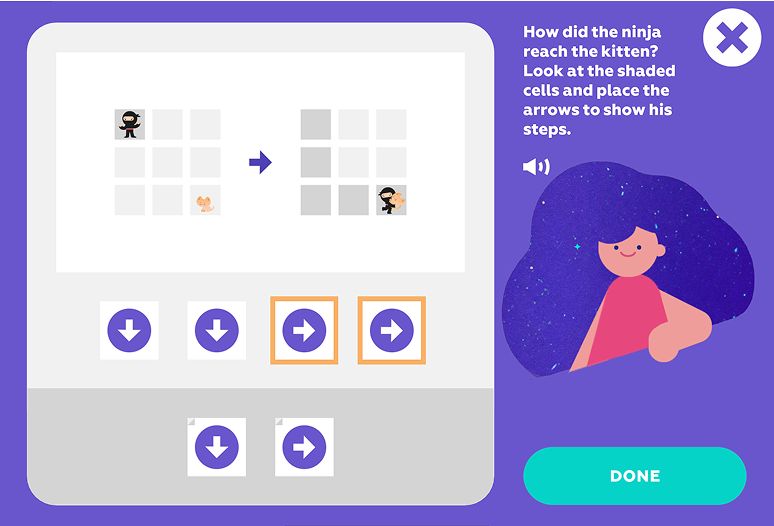
The basics of algorithms in the Funexpected Math app
You don’t need a computer to introduce coding concepts. Everyday routines can teach sequencing. Sorting objects by attributes like color or size helps kids build the logical skills needed for "if-then" reasoning and later data organization [3]. Engaging in "math talk" during activities - like asking, "We need three chairs for snack time; do we have enough?" - connects abstract reasoning to practical situations [2].
What Preschoolers (Ages 3–4) Can Learn
At ages 3–4, children enter what's known as the "symbolic function substage", where they begin using symbols - like numbers - through imaginative play [6]. This stage is ideal for introducing early math concepts in a way that feels like play rather than formal lessons. As Douglas Clements explains:
Preschoolers' brains undergo significant development, their experiences and learning affects the structure and organization of their brains, and preschoolers' brains grow most as a result of complex activities. [6]
Numbers and Counting
Preschoolers transition from rote counting - reciting numbers like a song - to rational counting, where they connect each number to a specific object. Two essential skills emerge here: one-to-one correspondence (touching or moving each object while counting) and cardinality (understanding that the last number counted represents the total) [7][10].
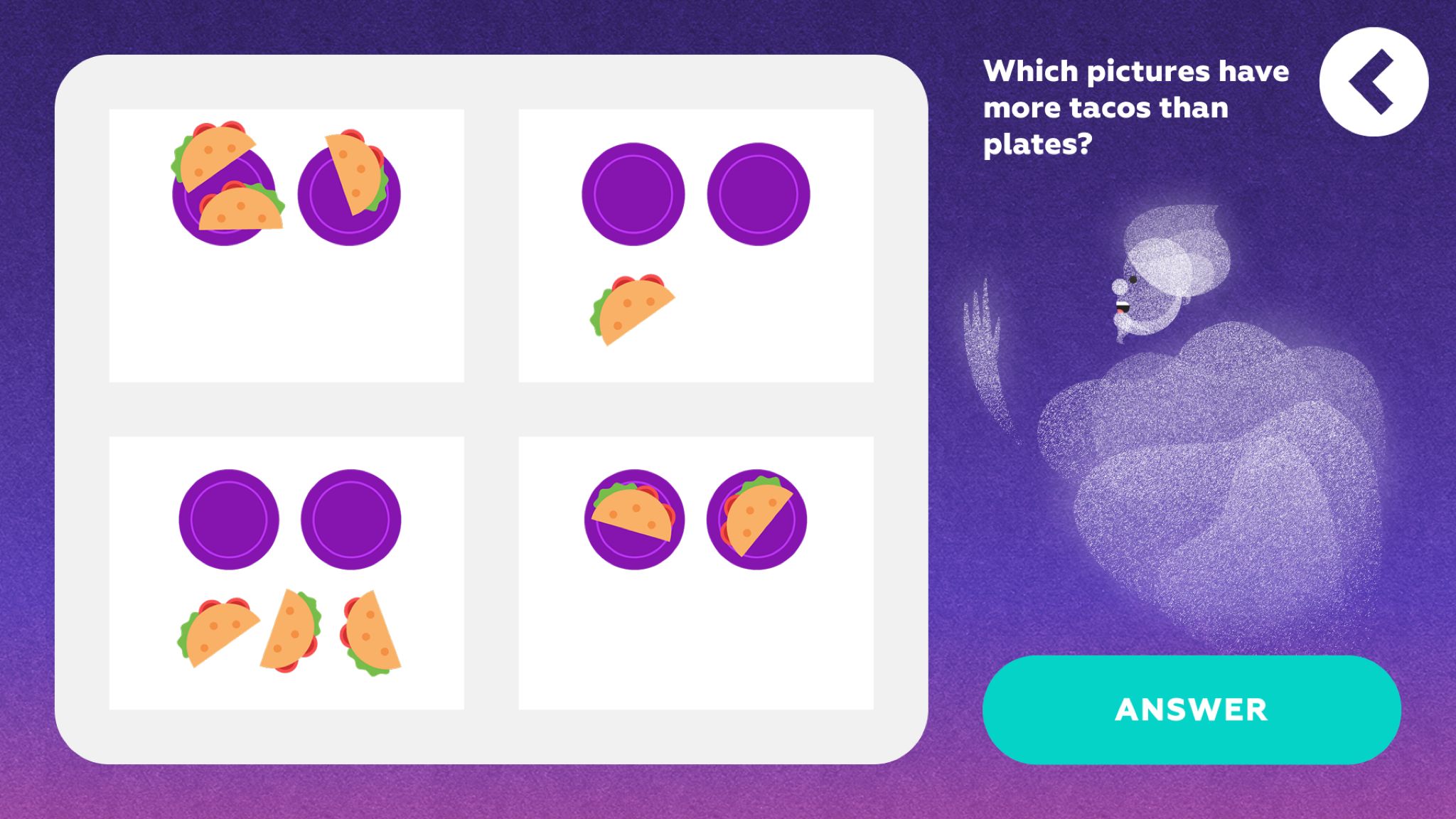
Training 1-to-1 correspondence in the Funexpected Math app
They also begin to recognize small groups of up to three objects instantly, a skill called subitizing [7]. For instance, if you show them three crackers, they might immediately say "three" without counting each one.
Everyday activities can make these skills fun and natural. Count out one cracker for each friend at snack time, tally fingers and toes during a bath, or use board games with dice to practice recognizing number patterns [11][2]. The focus isn’t on getting it "right" but on becoming comfortable with numbers through repetition and fun.
Next, let’s look at how spatial skills help lay the groundwork for math.
Spatial, Shape, and Construction Skills
Spatial reasoning helps kids understand how objects relate to each other and fit together. At this age, focus on identifying basic shapes - like circles, squares, and triangles - and using spatial words such as "over", "under", "next to", and "behind" [11][7].
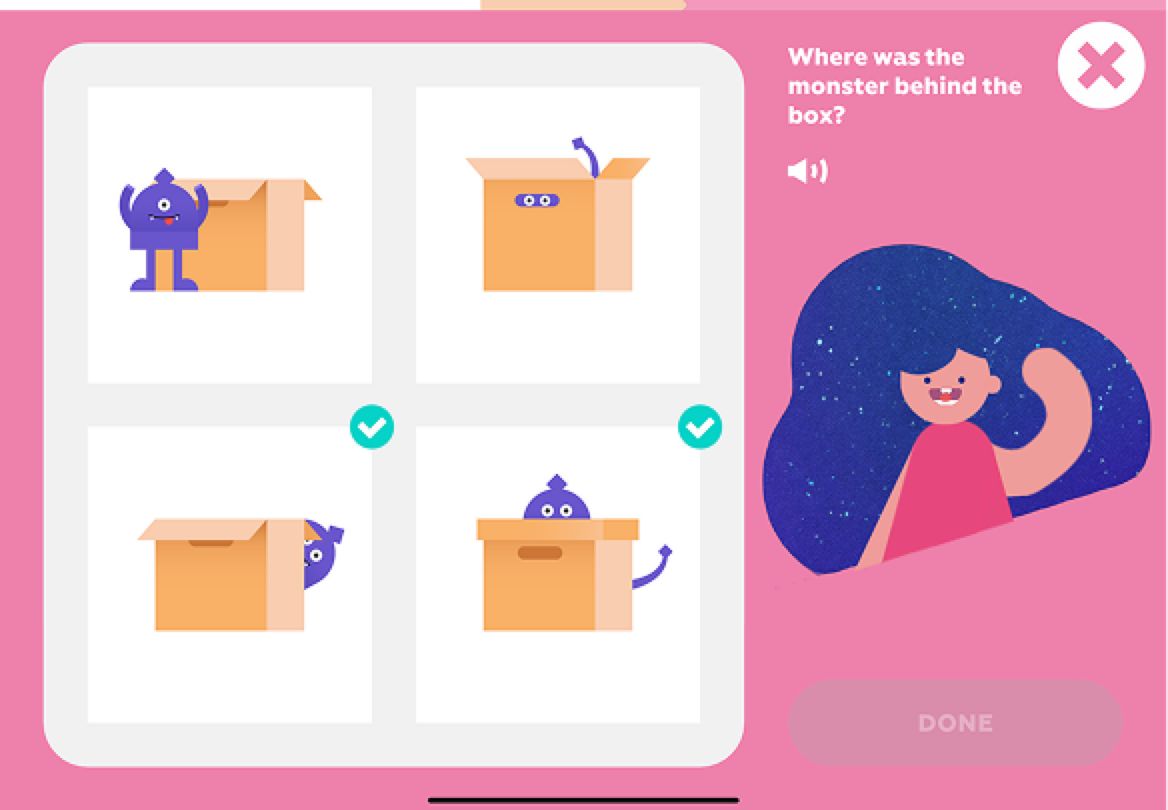
Learning spatial words in the Funexpected Math app
Building with blocks is a fantastic way to develop spatial awareness. As kids stack blocks or fit shapes together, they explore balance, symmetry, and three-dimensional relationships [5][11]. You can also turn everyday moments into learning opportunities with a "shape hunt", asking them to find circles (like plates) or squares (like windows) [10].
Use positional language during play: "Can you hide the teddy bear under the blanket?" or "Let’s put the ball next to the box" [5].
Patterns and Early Algebra
Recognizing and creating patterns introduces the basics of algebraic thinking. Start with simple AB patterns using objects like blocks - red, blue, red, blue. Once they’ve mastered these, move on to AAB patterns (red, red, blue) or ABC patterns (red, blue, green) [8][6].

A game on patterns within the Funexpected Math app
Sorting activities also build reasoning skills. Give kids a mix of buttons or toys to organize by color, size, or texture, or string beads in repeating patterns [5][3]. These activities teach them to notice attributes and make predictions. As Diana Townsend-Butterworth puts it:
Math is helping them to make sense of the world around them and teaching them to reason and problem solve. [11]
Even reading books with repetitive phrases sharpens their ability to predict what comes next.
Beyond patterns, preschoolers also start comparing objects by size and quantity.
Measurement and Data
Before rulers and measuring cups, preschoolers learn about measurement through hands-on exploration. For example, they might stack snap cubes to measure a book’s height or use shoes to measure the length of a rug. These activities make abstract ideas tangible.
At age three, kids can compare two objects side-by-side - "Which stick is longer?" or "Which cup holds more water?". By age four, they begin using multiple units to measure one object, like lining up blocks to measure a table [6].
Seriation, or arranging items by size or weight, also develops during this time. Try asking, "Can you line up these cars from smallest to largest?" during play.
Water and sand tables are excellent for exploring volume and capacity. Provide different-sized containers and let them experiment with "more" and "less" [7]. Cooking together offers another chance to practice measuring: pouring flour into a cup or counting spoonfuls of sugar [11].
Simple data collection can also start here. Create a "Favorite Fruits" chart with stickers to show which fruit each child prefers, then discuss which has "more" votes [8]. This introduces concepts like comparison and early graphing.
Sequencing Actions
Understanding sequences - things happening in a specific order - is crucial for logical thinking and later problem-solving. Everyday routines are perfect for teaching this. For example, explain, "Snack time comes after circle time", or "We wash our hands before eating" [5].
Incorporate ordinal language like "first", "second", and "last" into activities. When lining up for recess, ask, "Who is first in line? Who is last?" [7]. During storytime, talk about what happened "yesterday", "today", and "tomorrow" to build time awareness [5].
Books with repetitive phrases also help reinforce sequencing. After reading the same book a few times, pause at familiar parts and let kids fill in the words [8].
Even household tasks can teach sequencing. For example, setting the table can become a lesson: "First we put down the plates, then the cups, and finally the napkins".
Math Concept | Preschool Skill (Ages 3–4) | Everyday Activity Example |
|---|---|---|
Counting | Counting out one napkin for each person at the table [5] | |
Subitizing | Recognizing groups of up to 3 objects instantly [7] | Showing three fingers and saying "three" without counting [7] |
Geometry | Identifying circles, squares, triangles [7] | Going on a "shape hunt" to find squares around the house [5][10] |
Patterns | Stringing beads in a red-blue-red-blue sequence [5] | |
Measurement | Comparing two objects directly [6] | Lining up blocks end-to-end to measure a table [6] |
Sequencing | Understanding temporal order [6] | Talking about what happened "yesterday" vs. "today" [6] |
The National Council of Teachers of Mathematics encourages educators and parents to:
Capitalize on the wonder and joy children naturally bring to their mathematical learning and their observations of the world. [8]
At this stage, math is all about discovery, exploration, and making sense of the world - not worksheets or drills. Hands-on play is the key to unlocking their curiosity and understanding.
What Kindergarteners (Ages 5–6) Should Learn
By the time kids reach kindergarten, they start applying basic math skills to everyday situations. According to the Common Core State Standards for Mathematics:
In Kindergarten, instructional time should focus on two critical areas: representing and comparing whole numbers, initially with sets of objects; describing shapes and space. [12]
Beyond meeting these standards, kindergarten math also encourages deeper reasoning skills, setting the stage for more advanced problem-solving in the future. Building on the playful learning experiences of preschool, kindergarten introduces more structured practice to solidify these concepts.
Stronger Number Sense with Informal Addition and Subtraction
Kindergarteners learn to count to 100 by ones and tens, understand the concept of cardinality, and write numerals from 0 to 20 to represent quantities.

Counting up to 100 in tens (Funexpected Math app)
They also compare written numerals between 1 and 10, determining which is greater or less [13][12].
Addition and subtraction come alive through real-life scenarios. For example, if three kids are playing and two more join, how many are there now? Children use objects, fingers, drawings, or even act out situations to represent "putting together" or "taking from". By the end of kindergarten, they should be able to fluently add and subtract within 5 [13][12].
A key concept at this age is decomposing numbers - breaking numbers up to 10 into smaller parts in multiple ways. For instance, the number 5 can be split into 2 + 3, 4 + 1, or 3 + 2.

Decomposing number 5 in the Funexpected Math app
This skill lays the groundwork for understanding place value later on. They also practice finding the number that makes 10 when added to any number from 1 to 9, using objects or drawings [13][12].
Engaging activities like the "100 days of school" method or using blocks help kids build fluency in numbers and basic operations. For numbers 11–19, they start grouping ten and adding the "ones" to introduce early place value concepts [14].
Spatial, Geometry, and Composition Skills
Kindergarten geometry goes beyond naming shapes. Kids learn to identify, describe, compare, and compose two-dimensional shapes (like circles, triangles, and hexagons) and three-dimensional shapes (like cubes, cones, and spheres) [15][4].
A big milestone is recognizing that shapes stay the same even when rotated or flipped [15]. To reinforce this, offer shapes in various sizes, types, and orientations [16].
Shape composition is another focus - using smaller shapes to create larger, more complex ones. Pattern blocks are great for this. Activities like "Match Mine", where one child describes a design for another to replicate without seeing it, help develop these skills [16].
Spatial reasoning also grows through the use of positional language like "above", "below", "next to", and "behind" [15]. Advanced skills include mentally manipulating shapes by joining, folding, or rotating them. Encourage kids to view 3D shapes from different angles to build an understanding of perspectives [17].
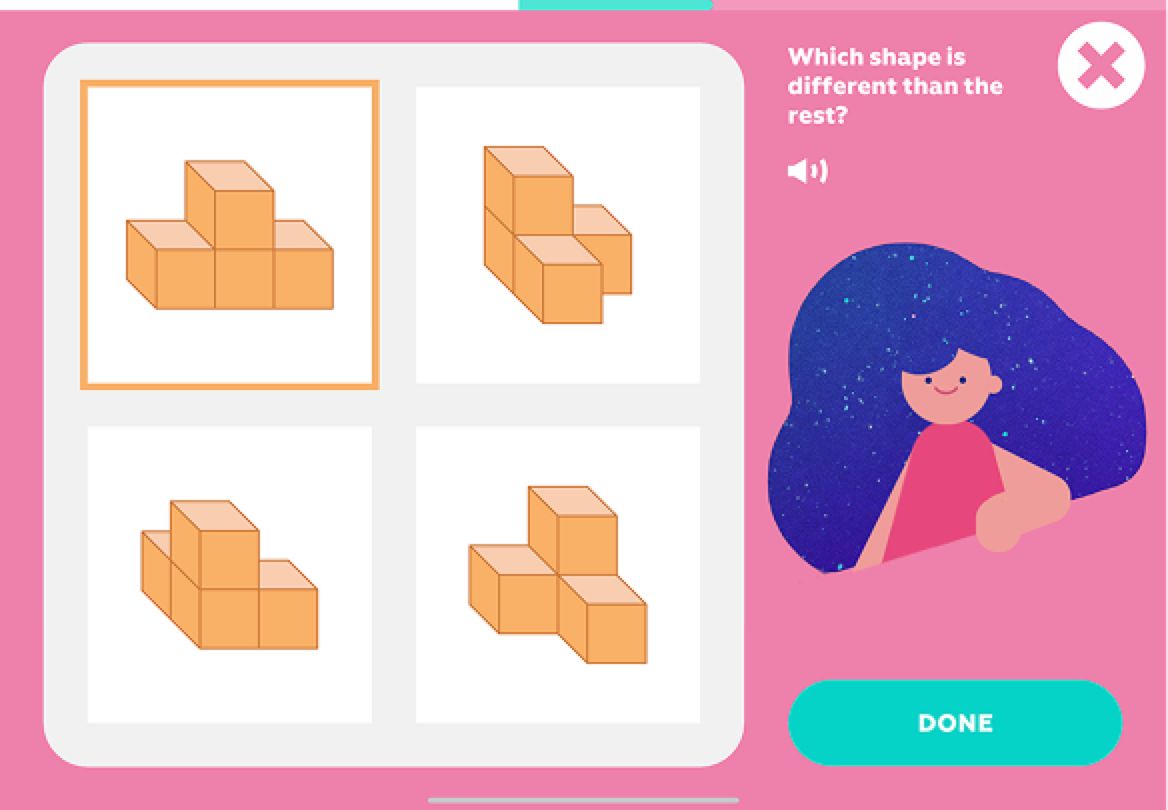
As Illustrative Mathematics explains:
Students need to see and interact with many examples of a shape to accurately relate what's in their environment to the geometric term. [15]
Ask kids to spot flat and solid shapes in their surroundings, like recognizing a tissue box as a rectangle or a ball as a sphere [4].
Patterns, Structure, and Early Algebra
Kindergarteners move beyond simple AB patterns to more complex ones, such as AAB, ABC, or AABB. They also start understanding the logic behind patterns, not just copying them.
Sorting becomes more advanced too. Instead of sorting by just one attribute, like color, kids can now organize by multiple attributes, such as color and size or shape and texture.

Sorting by 2 attributes in the Funexpected Math app
This helps them think about categories and relationships, which are early algebra skills.
As their pattern recognition sharpens, they also begin applying logical ordering to tasks like measurement.
Measurement and Data Analysis
Kindergarteners progress from simple comparisons to using multiple units for measurement, introducing the idea that measurement involves counting units.
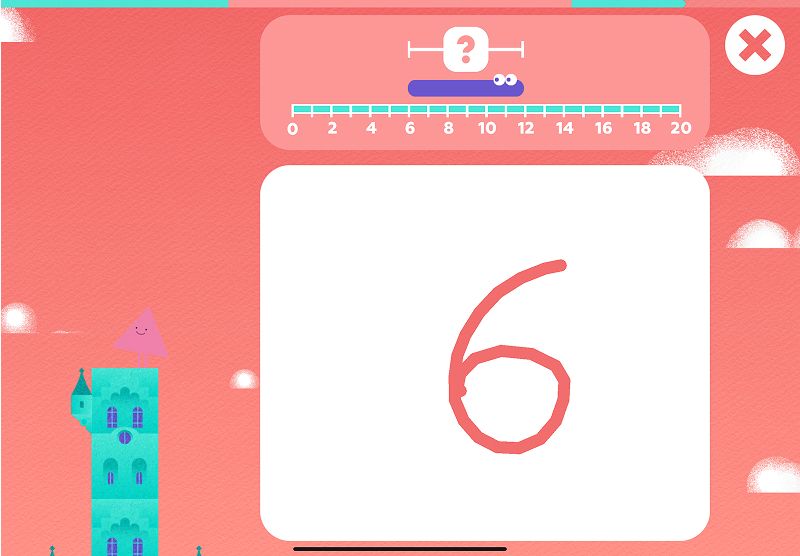
Measuring in units in the Funexpected Math app
They enhance their ability to order objects by attributes like size or weight. This process, called seriation, might involve arranging five or more items from smallest to largest or lightest to heaviest.
Data interpretation also takes a step forward. Instead of just creating a "Favorite Fruits" chart, kids can analyze the data. For example, they might answer questions like, "How many more people like apples than bananas?" or "Which fruit is the least popular?"
Activities like cooking are still great for teaching measurement. Measuring ingredients introduces concepts like volume, fractions (e.g., half a cup), and following sequences [11].
Algorithmic Thinking and Early Coding
Algorithmic thinking teaches kids to break down complex tasks into smaller, manageable steps [18]. While this skill is central to computer science, it also supports logical reasoning and systematic problem-solving in any field [19].
Dr. Joohi Lee, a professor specializing in early childhood math education, explains:
Computational thinking is a cognitive framework for problem solving... It equips children with the ability to think logically, analyze problems, and develop solutions systematically. [19]
Kindergarteners practice sequencing through daily routines like brushing teeth, getting dressed, or following a recipe [20]. They also start understanding basic conditional logic, such as "IF it is raining, THEN wear a coat", and decomposition, which involves breaking tasks into smaller steps - like explaining how to draw a square step by step [17][18].
Physical activities, such as dance routines (e.g., "clap, stomp, jump"), reinforce sequencing and logical thinking [19]. Board games like Robot Turtles introduce programming concepts without screens [21]. For digital learning, Funexpected Math app teach the basics of visual programming through a block-based language [21].

Algorithmic game ‘Ninja‘ within the Funexpected Math app
Interestingly, while 90% of U.S. parents want schools to teach computer science, only 40% of schools currently offer it. Effective early coding programs can be brief - just 15-20 minutes a day - to balance screen time with other learning [21].
As The Gratitude Garden Preschool notes:
Programming literacy is an incredibly important skill... not because they will all go into it as a career - that isn't realistic - but because it impacts every career in the 21st-century world. [21]
Skill Category | Kindergarten Goal | Practical Activity |
|---|---|---|
Number Sense | Use blocks; decompose numbers [14] | |
Geometry | Pattern block puzzles; "Match Mine" games [15] | |
Patterns | Extend AAB, ABC, AABB patterns | Create and explain original patterns |
Measurement | Use multiple units; interpret data [15] | Analyze "Favorite Fruits" charts |
Algorithmic Thinking |
At this stage, kindergarteners are ready to move beyond basic concepts, applying their knowledge to more abstract and systematic problem-solving. These skills will serve as a strong foundation for the challenges of elementary school and beyond.
Research-Backed Priorities for Later Math Success
Why These Areas Matter for Future Learning
Early math skills are more than just numbers - they lay the groundwork for both academic and everyday problem-solving. Studies show that early understanding of concepts like counting, patterns, and set sizes strongly predicts success not only in math but across other subjects as well.
For instance, preschoolers who grasp basic math ideas tend to perform better in fifth grade. Similarly, children entering kindergarten with a strong grasp of math concepts often excel in both math and reading later on [22]. These early abilities act as stepping stones for more advanced topics: spatial sense helps with geometry, pattern recognition leads to algebra, and number sense builds the framework for organizing and understanding numbers. Even mastering Algebra 1 - a milestone that typically takes 6 to 12 months - depends on these early foundations [23].
Beyond academics, early math fosters logical thinking and creative problem-solving by teaching kids that there’s often more than one way to tackle a challenge. This highlights the importance of nurturing skills like spatial reasoning, pattern recognition, and number sense both at home and in the classroom.
How to Support These Goals at Home and in Classrooms
You don’t need fancy tools or elaborate lesson plans to develop early math skills - everyday moments are full of opportunities to "mathematize" life. This simply means weaving math language and thinking into daily activities.
Start by using "math talk" in routines. Words like "more", "empty", "full", "heavy", and "light" introduce math concepts naturally. As the National Association for the Education of Young Children notes:
The more we talk math, the better chance infants and toddlers have to build a positive attitude toward math learning and learning in general.
Take walks as an example - point out patterns like stripes on a shirt or petals on a flower to teach sequencing and predictability. Household chores can also double as math lessons. Sorting laundry by color or matching socks teaches counting and one-to-one correspondence. In the kitchen, cooking introduces measurement, fractions, and counting in a hands-on way that connects abstract ideas to real-life actions.
To boost spatial and geometric thinking, provide tools like blocks, nesting cups, or shape-sorters. Use spatial language during play - phrases like "on top of", "underneath", or "next to" help kids develop spatial reasoning, a critical skill for STEM fields.
Keep activities short and engaging - 10 to 15 minutes is often enough. Physical objects work better than worksheets for young learners. Simple timers or hourglasses can teach time concepts, while books with repeating patterns can reinforce predictability. By incorporating these strategies into daily life, you can help children build a strong math foundation that supports their future learning.
Conclusion: Building a Strong Math Foundation Early
Developing early math skills is a cornerstone for both academic achievement and everyday life. A 2007 study by Greg Duncan highlights that early understanding of numbers and their order is a stronger predictor of future math success - and even overall academic performance - than reading, attention, or social-emotional skills [24].
The encouraging part? You don’t need to be a math wizard to guide young children in building these skills. Consider using some digital support in your child’s learning quest – quality apps like Funexpected Math cover all the crucial skills mentioned above.
These foundational skills not only pave the way for academic growth but also prepare children for practical tasks like managing a budget, following recipes, and tackling everyday problems [24]. Focusing on areas such as number sense, spatial reasoning, patterns, measurement, and logical thinking lays the groundwork for these abilities.
However, many preschools devote surprisingly little time to math instruction. Research reveals that in some six-hour preschool programs, intentional math teaching may total as little as 58 seconds per day. Yet, simply increasing math-focused time from 2% to 4% of the school day can result in noticeable improvements [24]. Prioritizing these core math concepts equips children with tools they’ll use for a lifetime.
FAQs
What does “number sense” mean for a 3–6 year old?
For children aged 3 to 6, number sense is about understanding how numbers function and applying this knowledge to simple math tasks. It involves recognizing numbers, understanding quantities, comparing values, and realizing that the last number in a count represents the total (known as cardinality). It also includes understanding that adding makes quantities larger, while subtracting makes them smaller. By engaging in play and hands-on activities, kids can develop confidence and adaptability in working with numbers.
How can I tell if my child is ready for early addition or subtraction?
Your child might be ready to tackle early addition and subtraction if they recognize numbers, count with confidence, and show a basic understanding of how numbers work. Pay attention to whether they understand and use terms like "more", "add", "together", or "total." Many kids, even as young as four, can begin to understand simple addition and subtraction when it's presented in a way that suits their age and learning style.
Related Blog Posts
Transform Math Learning for Kids
Explore Funexpected's interactive math program designed for children aged 3-7. Build math fluency, logic, and problem-solving skills through engaging, hands-on activities and a personalized digital tutor.