Teaching Kids to Tell Time: A Parent's Guide
Early Childhood Education
Aug 24, 2026
Step-by-step guide to teach children time using routines, play, toy clocks, and matching analog to digital formats.

Most kids should not start with the clock. They should start with daily life.
If you want to help a child tell time, teach it in 4 simple steps:
Understand the day: morning, afternoon, evening, night
Learn short and long amounts of time: seconds, minutes, hours
Read an analog clock: first o’clock, then half past, quarter past, quarter to, and 5-minute times
Match analog and digital time: like 3:30 and half past three
That order matters. Young children grasp sequence words like first, next, then, last before they can read clock hands. And since there are 60 minutes in an hour and clocks use both hours and minutes at the same time, telling time is harder than simple counting.
Here’s the short strategy you can use:
Tie time words to daily routines like waking up, lunch, cleanup, and bedtime
Use pictures, toy clocks, and timers to show what happens next and how long it takes
Teach analog time in small steps instead of all at once
Use digital clocks at home - like the microwave or car clock - to match the same time in a second format
Keep practice short and repeated, because time skills usually build step by step
A child does not need to learn everything at once. First comes order. Then comes the clock.
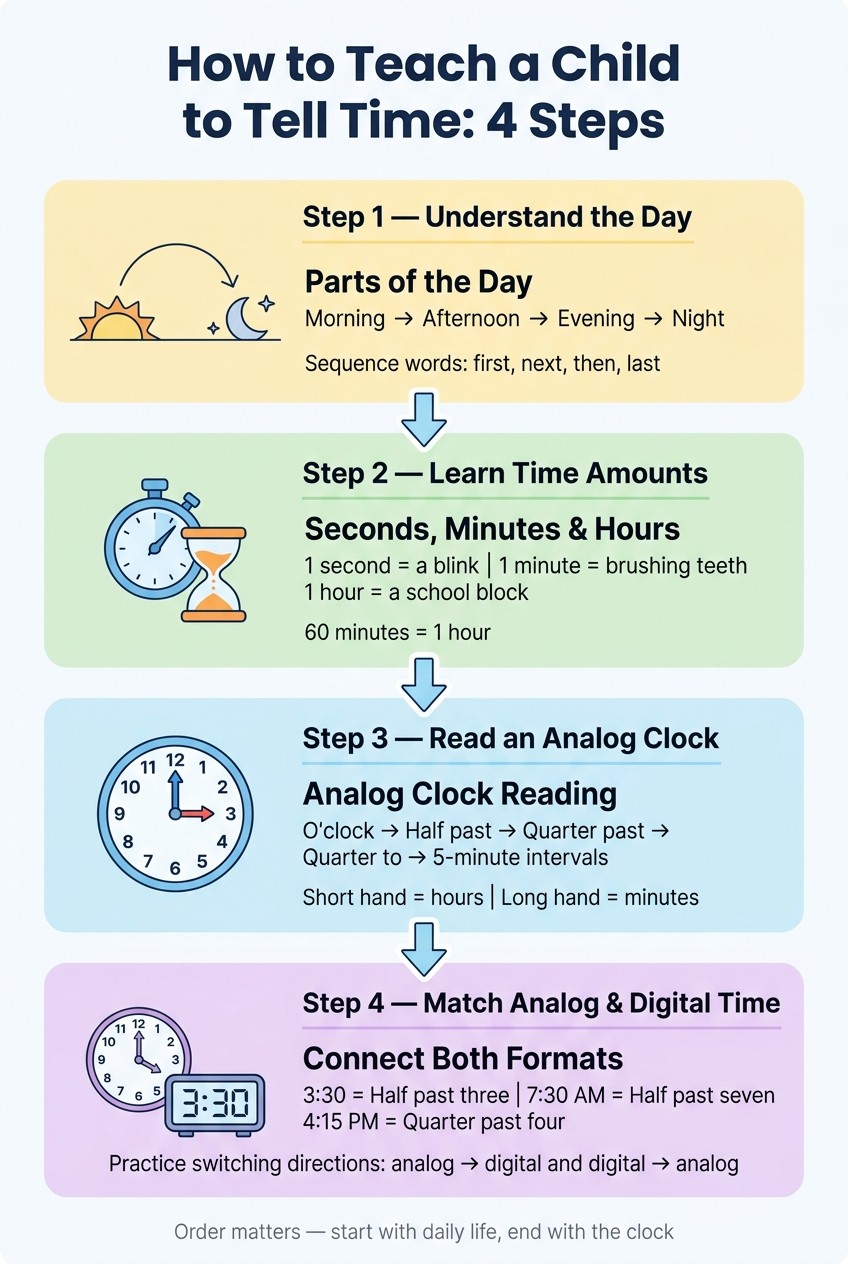
How to Teach a Child to Tell Time: 4-Step Learning Path
How To Read a Clock | Telling Time for Kids
Start with the idea of time in everyday life
Time makes more sense to kids when it’s tied to things they already do every day.
Teach seconds, minutes, and hours using everyday examples
Start with short, familiar moments. A second can be a blink or a clap. A minute can be the time it takes to brush teeth. Five or ten minutes – an episode of their favorite show on YouTube. An hour can be about the length of a school session, a movie, or a night’s sleep.
These simple examples give children something concrete to hold onto. Later, they can connect those time words to clock hands and numbers.
Use parts of the day and sequence words
Morning, afternoon, evening, and night give children a simple map of the day. Add sequence words - first, next, then, last - and kids begin to see that time moves in a clear order.
Understanding before and after is harder. One easy way to practice is with photo sequencing. Show pictures from a familiar routine and ask your child to put them in order, for example: getting dressed, eating breakfast, brushing teeth, and leaving for school.
Use play to practice order and timing
Play is a simple way to build this skill. Sequencing helps children plan and follow steps, which is a big part of learning time. Use small, familiar routines like socks before boots or boots off before bed.
When those patterns click, the clock face stops looking random. It starts to match the order children already know from daily life.
Once children can order parts of the day, they are ready to match those ideas to a clock face.
Teach analog clocks one step at a time
Once a child can sort the day into morning, afternoon, evening, and night, the clock face is the next step. An analog clock has numbers, two hands, and a round face, so kids need to read it in a different way than they read a page. It helps to wait until your child can put morning, afternoon, evening, and night in order and knows that an hour is a block of time. A large toy clock with movable hands is a good place to start.
Name the clock parts and start with o'clock
Start by naming each part of the clock face: the 12 numbers, the short hour hand, and the long minute hand.
Learn the correct position of numbers – a child need to grasp that the lineup is always the same, and that is exactly why clocks make sense.
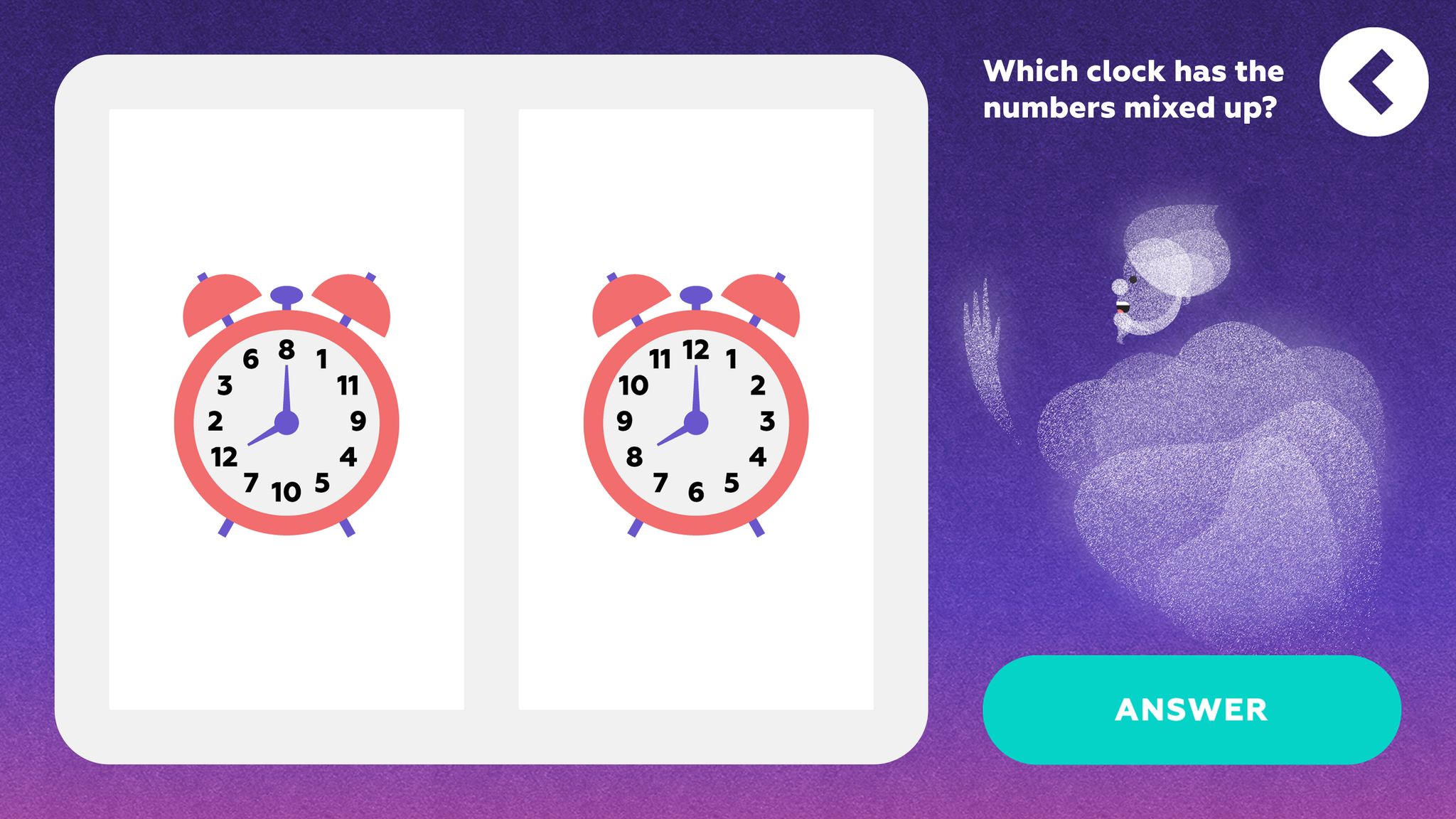
Learning the analog clock face in the Funexpected Math app
Begin with whole hours only. Show your child that when the short hand points to a number and the long hand points straight up to 12, it's o'clock. The short hand shows the hour. The long hand on 12 means that hour is just starting.
Make sure child understands that clock hands move from lesser to bigger numbers. Later this understanding will help the child to grasp terms like “clockwise“ and “counter-clockwise“.
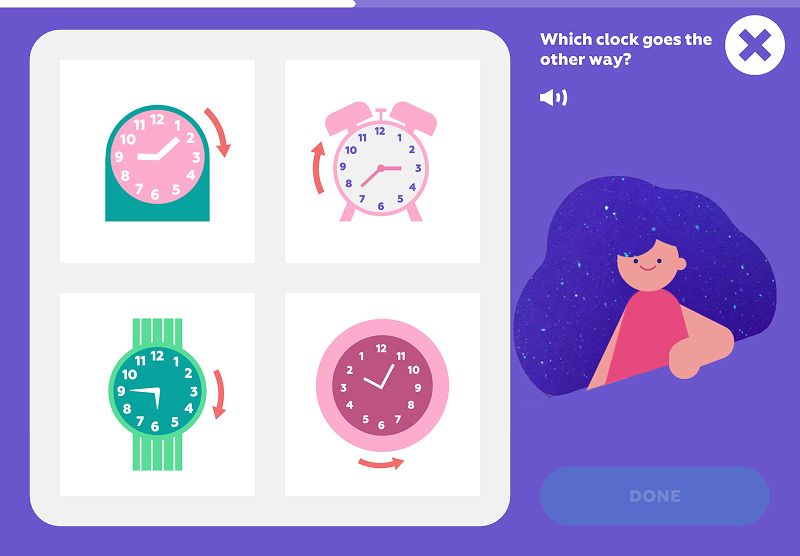
Learning the clock hands rotation in the Funexpected Math app
Use times from your child's own day so the lesson feels concrete. For example:
7 o'clock for waking up
12 o'clock for lunch
Once o'clock feels easy, move on to half past and quarter hours.
Add half past, quarter past, quarter to, and counting by 5s
Teach half past, quarter past, and quarter to as 30 minutes after the hour, 15 minutes after the hour, and 15 minutes before the next hour. Show how the long hand works:
On 6, half the hour has passed
On 3, a quarter has passed
On 9, a quarter remains before the next hour
This understanding will be a great help for the kid when it is time to learn fractions (or even angles).
Then practice counting by 5s around the clock to read times like 3:25. This is where many kids start to see how the numbers around the clock connect to minutes.
Practice with toy clocks, timers, and worksheets
Set the toy clock to the same daily times each day, such as 8:00 for school and 3:30 for a snack. Repeating the same times helps the pattern stick. You can also use a timer for short tasks, like brushing teeth, so your child can feel what one minute is like.
Worksheets help in a different way. A child might draw hands on a blank clock face or match a clock picture to a written time. It's best to use toy clocks first and save worksheets for later check-ins and extra practice.
When a child can set the toy clock with confidence, matching analog and digital time gets much easier.
Connect analog clocks to digital time
Once analog time clicks, digital time is just the same moment shown in a different way. When a child can read an analog clock, a digital clock becomes a second format for the same time.
Teach digital hours and minutes using clocks already at home
Start with the digital clocks your child already sees each day - on the microwave, oven, car dashboard, or a smartphone. Begin with a full hour, like 8:00, and match it to the analog clock.
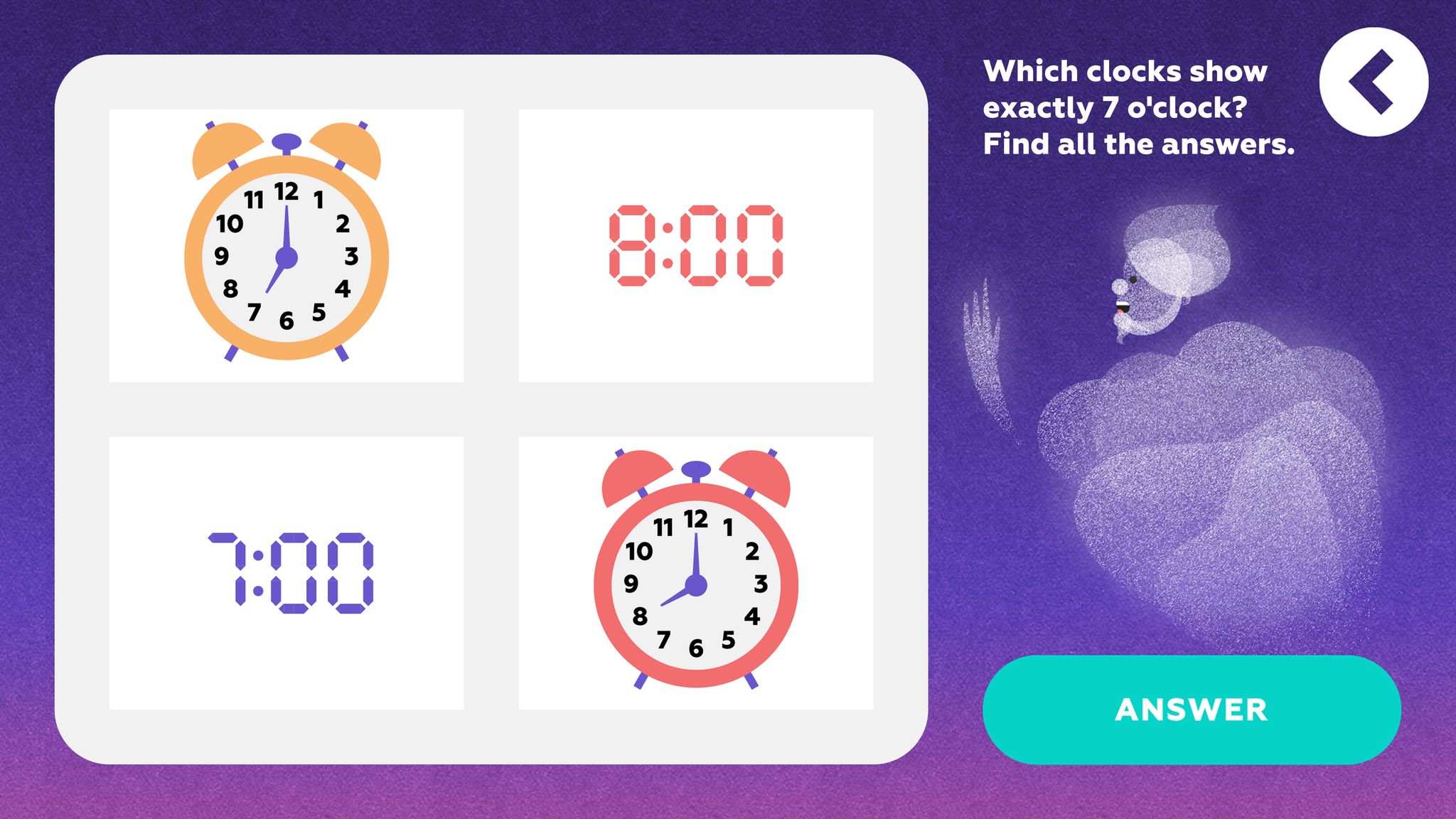
Matching analog and digital time in the Funexpected Math app
When full hours feel easy, bring in minutes. Link digital times to the analog phrases your child already knows. For example, use 7:30 AM for half past seven and 4:15 PM for quarter past four. Stick with the U.S. 12-hour format, including AM and PM, so practice lines up with the clocks your child sees at home.
Match the same time in analog and digital formats
Practicing side by side helps the connection stick. Set a toy clock to a time like 3:25, then write 3:25 PM next to it and ask your child how the two formats line up.
After your child can match one time, switch directions. Show a digital time and ask them to move the clock hands to match it. Then do the reverse. That makes it clear that both formats name the same moment.
You can also take photos of familiar parts of the day, then match each one to a toy clock and a written digital time [1].
Use routines and simple tools to make time-telling stick
Once children know whole hours and can match them to digital time, daily routines help the skill stick. Time-telling works best when it shows up in everyday moments like getting dressed, snack time, cleanup, and bedtime. In those moments, the next step is right there on a clock or timer.
Create visual schedules and countdown routines
A picture schedule makes abstract time easier to see. You can pair each activity with a clock image that shows when it starts, or lay out the day’s routine in order so a child can follow it step by step. When a child can name what comes next, they start linking clock positions with routine events.
Use a schedule to show what happens next. Use a timer to show how long to wait. A kitchen timer or sand timer makes waiting easier to grasp. The sand creates a clear finish line, which helps short waits feel more concrete.
Set age-appropriate goals and track progress
Moving too fast can make time-telling feel frustrating. A simple progression helps keep things clear:
Stage | Focus | What success looks like |
|---|---|---|
Start with daily routines | Parts of the day, sequence words like first, then, next | Can say morning, afternoon, and night correctly |
Move to whole hours | Recognizing o'clock and understanding earlier/later | Can read a full-hour time on an analog clock |
Add smaller intervals | Half-hours, quarter-hours, and five-minute intervals | Can match an analog and digital time to the nearest 5 minutes |
Use Funexpected Math to build the skills behind time-telling
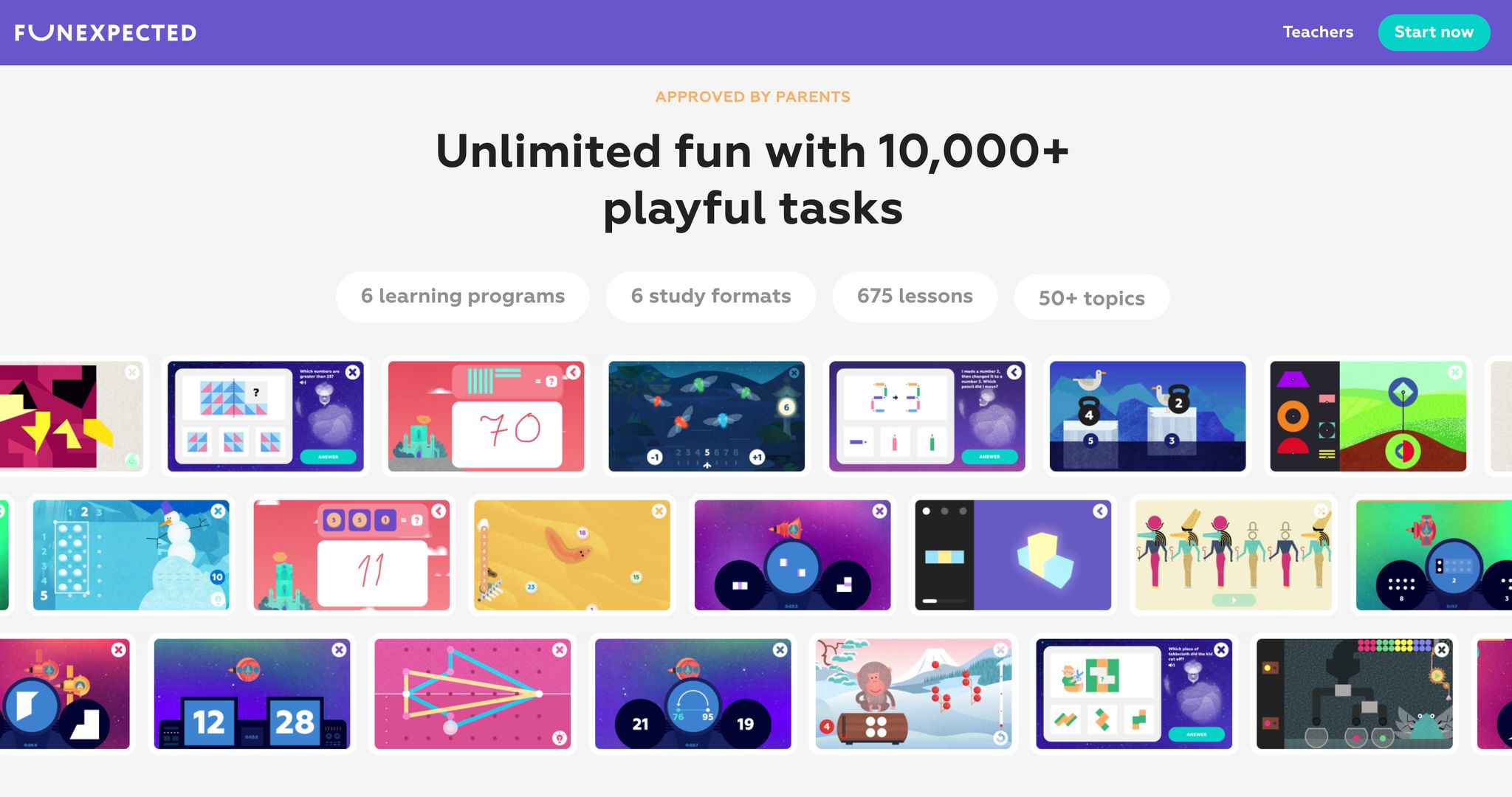
Reading a clock depends on smaller skills first: number sense, sequencing, and time order. For extra practice between daily routine moments, play-based activities can help build those skills.
Funexpected Math is a play-based app for ages 3–7 that supports these areas. Short sessions can help children practice sequencing, number patterns, and time order. The app builds these skills through interactive activities that directly support clock reading - counting by fives, matching order, and following sequence [2].

Counting by fives on the number line in the Funexpected Math app
Conclusion: a clear path from time concepts to reading a clock
Children tend to learn time in stages. It usually starts with daily routines, then moves to analog clocks, and after that, digital time. Teaching a child to tell time works best as a step-by-step process, not a one-time lesson.
Steady practice helps the skill stick. For extra support, Funexpected Math helps build the number and sequencing skills that sit behind clock reading. The main aim is confidence with the basics: parts of the day, analog clocks, and connecting time to everyday life.
With time words, routines, and clock practice, children can move from understanding time to reading it.
FAQs
What age can kids learn to tell time?
Children usually start learning basic ideas about time between ages 5 and 6. Around this age, they begin using words related to time, understanding the sequence of everyday events, and learning how to tell time on clocks.
By ages 6 to 7, they often move on to reading both digital and analog clocks. They also start using calendars to keep track of days, weeks, and months.
Should I teach analog or digital first?
It’s less about following a strict sequence and more about helping your child build a sense of time. A good place to start is chronological order: what happens first, next, and later in everyday routines. That gives kids a solid base before you spend much time on clock faces.
You can teach both analog and digital time as children learn to move through their day. A multi-sensory approach that uses hands-on activities along with digital tools can make time easier to grasp and help them switch between both formats with confidence.
What if my child still struggles with time?
If your child still struggles with telling time, try not to panic. Trouble with clocks or time intervals can sometimes point to a math challenge, so it helps to stay patient and keep the mood light.
Keep practice short and pressure-free. A few small wins can go a long way, especially when your child is already feeling stuck.
Hands-on activities and simple games often help more than drilling worksheets. It also helps to ask your child to explain how they’re thinking. That can show you where things are clicking and where they’re getting lost.
If these struggles continue for months, talk with their teacher or look into a professional assessment.
Related Blog Posts
Transform Math Learning for Kids
Explore Funexpected's interactive math program designed for children aged 3-7. Build math fluency, logic, and problem-solving skills through engaging, hands-on activities and a personalized digital tutor.