Back-to-School Season: How to Refresh Your Child's Math Skills After Summer Break (Ages 3–8)
Early Childhood Education
Aug 14, 2026
A short, low-pressure 10–15 minute daily plan to help kids 3–8 regain counting, number sense, shapes, and basic facts after summer.

A short math reset before school starts can help most kids get back on track in just 10–15 minutes a day. After summer, it’s better to keep it simple: check counting, number sense, shapes, patterns, and easy add/subtract skills, then practice only 2–3 weak spots for one week.
Here’s the whole idea in a nutshell:
Watch instead of testing. Look at snack time, play, or chores to spot where your child gets stuck.
Match practice to age.
Ages 3–4: counting, sorting, shapes, simple patterns
Ages 5–6: number bonds, addition/subtraction within 10, numbers to 100
Ages 7–8: math facts, place value, money, time, word problems
Keep sessions short. Research often shows young kids do better with brief practice than long drills.
Use daily life. Counting grapes, sorting laundry, setting the table, and spotting shapes in the car all work.
Mix formats. Hands-on play, a printable page, or a short app session can each fit into the week.
Focus on confidence. If a child ends on a small win, they’re more likely to try again tomorrow.
One fact worth knowing: summer learning loss can really affect early math, especially in younger grades. That is why a short reset in early August can help before class starts.
If you’re doing this at home, skip long worksheets, use what’s already in the house, and follow a simple one-week plan built around the skills that slipped the most.
Find the math skills that faded over summer
Skip tests and checklists. Just watch your child during snack time or play, and ask some natural questions. You’ll see pretty fast which skills still feel easy and which ones need a short review. Start with a few simple observations, then pick the main things to work on first.
Check number sense, counting, and number recognition
Grab a small handful of crackers or grapes and ask your child to count them out loud. Pay attention to what happens. Do they touch each item as they count, or do they lose their place? If they skip numbers, count the same item twice, or can’t connect a spoken number to one object, they may need more practice with one count for each object.
You can also check spotting small groups at a glance (subitizing). That means noticing a small group without counting one by one. Hold up 3 fingers or put 4 grapes on the table and ask, “How many?” If your child counts even 2 or 3 items one at a time instead of knowing right away, a little extra practice with subitizing may help before school starts. Try out this video to refresh your child’s subitizing skills:
Check patterns, shapes, and sorting
Make a simple pattern with things from around the house and ask your child to keep it going. If they pause for a long time or repeat the wrong item, that tells you something.

Training pattern skills in ‘Gods‘ game within Funexpected Math app
You can also ask them to sort toys, snacks, or crayons by color or size and see how comfortable they seem.
For shapes, try a quick scavenger hunt. Ask them to find “something shaped like a rectangle” or “something round” in the house.
Spatial language can slip by if you’re not looking for it, but it matters. Try a playful direction like “put the stuffed animal behind the chair” or “set your cup next to the plate.” If words like above, below, beside, inside, and outside trip them up, that’s a good sign those ideas need a little review before they hear them in class.
These quick checks can show whether your child just needs a light refresher or should go back to an easier step first. To refresh spatial language, your child can watch this video:
Try simple addition, subtraction, and everyday problem-solving
Keep this casual. At snack time, you might say: “You have 4 grapes - if I give you 1 more, how many will you have?” Or: “There are 5 crackers. You eat 2. How many are left?” Watch how your child works it out. They may use fingers, count objects, or know the answer right away. All of those are okay at this age. What matters more is whether they freeze, avoid the problem, or say something like “I’m not good at this.” If you feel like your child is experiencing math anxiety, you might want to consult this article.
Age Range | Warning Signs to Watch For | Quick Check to Try |
|---|---|---|
3–4 years | Trouble counting in sequence; can't match numbers to objects | Count 5 snack pieces together; ask "how many?" |
5–6 years | Relies heavily on fingers for simple sums; can't identify or write numbers beyond 10 | Ask "what's 3 + 2?" and show the number 14 |
7–8 years | Struggles with mental math; can't apply math to real situations | "We have 8 grapes and 3 people - how can we share them?" |
Once you spot the gaps, match the practice to your child’s age and keep it short.
Match practice to your child's age and stage
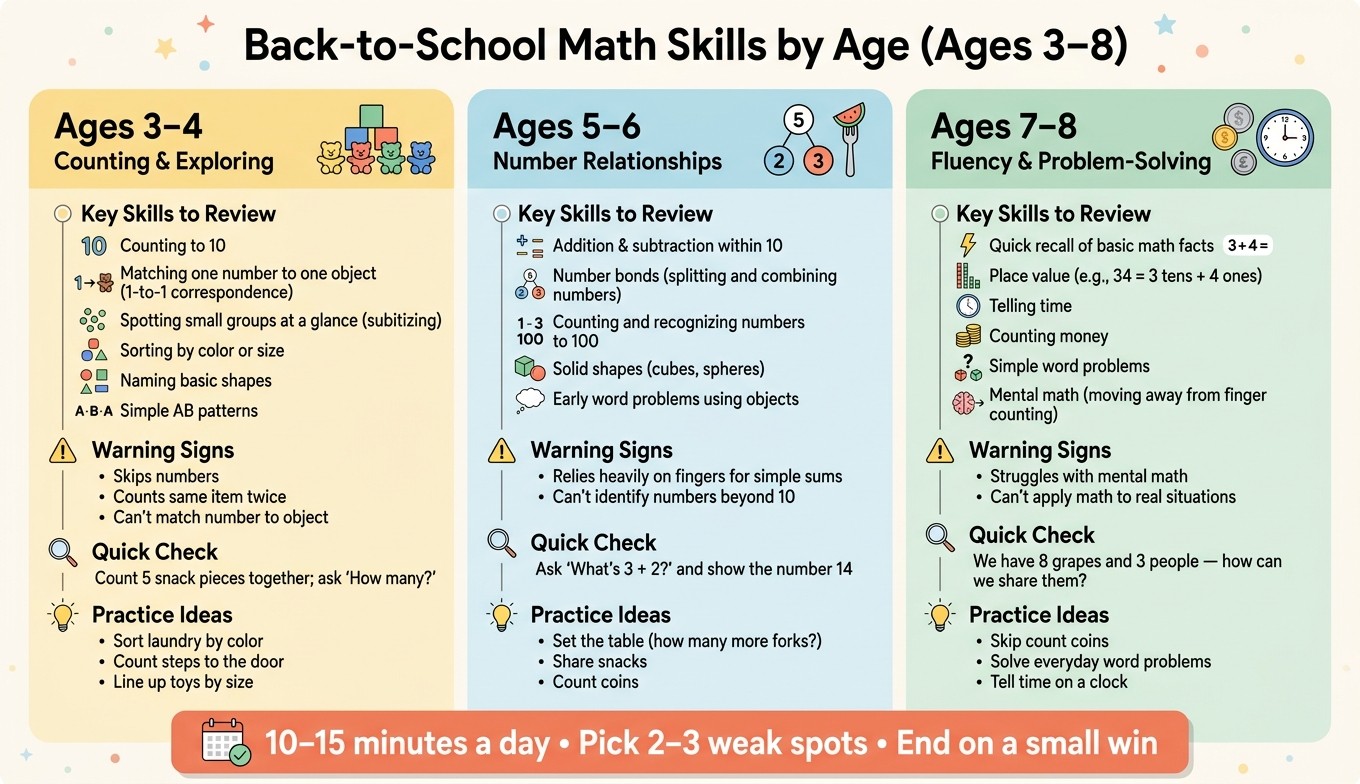
Back-to-School Math Skills by Age: What to Review (Ages 3–8)
Now that you know what faded, match practice to your child's age. Pick 2–3 priority skills that fit where your child is right now.
Ages 3–4: counting, sorting, shapes, and simple patterns
At this age, focus on counting to 10, matching one number to one object, and spotting small groups without counting. If counting objects still feels shaky, start there first.
Keep practice hands-on and simple. Count, sort, name shapes, and make easy patterns with things you already have at home. You can sort laundry by color, count the steps to the front door, or line up toy cars by size. For patterns, make a basic AB sequence with two colors of cereal and ask your child to keep it going. For shapes, ask them to find something round or rectangular in the room.

A sorting task for ages 3-4 in the Funexpected Math app
As children get closer to 5 and 6, the focus starts to shift from spotting numbers to seeing how numbers work together.
Ages 5–6: number relationships and early operations
If your child still uses fingers for simple sums, that's okay. Keep practice centered on addition and subtraction within 10. The goal is to build number relationships, not push speed.
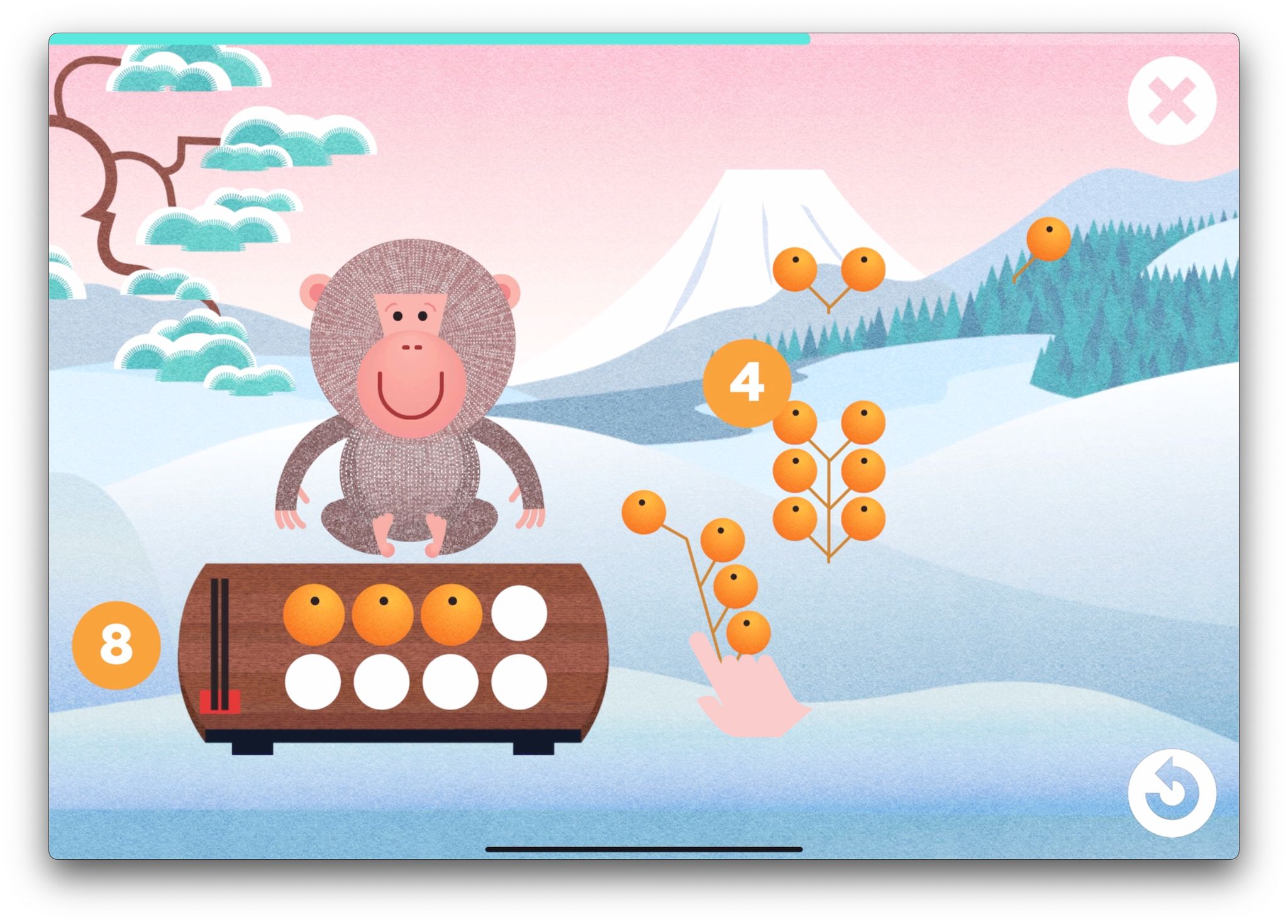
Addition within 10 in ‘Monkey’ game (Funexpected Math app)
Use forks, snacks, and toys to show that numbers can be split apart and put back together.
Setting the table is an easy math moment: we need 5 forks, and 3 are already out - how many more do we need? Sharing snacks works the same way. This is also a good time to keep working on numbers to 100 and introduce solid shapes like cubes and spheres.
By ages 7 and 8, the goal shifts again. Now it’s less about counting out every answer and more about solving with less effort.
Ages 7–8: fact fluency, place value, and simple word problems
At this stage, focus on quick recall of basic facts, place value, and word problems. A child here should start seeing 34 as 3 tens and 4 ones, and begin moving from finger counting to working through answers in their head. If you feel like your kid’s understanding of place value is shaky, try refresh it with this video:
Short practice tied to daily life works well. Try skip counting coins, talking about money, telling time, or solving quick word problems based on everyday situations. Two short sessions a week can keep skills moving without making it feel like too much.
Build short daily math routines that fit family life
Once you know where the gaps are, turn one daily routine into a bit of math practice. Stick to the two or three skills you picked out above. That keeps this feeling like a back-to-school reset, not more school piled on at home.
Keep sessions to 10–15 minutes and end on an easy win
Pick one time each day and keep it short: 10 to 15 minutes is enough. A small routine works better than a long session that drags on.
Try to end with something your child can do with ease. That small win matters. It helps them leave the session thinking, I can do this, which makes tomorrow much easier.
Use everyday moments for counting, comparing, and problem-solving
Use the moments you already have. Math practice doesn't need a desk, a workbook, or a big setup. A few minutes during chores, meals, or car rides can do the job.
Pick the examples that fit your child's age and the skills you found above.
Activity | Practical Example | Math Skill |
|---|---|---|
Daily chores | Sorting laundry by family member or color | Sorting and classifying |
Meal prep | Measuring flour or counting eggs for a recipe | Measurement and counting |
Car rides | Spotting shapes in road signs or counting red cars | Geometry and counting |
Outdoor play | Jumping on sidewalk chalk numbers | Number order |
Brushing teeth | Counting seconds while brushing | Time and sequencing |
Lower math stress with praise, choice, and playful repetition
Keep the tone light. No pressure, no long lectures. A little praise goes a long way, especially when your child is rusty or hesitant.
Small choices can help too. Let them pick between two activities, choose the color of the chalk, or decide whether to count toys or snack crackers. And if they ask to do the same game again, that's fine. Repeating a favorite activity can help build confidence without making practice feel heavy.
If you want more variety, the next section shows hands-on, printable, and app-based options.
Choose hands-on, printable, or app-based practice
Once you know what to review, pick the format that matches your child’s energy and the skill you want to work on. Some days call for movement and play. Other days are better for a short worksheet or a few minutes on a tablet. A tired preschooler usually does better with something light, while a focused 7-year-old may be ready for a bit more structure.
Choose the format that fits your child’s age, attention span, and the skill you want to review.
Format | Best Use | Time Needed | Supervision | Age Fit |
|---|---|---|---|---|
Hands-on Play | Introducing new skills | 5–15 mins | High (parent-led) | Ages 3–6 |
Printable Practice | Number tracing, matching sets, school readiness | 10–15 mins | Medium | Ages 5–8 |
App-based Review | Independent review | 10–15 mins | Independent | Ages 3–7+ |
Start with the format that lines up best with your child’s age and attention span.
Hands-on play with toys, blocks, and snacks
Hands-on play is often the easiest place to start. Use toys, blocks, fruit, or crackers to count, sort, make patterns, and play simple take-away games. It feels more like play than “doing math,” which is half the battle with younger kids.
Shape hunts around the house also work well for ages 3–5 and need almost no prep. Ask your child to find something square, then something round. It’s simple, but it gets them noticing math in everyday life.
Printable pages and book-based review
Paper practice starts to make sense once a child is comfortable holding a pencil. Tracing numbers, matching a group of drawn objects to the right numeral, or finishing a short shape-sorting page helps kids get used to the kind of work they’ll see in school.
Get a free set of printable worksheets from Funexpected Math.
You can also pair printables with a counting book or a simple math read-aloud. That gives you reading and math in one sitting, which can be a nice two-for-one when time is tight.
App-based practice with step-by-step support
App-based practice is a good fit for independent review, especially when you want guided practice that adjusts to what faded over summer. Short sessions tend to work best here because they’re easy to repeat during the week.
Funexpected Math is made for ages 3–8 and offers personalized lessons plus guided, age-appropriate practice in math, logic, early coding, and spatial skills.

Learning sessions at Funexpected Math are designed to last exactly 12-15 minutes, which is an optimal timing for daily supportive lessons. A 7-day free trial is available. Monthly subscription is $10.99/month [1].
Use adaptive apps for short review sessions that adjust to your child’s pace. A good format makes practice easier to come back to again and again during the week.
A one-week back-to-school math plan
Once you know where the gaps are and which format works best, use this simple one-week plan. The idea is simple: do one short activity each day for a week to help reset key math skills before school starts.
Pick 2–3 skills and plan one short activity each day
Start by noticing how your child handles everyday tasks like counting out snacks, sorting socks, or setting the table. Those small moments can tell you a lot about which skills need a little review. Then pick two or three skills to work on during the week. Good places to start are counting and number recognition, shapes and sorting, or simple addition and subtraction. Keep each session to 10–15 minutes.
Stick with the same target skills for the full week. The only thing that changes is the activity format.
Day | Format | Activity | Skill Focus |
|---|---|---|---|
Monday | Hands-on | Sort laundry or count snacks | Counting & sorting |
Tuesday | App-based | Short session on Funexpected Math | Quick number recognition |
Wednesday | Printable | Number-bond pages or simple shape pages | Shapes and numerals |
Thursday | Movement | Jump on a floor-tape number line | Addition & subtraction |
Friday | Game or book | Card game or math-themed picture book | Number sense |
Rotate formats to keep practice fresh and hold attention
Rotate formats so practice stays fresh without piling on more skills. A mix of hands-on play, printables, books, and app-based practice can help hold your child’s attention through the week. If your child clearly likes one format more, lean into it. That’s fine. The point is steady practice without pressure.
Aim for confidence, not perfection
This week is about confidence, not perfection. Praise effort more than accuracy. A little repetition, done in a low-pressure way, can help your child feel more comfortable with math again.
FAQs
How do I know if my child needs a math reset?
Look for trouble with age-appropriate skills, such as:
counting in order
matching numbers to quantities
recognizing basic patterns
using simple math in everyday situations
Other signs can show up in small, everyday moments. A child may still rely on fingers for simple addition, have a hard time copying symmetrical shapes, or start avoiding math altogether. Some kids also make negative comments about math, which can be a clue that the subject feels stressful or frustrating to them.
What if my child resists math practice at home?
Keep math practice low-pressure and upbeat. Put the focus on effort, not just getting the right answer. Short sessions of 10–15 minutes often work best because they help kids practice without feeling worn out.
It also helps to make math feel useful in everyday life. Tie it to your child’s interests whenever you can. If they like sports, use scores and stats. If they like baking, talk through measurements. That small shift can make practice feel less like a chore and more like something that fits into their world.
Mistakes matter too - but not in a bad way. Treat them as part of the learning process, not proof that your child “isn’t good at math.” A wrong answer can open the door to a better way of thinking.
If your child still pushes back, change the format. Hands-on activities, games, and interactive digital tools can make practice feel more inviting and less like sitting down for another worksheet.
When should I worry that my child is behind in math?
Pay closer attention if your child keeps having trouble with counting in order, spotting basic patterns, understanding math families, doing mental math, or using math in day-to-day situations.
It also matters if your child often avoids math or talks about it in a negative way. When these struggles keep showing up, it may be time to talk with your child’s teacher or look into a professional evaluation.
Related Blog Posts
Transform Math Learning for Kids
Explore Funexpected's interactive math program designed for children aged 3-7. Build math fluency, logic, and problem-solving skills through engaging, hands-on activities and a personalized digital tutor.