Scaffolding in Education: How to Support Children’s Learning Step by Step
Early Childhood Education
Jun 6, 2026
Practical scaffolding tips for parents of 3–7 year olds to build confidence, independence, and early math skills through guided steps.

Scaffolding in education means giving just enough support to help a child learn or complete a task they can't yet do alone. It’s like building a bridge between what they already know and what they’re ready to learn. Over time, you gradually reduce the help as they gain confidence and independence.
Why It Matters
Scaffolding encourages problem-solving and resilience.
Builds confidence and independence.
Strengthens life skills like focus and decision-making.
Helps kids view mistakes as part of learning.
Key Tips for Parents
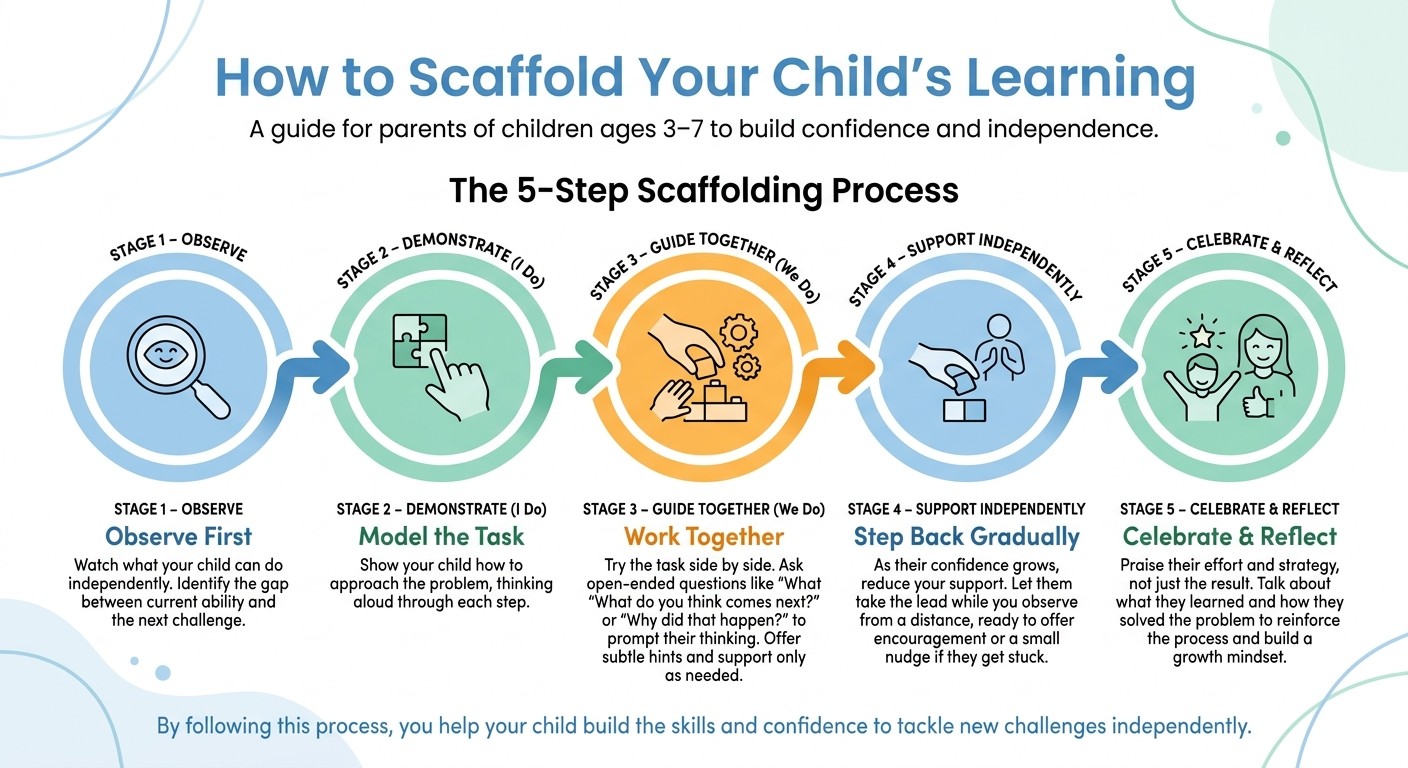
Observe first: See what your child can do independently.
Offer help in small steps: Guide them without taking over.
Use questions: Ask open-ended questions like, "What do you think will happen if we try this?"
Step back gradually: Let them take the lead as they improve.
Everyday Examples
Play: Guide them in building a block tower by asking, "Which block goes on the bottom?"
Routines: Break tasks like getting dressed into steps and let them handle what they’ve mastered.
Math: Count items together or sort objects by color or size.
Avoid These Mistakes
Jumping in too quickly to fix problems.
Giving answers instead of letting them figure it out.
Missing signs of frustration - simplify tasks if needed.
Digital Tools
Apps like Funexpected Math use scaffolding by adjusting tasks to your child’s skill level, offering guiding questions and hints, and breaking challenges into smaller steps. Pairing digital tools with hands-on activities at home can reinforce learning.
By balancing support and independence, scaffolding helps children grow into confident, capable learners. It’s about being there when needed and stepping back when they’re ready.
What Scaffolding Is and Why It Matters
Scaffolding in Simple Terms
Scaffolding is all about offering short-term, focused support to help a child achieve something they couldn’t quite do on their own - yet. Think of it as a bridge that connects what your child already knows to what they’re ready to learn, with your guidance helping them cross.
This concept ties directly to Vygotsky's classic Zone of Proximal Development (ZPD) framework, which highlights how children grow when faced with challenges that are just the right level of difficulty - not so easy that they lose interest and not so hard that they feel frustrated and anxious.
A practical example of scaffolding is the "I Do, We Do, You Do" approach. First, you demonstrate the skill. Then, you work on it together. Finally, you step back and let your child take the lead. This gradual reduction of support not only helps them master specific tasks but also encourages broader developmental growth.
How Scaffolding Supports Child Development
Scaffolding doesn’t just help kids complete tasks; it helps shape essential life skills. By working through challenges with guidance, children build reasoning, improve communication, and gain confidence. Instead of simply being handed solutions, they learn to problem-solve and develop the resilience to try again when things don’t go as planned.
This approach also strengthens the bond between you and your child. As Dr. Lindsay Katz, Pediatric Neuropsychologist at Cleveland Clinic, explains:
"Scaffolding builds stronger relationships because it creates a positive, safe environment to grow in." [1]
Feeling supported but not overly shielded encourages kids to tackle challenges head-on. This sense of security lays the groundwork for more profound emotional and cognitive benefits down the road.
The Psychological and Cognitive Case for Scaffolding
The benefits of scaffolding go far beyond helping with day-to-day tasks. Offering the right level of challenge helps form neural pathways that improve planning, focus, and emotional regulation. Research suggests that children whose parents use scaffolding techniques tend to develop stronger executive functioning skills, which are crucial for problem-solving and decision-making. [2]
Another key benefit? Scaffolding changes how kids see failure. Instead of viewing mistakes as something to fear, they start to see them as a natural and necessary part of learning. This mindset builds resilience, or the ability to bounce back and keep trying. Harold S. Koplewicz, MD, President of the Child Mind Institute, highlights the downside of skipping this process:
"The irony of swooping in is that parents believe they're helping their kids by preventing pain. But what they're actually preventing is growth." [3]
The goal of scaffolding isn’t to make life easy for your child. It’s to make the right challenges achievable - and then gradually step aside to let them take ownership of their growth.
Scaffolding Children's Learning
Key Principles of Scaffolding for Parents
Scaffolding in Education: The Step-by-Step Support Framework for Parents
Build on What Your Child Already Knows
Start by observing your child as they try to tackle a task on their own. This helps you pinpoint what they’re already confident in and where they start to face challenges. That gap - between what they can do independently and what they can’t do yet - is where scaffolding works best.
One effective way to uncover what your child knows is by asking "I wonder" questions - open-ended prompts like, "I wonder what would happen if we put the big block on top?" These types of questions encourage curiosity and provide insight into their thought process without directing them toward a specific answer. As BabySparks explains:
"A key to scaffolding is asking yourself this question: What am I doing for my child that she is developmentally prepared to do on her own?" [4]
To make new ideas more accessible, try connecting them to things your child already enjoys - whether it’s a favorite game, a daily routine, or a beloved storybook character. This approach makes unfamiliar concepts feel less intimidating and easier to grasp.
Give Just Enough Help, Then Step Back
The goal of scaffolding isn’t to make tasks easy but to make them just within reach. Offer a small hint, ask a guiding question, or give a quick demonstration, then step back and let your child take the reins. If they make a mistake, avoid correcting them outright. Instead, follow up with a question that gently steers them toward the right answer by drawing on what they already know. [5]
Research suggests that children learn and explore more effectively when parents provide hints and ask questions, rather than offering detailed, step-by-step instructions. [6] As your child becomes more confident in their abilities, your support should gradually fade. This slow withdrawal helps build independence. Breaking tasks into smaller steps can also make this process smoother and more empowering for your child.
Break Tasks into Smaller Steps
Big tasks can feel overwhelming, but breaking them into smaller, manageable steps makes them easier to handle. The key is progression: don’t move on to the next step until your child has mastered the current one. [1]
For instance, when teaching early counting, you might start by having your 4-year-old touch each item as they count - starting with three items, then five, and eventually ten.[7] Each small success builds their confidence for the next step. This approach works for everyday tasks too, like getting dressed or washing hands.
Narrate the sequence ("First socks, then shoes") and gradually let them take over each part as they become more capable. [8]
"The goal is never to do it for them. It's to help them do it themselves." - Dana Alqinneh, Early Childhood Educator [7]
These principles lay the groundwork for using scaffolding techniques in daily life, helping your child grow and thrive.
Scaffolding Strategies Parents Can Use Every Day
Scaffolding Through Play
Playtime is one of the best opportunities for scaffolding - it’s natural, fun, and doesn’t require fancy toys or a rigid plan. The trick is to engage as a partner, not take over as the boss. Start by observing and letting your child explore on their own before stepping in.
For instance, if your child is struggling to build a block tower, resist the temptation to fix it for them. Instead, ask a simple question like, "Would the big block or the small block work better at the bottom?" This keeps the focus on their problem-solving while easing frustration. In pretend play - like setting up a grocery store - you can break it into steps: gathering items, setting up checkout, and practicing how to "pay." Tackling one step at a time helps your child feel accomplished and keeps their interest alive.
If their enthusiasm dips, switch things up while sticking to the same goal. For example, if they’re learning to sort shapes with blocks but lose interest, try sturdy cardboard boxes or board books to present the same concept in a new way.
These playful methods effortlessly blend into everyday routines, creating even more chances for learning.
Using Daily Routines to Build Life Skills
Daily routines are packed with opportunities to scaffold life skills. Activities like handwashing, dressing, and mealtimes follow natural sequences that children can gradually learn to manage on their own.
Take handwashing as an example. Start by explaining why it’s important and showing them the steps. After doing it together a few times, encourage independence by asking guiding questions like, "What do we do first?" This helps them remember and take ownership of the routine.
When helping your child get dressed, break it into smaller steps - like choosing a shirt, pulling it over their head, and finding the armholes. Let them handle the parts they’ve mastered, stepping in only when needed.
At mealtimes, you can teach skills like pouring by modeling how to hold a small pitcher with two hands. Begin with hands-on guidance, then shift to verbal prompts, and finally let them try independently. Over time, they’ll gain confidence and take on these tasks without your help.
Teaching Early Math at Home
Scaffolding can also make early math concepts part of your child’s daily life. Sorting activities are a great way to start. Encourage your child to group similar items, like separating yellow toy cars from red blocks or arranging shoes by size. These simple tasks build the logic skills needed for more advanced math later.
Counting becomes more engaging when tied to real-world actions. Count spoonfuls while cooking or steps while going upstairs. Begin by counting together, then gradually let your child take the lead as they become more comfortable.
For shapes, go beyond asking, "What shape is this?" Instead, ask, "How do you know it’s a square?" This encourages reasoning instead of simple memorization.
"Children gain a sense of 'I did it!' not because someone did it for them, but because someone believed they could and helped them get there." - Dana Alqinneh, Early Childhood Educator
Baking is another way to weave math into everyday life. Start by guiding your child through measuring one ingredient at a time. Once they’re comfortable, move on to mixing and following the full recipe. This gradual shift from simple to complex mirrors how scaffolding supports their growing independence.
Digital Scaffolding with Funexpected Math
The hands-on strategies we've mentioned above - like asking guiding questions, breaking tasks into steps, and stepping back at the right time - can also work beautifully in digital learning when paired with the right tools. Funexpected Math takes these scaffolding principles and integrates them seamlessly into its design, offering an interactive way for kids to explore math concepts.
How Funexpected Math Uses Scaffolding
The app features an AI tutor named Aika, which tailors each child's learning experience in real time.

Aika, the digital tutor in the heart of the Funexpected Math app
Aika continuously assesses what a child can handle and adjusts the difficulty of tasks to keep them in their Zone of Proximal Development. This means kids are always challenged, but never overwhelmed.
When they hit a tough spot, Aika provides hints - visual or auditory - that nudge them toward the solution without simply giving it away:
Tasks are broken into smaller, manageable steps, and new skills are introduced through interactive demonstrations before kids try them on their own. These digital techniques mirror traditional scaffolding strategies, ensuring learning happens both on and off the screen.
Scaffolding Feature | How It Works in Funexpected Math |
|---|---|
Adaptive Difficulty | Learning program adjusts in real time to match the child’s current skill level. |
Hints & Clues | Offers prompts to guide the child without revealing the answer. |
Chunking | Breaks complex concepts into smaller, more approachable missions. |
Modeling | Demonstrates how to use digital tools before asking the child to try. |
Feedback Loop | Provides immediate feedback to confirm correct actions or gently correct errors. |
Funexpected Math covers 50+ math topics across six tracks, including numeracy, logic, spatial reasoning, and even algorithms and early coding. With 675 lessons and 10,000+ tasks, it offers variety without pressure - there are no time limits or competitive rankings. This creates a low-stress environment where kids can build confidence while staying engaged.
Combining Parent Support with Funexpected Math
The app works best as part of a balanced routine. For example, you could aim for 10–15 minutes of daily app practice alongside 30 minutes of weekly hands-on math activities like cooking, building, or sorting. This combination keeps screen time purposeful while reinforcing concepts through real-world experiences.
The parent dashboard is a handy tool for tracking progress. Reports can highlight areas where your child might need extra support. If spatial reasoning tasks in the app seem challenging, you could introduce physical blocks or shape puzzles at home. You can also incorporate math vocabulary from the app - words and concepts like pattern, symmetrical, or more than - into everyday conversations, whether during meals or car rides. This back-and-forth between digital and physical learning helps solidify understanding far more effectively than relying on one method alone.
"Scaffolding is the middle path... You're not hovering. But you're not gone, either. You're offering presence, not pressure." - Hannah Reed, MS, LPC, RPT™ [9]
This balance is just as important in digital learning. For instance, when Aika provides a hint, you can join your child and think aloud together: "Hmm, the hint is showing a bigger shape - maybe we need to find something that fits inside it." Sharing your reasoning aloud turns a solo activity into a collaborative moment, helping your child internalize problem-solving skills while making the experience more engaging.
How to Avoid Over-Helping and Common Mistakes
While effective scaffolding is essential, it's just as important to steer clear of habits that can unintentionally hinder a child's ability to learn independently. Even with the best intentions, parents sometimes cross the line from guiding to overstepping, which can hold back a child's growth.
Doing the Task for the Child
One of the most common mistakes is stepping in too quickly to solve a problem - what experts often call over-assisting. While it might seem helpful to jump in when a child struggles, this can send the wrong message: that they aren't capable of overcoming challenges on their own. Over time, this can chip away at their confidence and willingness to try.
"The irony of swooping in is that parents believe they're helping their kids by preventing pain. But what they're actually preventing is growth." - Harold S. Koplewicz, MD, President of the Child Mind Institute [3]
Instead of taking over, try modeling the task first. Show your child how to approach the problem, talking through each step as you go. Then, give them the chance to try it themselves. A simple pause - letting them work through it - can make all the difference in building their problem-solving skills.
Giving Answers Too Quickly
Another frequent misstep is providing answers before the child has had time to think. While it’s tempting to jump in with a solution, this robs them of the chance to explore and learn from the process. Children often need a moment to process a question or figure out visual cues on their own [4].
Instead of saying, "This piece goes here" or "Try it like this," encourage their curiosity with open-ended questions. For example, ask, "What do you think might happen if you turn it another way?" or "What part do you think is tricky right now?"
"Scaffolding isn't providing answers or just doing the task yourself. The assistance you offer should be aimed at developing the child's skillset so they can eventually transition to independence." - Lindsay Katz, PsyD, Pediatric Neuropsychologist, Cleveland Clinic [1]
The key is to balance your guidance with opportunities for the child to explore on their own.
Missing Signs of Frustration
Recognizing when a child is frustrated is just as important as knowing when to step back. It’s essential to differentiate between a productive struggle - where the child is still learning - and overwhelming frustration, where they may shut down. Signs of genuine frustration include clenched hands, tears, withdrawal, or repeatedly trying the same unsuccessful approach [3].
If you notice these signs, don’t take over completely. Instead, simplify the task or break it into smaller steps. You could ask, "Should we try it this way or take it one step at a time?" Validating their feelings is also crucial. Saying something like, "I can see you're worried this might not work" acknowledges their emotions and helps reduce stress, keeping the challenge manageable without removing it entirely.
Conclusion
Scaffolding provides temporary support for your child until they're ready to handle tasks independently. As they gain confidence and skill, you gradually step back, allowing them to grow stronger and more self-reliant.
This approach not only develops practical abilities but also nurtures important life skills. The key is finding the balance between offering help and encouraging independence. Whether you're guiding a preschooler through buttoning a shirt, sparking curiosity during a bedtime story with "I wonder what happens next?", or sitting with them as they tackle an early math problem, these small, intentional moments add up to meaningful growth.
"Scaffolding is how adults support children's development and learning by offering just the right help at just the right time in just the right way." - Linda Groves Gillespie and Jan D. Greenberg, Early Childhood Specialists [10]
In the digital age, tools like Funexpected Math can extend this kind of support. Designed for children ages 3–7, the app offers over 10,000 tasks and a personalized digital tutor that adapts to your child’s current abilities. This individualized pacing mirrors the essence of scaffolding - meeting your child where they are and guiding them forward. Whether through daily interactions or digital tools, scaffolding sets the stage for independence and confidence.
As Justine Marie Bruyère, Ph.D., Lecturer at Vanderbilt University, explains: "The more intentional we are about scaffolding learning at home, the more dramatic the results will be, both at home and in the classroom." [11] Focus on steady progress, embrace curiosity, and gradually ease your support as your child achieves each new milestone.
FAQs
How do I know when to step in versus wait?
When your child is working on a task, start by watching how they handle it on their own. If they seem stuck or frustrated, step in, but keep your help minimal and focused. Instead of taking over, try offering hints or breaking the task into smaller, manageable steps. As they build confidence, gradually pull back your support to help them become more independent. The aim is to guide them through the process, not to solve the problem for them.
What if my child gets upset during “productive struggle”?
It's perfectly natural for kids to feel frustrated during moments of productive struggle. The key is to create an environment where they feel emotionally safe. Stay calm and offer reassurance. If their frustration starts to build, take a moment to acknowledge their feelings. You might give them a small hint to guide them or step back for a bit to let them process on their own. Another option? Switch to a different activity for a while. You can always revisit the challenge later when they’re feeling more confident and ready to tackle it again.
How can I scaffold without creating dependence?
To provide effective support without fostering dependence, think of yourself as a temporary guide rather than a long-term crutch. Start by assessing what your child can handle independently and identifying areas where they face challenges. Break tasks into manageable steps, offering just enough assistance to keep them motivated and on track. Resist the urge to step in and do the work for them - this can hinder their development. As they gain confidence and skills, gradually step back, giving them the opportunity to fully take charge of the task.
Related Blog Posts
Transform Math Learning for Kids
Explore Funexpected's interactive math program designed for children aged 3-7. Build math fluency, logic, and problem-solving skills through engaging, hands-on activities and a personalized digital tutor.