5 Best Math Apps for Preschoolers - Updated for 2026
Early Childhood Education
Jan 14, 2026
Explore five engaging math apps for preschoolers that make learning fun and effective, covering key concepts from counting to basic operations.

Want to help your preschooler build math skills while having fun? These five apps are designed to make early math learning engaging and effective for kids aged 3–8. From interactive games to playful stories, these apps cover key math concepts like counting, shapes, patterns, and basic operations. Here’s a quick breakdown of what each app offers:
Funexpected Math: Over 10,000 tasks and a digital tutor that adapts to your child’s level and pace. ($64.99/year, ad-free)
Todo Math: Customizable settings and one of the few apps suitable for special needs. ($69.99/year)
Fiete PlaySchool: A lesser-known but well-made app focused on STEM basics. ($34.99/year)
Khan Academy Kids: Free, interactive app with 5,000+ lessons. (Free)
Splash Math: A quality app well-aligned with school curricula. ($59.99/year)
Quick Comparison
App | Age Range | Key Features | Cost |
|---|---|---|---|
Funexpected Math | 3–7 | Personal digital tutor, adaptive lessons, visual aids, immersive storytelling | $10.99/month or $64.99/year |
Todo Math | 3–8 | Customizable settings, special needs | $69.99/year |
Fiete PlaySchool | 5–10 | Curriculum-based courses focused on STEM | $6.99/month or $34.99/year |
Khan Academy Kids | 2–8 | 5,000+ lessons on math basics, offline mode | Free |
Splash Math | 3–8 | Compliant with the school program | $9.99/month or $59.99/year |
These apps combine learning with play, helping preschoolers develop confidence in math during their critical early years. Keep reading to find the perfect app for your child!
1. Funexpected Math
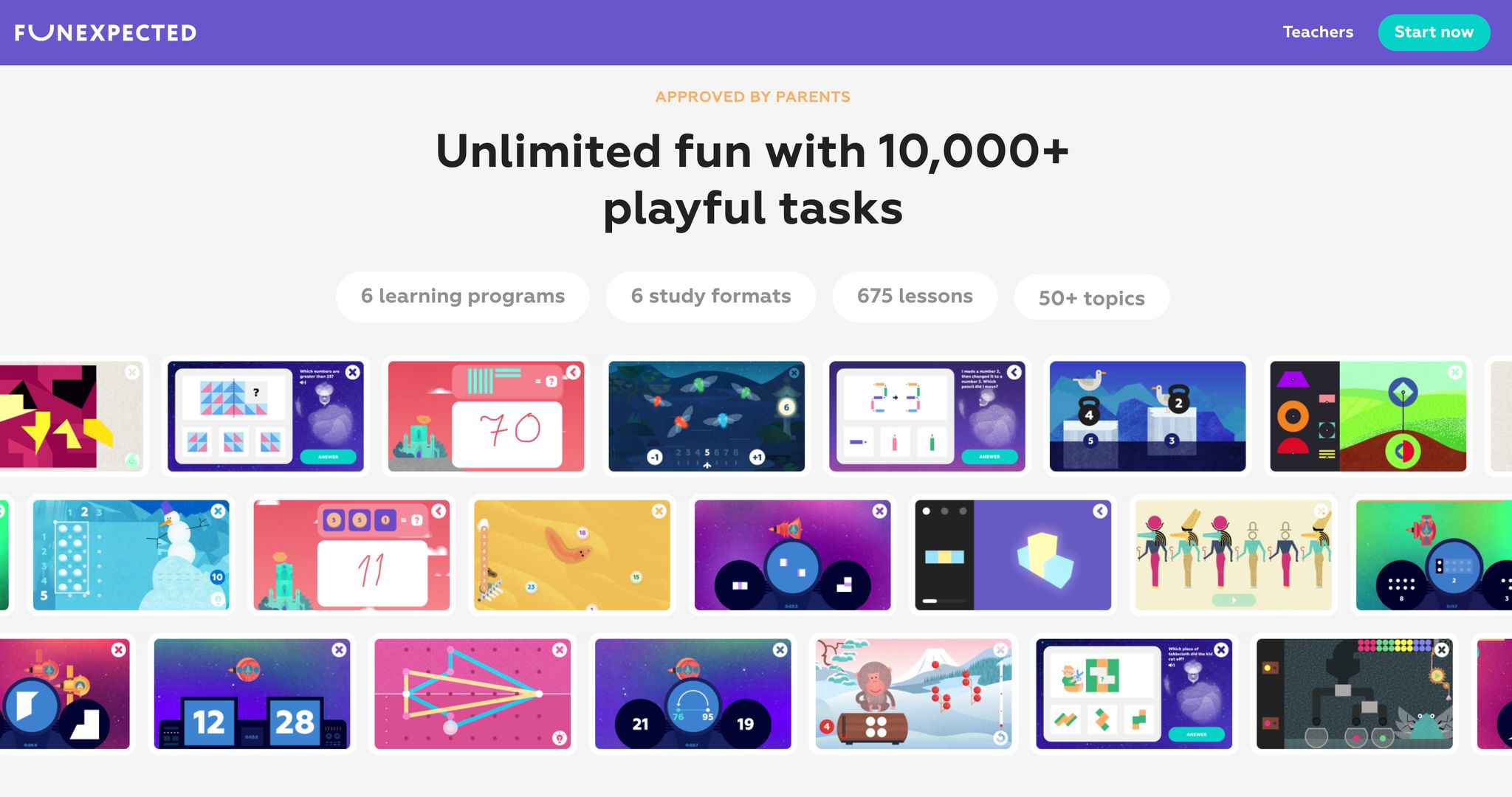
Funexpected Math is a learning app tailored for kids aged 3–7, focusing on early math skills through interactive and engaging activities. Its curriculum adjusts to each child's abilities, making learning both effective and enjoyable.
The app offers more than 10,000 tasks spread across 675 lessons, covering key math concepts for different age groups:
Age Group | Focus Areas |
|---|---|
3–4 years | • Recognizing numbers |
5–6 years | • Addition and subtraction techniques |
6–7 years | • Understanding place value |
One standout feature is the app's digital tutor, which adapts to each child's learning pace. It provides guidance and hints, ensuring a personalized experience that builds confidence.

Aika, the digital tutor within the Funexpected Math app
Educators have praised its effectiveness. Eric, a STEM teacher at Academy at the Lakes, shares:
"This app provides an engaging math learning experience without being too much of a game or just a digital worksheet. The kids love Funexpected and often ask if they can play math during free time" [3].
Studies show that children using Funexpected Math advance in their math skills three times faster than with traditional methods. Just two 15-minute sessions per week lead to noticeable improvements [4][5]. The app's use of visual aids and storytelling helps make abstract ideas easier to grasp, while fostering a safe space to experiment and learn from mistakes.
Funexpected Math has earned several awards, including the Kidscreen award, EdTech Breakthrough award, and Webby People's Choice award [3]. Its ad-free design, support for 16 languages, and fun "talking buddies" celebrating a child’s achievements make it a hit with both kids and parents worldwide.
There’s also a Funexpected Math YouTube channel, offering engaging math lessons for kids aged 3-7.
Each lesson ends with a catchy song helping a child to memorize the topic.
2. TodoMath

Todo Math is designed to build foundational math skills with an accessible approach. Developed with diverse learners in mind, it provides customizable settings to support children with different learning needs[6].
Todo Math have structured yet playful design. It encourages daily practice in a stress-free way.
Here’s a quick look at its standout features:
Feature | How It Helps |
|---|---|
Daily Math Challenges | Reinforces key concepts with bite-sized, structured practice |
Multiple Learning Modes | Supports diverse learning styles, including visual, auditory, and kinesthetic learners |
Progress Tracking | Allows parents to monitor skills development over time |
Accessibility Features | Includes dyslexia-friendly fonts and left-handed mode |
Offline Access | Makes learning possible anytime, anywhere |
These tools create a fun and effective way for preschoolers to improve their math skills.
What makes TodoMath different? It is one of the few math apps designed with special education in mind, offering features that support neurodivergent learners, including those with dyslexia and ADHD.
As well as Funexpected Math, the app focuses on mastery through play, with challenges that adapt to each child's progress.
Todo Math follows Common Core Standards and covers a wide range of topics, from counting and number tracing to early algebraic thinking[7].
With its research-backed approach and focus on accessibility, Todo Math provides a supportive, engaging way for kids to develop essential math skills[7].
Its adaptive technology tracks progress, adjusts support, and targets problem areas - delivering a personalized learning experience in a fun, interactive setting that preschoolers love[6].
3. Fiete PlaySchool
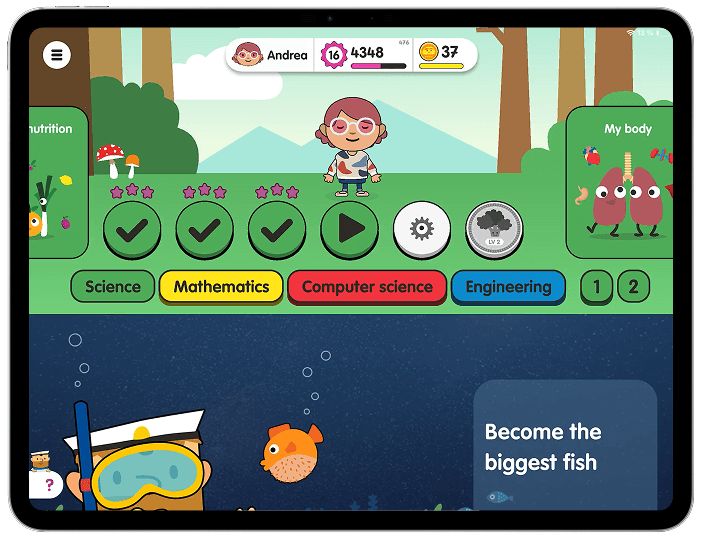
Fiete PlaySchool is a lesser-known but well-made app designed to make learning engaging and playful for children, with a focus on early STEM skills including mathematics, science, and technology. The app uses interactive mini‑games and guided courses to help children understand foundational concepts through exploration and play rather than rote memorization. [8]
The learning content in Fiete PlaySchool is curriculum‑based and aligned with official primary school standards, and children progress along learning paths where they can unlock badges after completing child‑friendly challenges. The app emphasizes learning through play, allowing children to experiment freely and explore topics at their own pace, which supports creative thinking and problem‑solving. [8]
Fiete PlaySchool is designed for children aged approximately 5–10, providing age‑appropriate challenges that build basic skills in areas like mathematics and broader STEM learning. [9] It is offered as an ad‑free and child‑safe environment with a subscription model that includes a free trial, ensuring a learning space without advertising or hidden in‑app purchases.
The app also encourages the development of future‑focused skills such as creativity, critical thinking, self‑confidence, and resilience, and digital badges help motivate children as they progress.
4. Khan Academy Kids
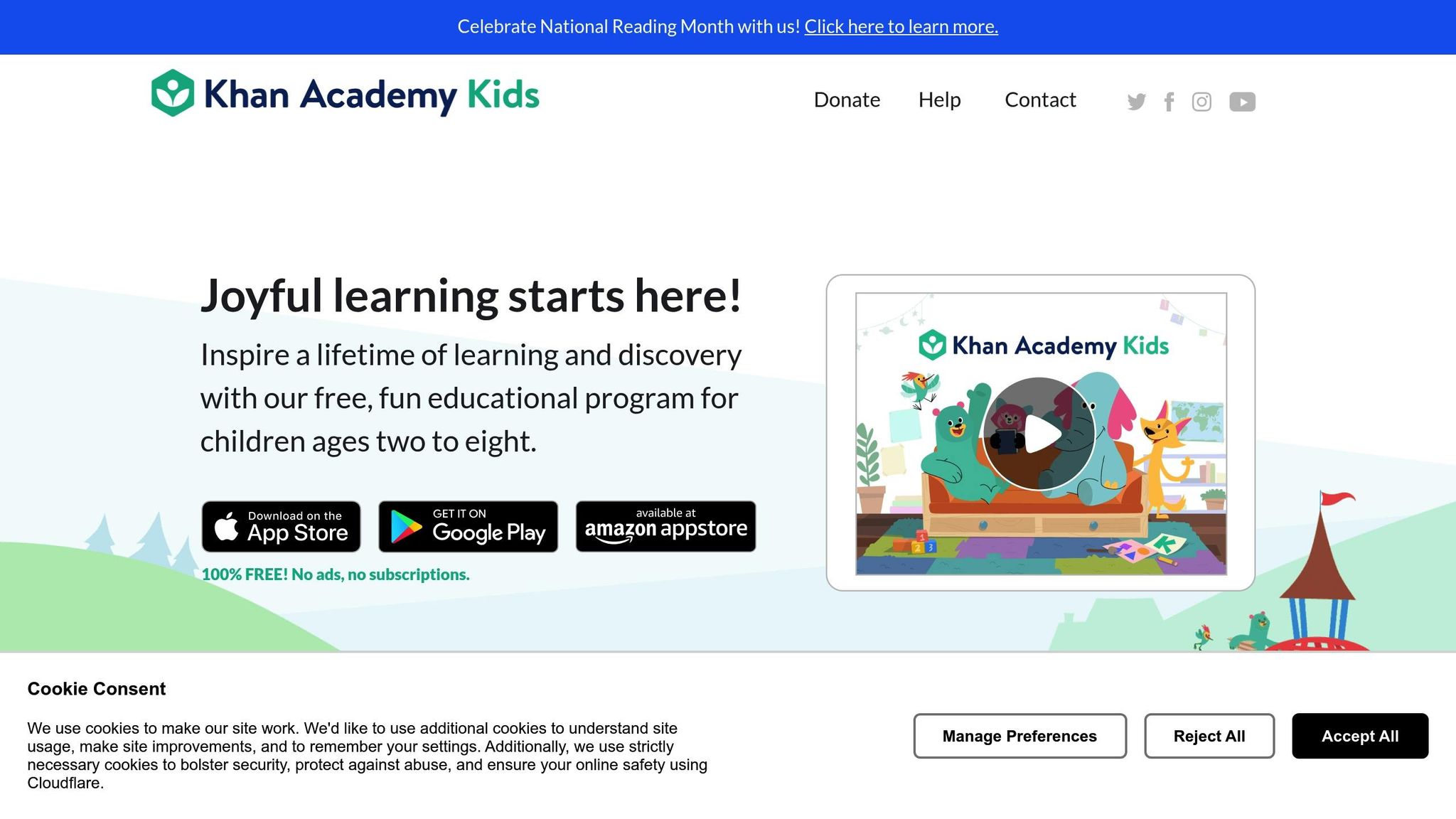
Khan Academy Kids is a free math app designed for children aged 2–8. With over 5,000 lessons and a 4.7-star rating from more than 49,300 reviews on Google Play [10], it offers a rich and engaging way for kids to learn math.
The app uses interactive activities led by fun characters like Kodi the Bear to teach essential math skills. Here's how it helps:
Math Concept | Learning Activities |
|---|---|
Number Recognition | Counting games and number tracing |
Shapes & Patterns | Shape sorting and interactive recognition |
Memory Skills | Memory puzzles |
The app adjusts to each child's pace using adaptive technology, ensuring lessons are tailored to their individual needs [11].
"Our personalized learning path dynamically adapts, ensuring each child is presented with activities, books, educational videos, and creative lessons that allow them to learn at their own pace, creating an individualized experience for every learner." – Khan Academy Kids [11]
Developed with input from Stanford experts, the app aligns with Head Start and Common Core Standards. It also works offline, offering access to books and games without an internet connection [10].
Parents often praise the app's impact. J. Hernandez shared on Twitter:
"Every day I am amazed @khanacademykids is free, and I am so grateful for how much it has contributed to my kid's development." – J. Hernandez [11]
With over 5 million downloads, Khan Academy Kids - created by the experts at Duck Duck Moose, known for 22 award-winning preschool games - has become a trusted resource for early math education. While some activities may require parental involvement, the app's extensive library makes it easy to find content suited to your child's age and skill level.
5. Splash Math

Splash Math is an award-winning educational app designed to make learning math enjoyable for children from Pre-K to Grade 5. With over 1,900 curriculum-aligned math games and activities, the app offers a learning experience that adapts to each child's skill level [12].
Core Features and Learning Approach
Splash Math offers a comprehensive K–5 curriculum, covering key concepts in math through interactive lessons, quizzes, and skill-building games. Similar to Funexpected Math app, SplashLearn features an AI-powered adaptive system that personalizes the learning experience, adjusting content based on each child's progress.
The math program covers foundational topics such as number sense, arithmetic, geometry, measurement, and data interpretation, ensuring children develop problem-solving skills in a structured way.
Content Structure and Engagement
Splash Math provides a structured, grade-wise curriculum [13]:
Age Group | Key Topics Covered |
|---|---|
2–5 years | Counting, basic addition and subtraction, shape recognition, phonics, and letter tracing. |
6–7 years | Addition and subtraction fluency, place value, simple fractions, sight words, sentence building, and early reading comprehension. |
The app incorporates game-based learning, offering rewards, streaks, and progress tracking to keep kids motivated.
Pricing and Accessibility
Splash Math offers a free version with limited content and several options of premium subscription (1 month, 3 months and annual plans) for full access. It is available on iOS and Android, making it easily accessible for home and classroom learning [14].
Final Thoughts
Interactive apps are transforming early math education. Research suggests they can outperform older teaching methods when they include active learning and meaningful interaction [15].
Here are some practical tips to maximize their effectiveness:
Aspect | Best Practice | Benefit |
|---|---|---|
Screen Time | Set clear limits early | Encourages healthier screen habits [16] |
App Selection | Choose apps that focus on problem-solving | Improves learning outcomes [1] |
Parental Involvement | Guide usage and track progress | Promotes responsible tech use [16] |
Frederick M. Hess highlights an important point:
"The essential question isn't simply whether apps work but rather, for whom and under what conditions they are effective." [17]
Apps offering motivational feedback and adjustable difficulty levels are particularly effective. They not only improve problem-solving skills but also help keep kids engaged [2].
Children using these apps often show growth in problem-solving abilities and greater confidence in math [18]. To get the most out of these tools, monitor your child’s progress, explore math concepts outside the app, and ensure the content aligns with their developmental stage [19]. Every child learns differently, so tailor your approach to their unique needs and engagement levels [1].
Related Blog Posts
Transform Math Learning for Kids
Explore Funexpected's interactive math program designed for children aged 3-7. Build math fluency, logic, and problem-solving skills through engaging, hands-on activities and a personalized digital tutor.