How to Develop Critical Thinking Skills in Kids
Early Childhood Education
May 17, 2026
Age-by-age tips, routines, and activities to teach kids to question assumptions, evaluate evidence, and solve problems.

Critical thinking helps kids solve problems, evaluate information, and make decisions independently. It’s essential for navigating today’s world of misinformation, social media, and complex challenges. Here's what you need to know:
Teach Core Skills: Focus on questioning assumptions, evaluating evidence, logical reasoning, and considering different perspectives.
Practical Tips: Use open-ended questions like "What do you think?" or "How do you know?" Encourage play-based learning with puzzles, strategy games, and hands-on activities.
Age-Specific Prompts: Tailor your approach as kids grow. For example, ask 3-year-olds, "What happens if…?" and 6-year-olds, "What other ways could you try this?"
Daily Routine: Start the day with questions, explore through play midday, and reflect on decisions in the evening.
Common Mistakes: Avoid giving answers too quickly, helping too much, or missing learning opportunities in mistakes.
Key Priorities: Build curiosity, support risk-taking, and use quality digital tools for structured learning.
How To Teach Children Critical Thinking
What to Teach: Core Skills for Critical Thinking
Core Concepts to Teach
Critical thinking rests on four main ideas that kids can grasp at any age: questioning assumptions, evaluating evidence, logical reasoning, and considering alternative perspectives [1].
Start by teaching children to spot when a source might have a hidden agenda. Help them understand the difference between weak evidence, like a personal story about someone recovering from a cold by eating oranges, and strong evidence, such as results from well-designed experiments with fair comparisons. Logical reasoning allows kids to see cause-and-effect relationships, while considering alternatives opens their minds to different viewpoints and solutions.
"Critical thinking isn't just about getting the right answer. It's about raising kids who ask better questions, weigh evidence, and solve problems independently." – Kubrio [2]
Introduce the idea of intellectual humility early on. Show kids that admitting uncertainty and being willing to change their views based on new evidence is a sign of strength [2]. By the time they’re around 10 or 11, most children can understand that strong claims need solid evidence and fair comparisons, not just anecdotes [1]. This aligns with findings from the World Economic Forum, which lists analytical thinking as the most sought-after skill by employers.
It’s important to adapt these concepts to your child’s age and development stage, as outlined below.
Skills by Age Group
Children's brains develop over time, with the frontal lobe - responsible for reasoning and judgment - not fully maturing until their mid-20s [3]. This means parents should tailor their teaching approach to match their child’s cognitive abilities at different ages.
Age Group | Focus Skills | What They Can Do |
|---|---|---|
3–4 Years | Pattern recognition, basic logic | Ask “what happens if“ and "why" questions; recognize basic cause and effect |
5–6 Years | Hypothesis testing, categorization | Compare and contrast concepts; identify patterns |
7–9 Years | Deductive reasoning | Follow logical sequences; explore how things work |
10–13 Years | Evidence evaluation, metacognition | Handle hypothetical scenarios; evaluate argument strengths |
Practical Ways to Build Critical Thinking
Ask Open-Ended Questions
Switch out simple yes/no questions for ones that encourage deeper thinking and explanation. For instance, instead of asking, "Did you have a good day?", try something like, "What was the most interesting thing you did today?" This approach helps kids reflect, analyze, and articulate their thoughts. When they make a statement, follow up with, "How do you know?" to nudge them toward providing evidence instead of just opinions.
You can also try the "Convince Me" game. If your child asks for something, have them give three logical reasons for their request and even a counterargument. For older kids, challenge them to spot persuasion tactics by asking questions like, "Who are these people?", "What do they want?", or "Are they trying to sell something?" Psychologist Laurence Steinberg from Temple University points out that phrases like "Do it because I said so" or "You're not old enough to understand" can discourage kids from questioning things that don’t make sense [1].
These kinds of question-driven interactions naturally pair well with playful learning activities.
Use Play-Based Learning
Play is a powerful way to develop intellectual skills in young children [4]. The trick is to balance structured activities with free play, where kids take the lead in exploring. Open-ended toys, like building blocks, nesting puzzles, or KAPLA and KEVA planks, are great because they can be used in countless creative ways [5]. Even everyday routines can become learning moments - like guessing which toys will float during bath time or sorting items by color, shape, or size [6].
Games that require strategy, such as chess, Scrabble, sudoku, or mazes, are excellent for building logical reasoning and foresight. Show your own curiosity by using phrases like "I wonder…" when tackling challenges together. Letting kids solve puzzles on their own also helps sharpen their problem-solving skills [5].
Use Technology Wisely
While hands-on play is essential, technology can also help kids grasp abstract concepts when used thoughtfully. For example, Funexpected Math offers over 10,000 tasks and 675 lessons across 50+ topics. The app is focused not only on numeracy, but also covers logical reasoning, pattern recognition, algorithmic thinking – everything that is essential for developing critical thinking.

A task on logical reasoning in the Funexpected Math app
Quality educational apps use adaptive technology and multisensory inputs to make abstract ideas more concrete, like allowing kids to rotate geometric shapes to understand spatial relationships. These kinds of tasks encourage the same analytical and adaptive thinking skills fostered by questioning and play.
Research published in School Psychology Review found that using a progress monitoring tool improved math performance by 14% among 3rd and 4th graders.
To make the most of screen time, you can sit with your child and encourage discussions about what they’re learning. For older kids, introduce the SIFT method: Stop (especially when content stirs strong emotions), Investigate the source, Find better coverage, and Trace claims back to their original context [1].
Keep digital sessions brief - two 15-minute sessions a week can make technology a growth tool rather than a passive distraction. And don’t forget to balance screen time with offline activities, like recreating app-based patterns using physical blocks.
Age-Appropriate Prompts to Spark Critical Thinking
Encouraging children to think critically starts with asking the right questions. These questions should invite explanation, prediction, and exploration, all while being tailored to their developmental stage. Give your child time to reflect and respond thoughtfully. Below are prompts designed for children aged 3–7 to nurture critical thinking at every step.
Prompts for Ages 3-4
At this age, kids are naturally curious and learn best through play and hands-on activities. Focus on questions that encourage them to observe, predict, and compare. For instance, while building with blocks, you could ask, "What do you think will happen if you add more blocks to your tower?" or "How can we make this tower taller and stronger?" This turns playtime into an opportunity to think critically.
When mixing paints or experimenting with water, try asking, "What do you think will happen if we mix these two colors?" Pause to let them process and share their thoughts. Simple comparisons also work wonders - ask, "What makes these two objects the same? What makes them different?" These types of questions help lay the foundation for more advanced reasoning skills.
Prompts for Ages 5-6
By this stage, children start to use logical reasoning and can explain their choices using "because." This is the perfect time to explore cause-and-effect relationships. During storytime, ask, "What do you think will happen next in this story?" Or, when they make a choice, follow up with, "Which snack would you pick and why?" These prompts encourage them to think through their decisions and articulate their reasoning.
When they complete a puzzle or activity, you might ask, "Can you explain how you solved this puzzle?" This helps them reflect on their thought process and strengthens their problem-solving skills. Instead of jumping in with answers or hints, try asking, "What do you think?" to promote independent thinking.
"It's spaces where a child doesn't have much pre-existing knowledge that misinformation can really flourish. Fill the void." – Lisa Fazio, Vanderbilt University's Department of Psychology [1].
Prompts for Ages 6-7
By ages 6-7, children are capable of forming detailed mental images and considering outcomes before acting. Use this developmental leap to ask questions that challenge them to think creatively and evaluate alternatives. For example, during play, ask, "What other ways could you try this?" or "What might happen if we change the rules?" When working with puzzles or building toys, try, "What do you think happens if you try that piece here?" rather than giving them the solution.
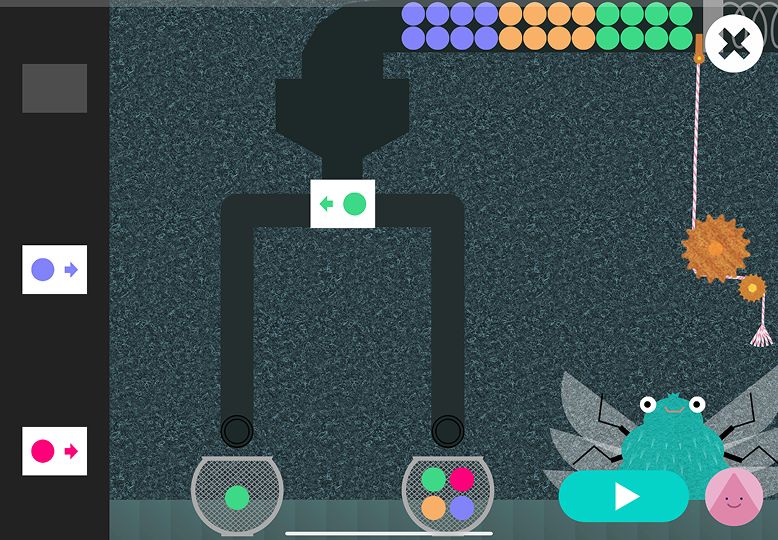
Learning logical operators IF… ELSE and predicting outcomes in the Funexpected Math app
This is also a great age to introduce basic media literacy. Questions like, "Who are these people?", "What are their motives?", and "Are they trying to persuade you in something?" can help kids start identifying persuasion tactics and thinking critically about the information they consume.
"People don't like being misled. [This] can motivate kids to take a moment and 'override their gut instincts,' and critically assess a claim." – John Cook, misinformation expert at Monash University [1].
A Simple Daily Routine to Build Critical Thinking
Building on the ideas of open-ended questions and playful learning, this routine weaves critical thinking into everyday life without requiring extra time. Just five minutes of meaningful questioning can be more effective than lengthy worksheets [7]. By creating touchpoints in the morning, midday, and evening, critical thinking becomes a natural part of the day rather than a chore. These small, intentional moments help reinforce the skills mentioned earlier.
Morning: Start with Open Questions
Kick off the day with thought-provoking questions to ignite curiosity. For example, try "Predict Then Check": ask your child how long they think it will take to get to school or what they expect the weather to do today [7]. Or go for something more imaginative, like "What if we didn’t have electricity today?" These kinds of questions don’t require any special tools but help set a curious tone for the day [8].
Midday: Encourage Exploration Through Play
As curiosity builds in the morning, channel it into playful exploration by midday. Engage your child with activities like "Scene Detective" - give them 60 seconds to observe a room, then quiz them on what they noticed or what might have happened there recently. Another fun option is "10 Uses for an Object": hand them something simple, like an empty jar, and challenge them to think of unconventional uses for it [7].
Interactive tools like Funexpected Math are also great during this time, blending play with logical challenges. Open-ended toys such as building blocks or KAPLA planks can further encourage spatial thinking and creativity. The best part? These activities let kids explore independently while keeping their minds engaged [9].
Evening: Reflect and Discuss
Wrap up the day with reflection to help your child think critically about their choices. During dinner, try "Reverse Engineering": ask them to figure out every ingredient in the meal and the order it was prepared. Follow this with a "Decision Audit" - pick a decision they made earlier in the day and discuss alternative options or potential downsides [7].
You can also adopt the "One Question Per Meal" rule: ask one challenging question during dinner. This simple habit, taking just a few minutes, helps build consistent critical thinking skills.
"Make 'How do you know?' your family catchphrase. When anyone states a fact, the response is 'How do you know?' No judgment. Just curiosity." – Kubrio [7]
This routine fits seamlessly with earlier strategies, reinforcing critical thinking in a way that feels effortless and natural.
Activities by Age: Exercises for Different Stages
Your daily routine sets the stage for activities that match your child's developmental needs. By introducing tasks that stretch their abilities just a little further, you can help them grow while reinforcing the critical thinking skills we’ve already discussed.
Activities for Ages 3-4
At this age, kids are starting to grasp cause-and-effect relationships. Simple activities like stacking blocks, sorting objects, or recognizing patterns can boost their spatial awareness and logical thinking. For example, you might ask them to predict the next step in a familiar routine. These exercises naturally complement the open-ended questions you’ve already been using.

A task on recognizing patterns in the Funexpected Math app
In the kitchen, turn cooking into a learning adventure. Count ingredients together or explore color mixing - like discovering how red and yellow combine to make orange.
When asking questions, give your child time to think before answering. Silence can be powerful, allowing them to process rather than guess. You can also model problem-solving out loud. For instance, say, "This container doesn’t fit on the shelf. Let me move these items first." This shows them how to approach challenges step-by-step.
Activities for Ages 5-6
By this stage, kids are ready for more complex tasks. Puzzles are a great way to encourage planning and testing ideas. You can also spark discussions about cause and effect with questions like, "What might happen if it rained all week?" or "Why do you think the plant near the window grew taller?"

Estimating the outcomes in the Funexpected Math app
Simple science experiments work well too. Try a sink-or-float activity where your child predicts which household items will sink and then tests their guesses. When they encounter difficulties, resist the urge to jump in with answers. Instead, acknowledge their effort and encourage them to keep trying - this builds resilience.
Activities for Ages 6-7
At this age, strategy games like checkers or basic card games are excellent for teaching planning and foresight.

Mastering the elimination method is crucial for critical thinking development
You can also present real-world problem-solving scenarios like, "You have three friends but only two cookies. How can you share them fairly?" These challenges encourage creative thinking.
Introduce coding as a way to develop logical sequencing and problem-solving skills. Coding activities help children practice debugging and refining their strategies, reinforcing the critical thinking skills they’ve been building.

Ninja, a visual coding game within the Funexpected Math app
Since kids this age can explain their reasoning, ask them to tell you why they made a particular choice. Reflecting on their thought process helps cement these skills for the future.
Common Parent Mistakes and How to Avoid Them
Even with the best intentions, parents can sometimes unintentionally hinder their child's ability to think critically. Recognizing these common missteps and adjusting your approach can give your child the room they need to develop and grow.
Giving Answers Too Quickly
It’s natural to want to help when your child is struggling with a task, but jumping in with solutions too quickly can interrupt their problem-solving process. Research highlights that critical thinking is built through practice, not an inherent skill [5]. Instead of providing instant answers, encourage your child to explore solutions on their own. Try asking open-ended questions like, "What do you think might work?" or "What other ways could you try?" This shifts your role from being the one with all the answers to a guide who supports their learning journey.
"When parents say things to their kids like, 'Don't talk back to me.' 'Do it because I said so,' 'You're not old enough to understand this,' that discourages kids from asking questions and challenging things that they don't think makes sense."
– Laurence Steinberg, Psychologist, Temple University [1]
Helping Too Much During Activities
While it’s tempting to step in and show your child exactly how to complete a task, over-assistance can dampen their creativity and problem-solving abilities. Constantly correcting or demonstrating the "right" way to do something can lead them to rely on imitation rather than their own reasoning. Instead, allow your child to approach tasks in their own way, even if their method differs from yours. This validates their independent thinking [10].
You can also model problem-solving by verbalizing your own thought process. For example, say, "I’m not sure which piece fits here. Let me try this one first and see what happens." This not only teaches them how to approach challenges but also complements the open-ended questioning strategy mentioned earlier.
Missing Learning Opportunities in Mistakes
Mistakes are powerful teaching moments, but they’re often overlooked or quickly corrected. Take inspiration from Thomas Edison, who famously turned setbacks into progress. In 1903, his storage battery failed due to leakages, costing him $1 million. Instead of giving up, Edison spent three years refining his design, eventually creating a superior product by tweaking the formula [5].
When your child makes a mistake, resist the urge to fix it right away. Instead, ask questions like, "What would you do differently next time?" or "What did you learn from trying it that way?" This helps them see mistakes not as failures but as opportunities to learn and improve.
"Critical thinkers are therefore curious experimenters who are not afraid to fail or who see failure as an opportunity to learn new things."
– Sanya Pelini, Ph.D., Educational Researcher [5]
Creating an environment where mistakes are seen as part of the learning process encourages your child to take risks and explore new ideas. Praise their effort and persistence rather than focusing solely on correct results. This approach builds the resilience they’ll need to tackle more complex challenges as they grow.
What Matters Most in Developing Critical Thinking
When it comes to fostering critical thinking in children, three key priorities emerge as the backbone of all learning. These priorities naturally align with earlier strategies and provide a solid framework for growth.
Build Consistent Curiosity
Encouraging consistent curiosity is a pivotal first step. This involves nurturing your child's natural inclination to ask questions and reflect on the world around them. Avoid shutting down their inquiries with dismissive responses, and instead, model curiosity yourself. Admit when you don’t know something and explore the answer together. This not only reinforces the value of curiosity but also shows that learning is a lifelong process, not just about finding the "right" answer [1].
Support Risk-Taking and Exploration
Risk-taking plays a crucial role in developing critical thinking. It’s not about innate ability but about practicing problem-solving through trial and error. Create an environment where your child feels comfortable experimenting, making mistakes, and trying again. Instead of stepping in immediately when they face a challenge, encourage them to brainstorm alternatives by asking, “What else could you try?” Mistakes aren’t failures - they’re opportunities to gather insights and grow.
Use Tools Like Funexpected Math

Digital tools can be a fantastic complement to everyday learning. While conversations and play lay the groundwork, apps like Funexpected Math offer structured opportunities to practice critical thinking.
Designed for children aged 3–7, this app provides adaptive challenges that align with kids’ learning pace. Funexpected Math supports multiple languages (16 in total) and complies with COPPA and FERPA, ensuring it’s safe and accessible. It’s a great way to extend the questioning and problem-solving habits you’re fostering at home.
FAQs
How do I know if my child is improving at critical thinking?
You can spot your child’s progress in critical thinking when they:
Develop their own ideas and assess evidence thoughtfully.
Stick with problem-solving, even when it takes some trial and error.
Identify facts versus falsehoods, such as recognizing online hoaxes.
These behaviors highlight their advancing ability to reason, solve problems, and judge the trustworthiness of information.
What should I do when my child gives a wrong answer?
When your child provides an incorrect answer, see it as an opportunity to encourage critical thinking. Rather than jumping in to correct them right away, try asking questions like, "What led you to that answer?" or "Can you explain why you think that's correct?" These prompts encourage them to analyze their thought process, learn from their errors, and sharpen their problem-solving abilities.
Related Blog Posts
Transform Math Learning for Kids
Explore Funexpected's interactive math program designed for children aged 3-7. Build math fluency, logic, and problem-solving skills through engaging, hands-on activities and a personalized digital tutor.