
2D Shapes
What Is a 2D Shapes?
Kids live in a three dimensional world. They can climb up a ladder and slide down a slide, run forward and back, move left and right. Very early, though, they also meet flat images on paper or on a screen.
Flat shapes are circles, squares, triangles and other polygons. A circle is the simplest shape, it looks the same from every side. A square changes how it looks when you rotate it. If we ignore how the shapes are turned, though, circles and squares differ only in size.
Triangles are a different story. They can be tall or flat, acute or obtuse, right angled or equilateral. Draw any three points that are not on one straight line. Connect them, and you get a triangle.
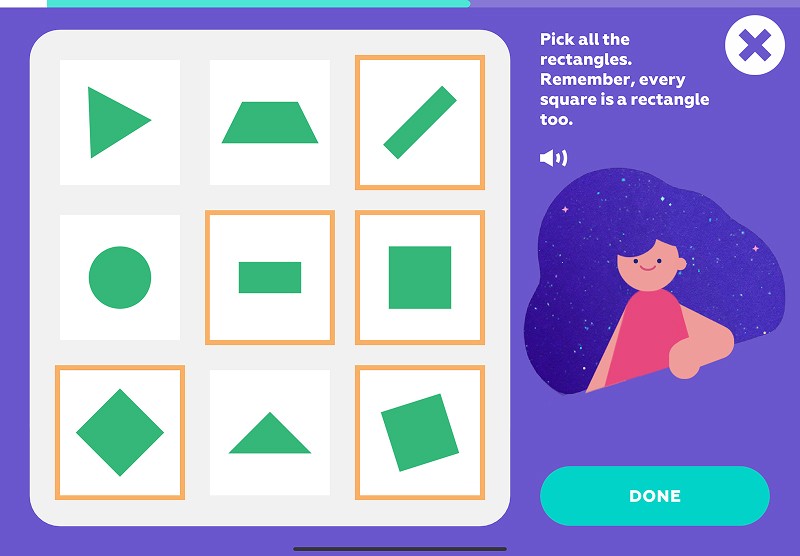
A regular polygon has all sides equal and all angles equal. A regular quadrilateral is a square. Among quadrilaterals we also single out rhombuses, where all sides are equal, and rectangles, where all angles are right angles. A square is a special quadrilateral. It has all sides equal and all angles right, so it is both a rhombus and a rectangle at the same time.

Why Does It Matter for Kids?
In classic work on perception, psychologist Eleanor Gibson showed that when kids recognize shapes, they often rely on the overall “look” rather than on geometric properties. A kid may see a long thin triangle and decide it is a quadrilateral, or treat a triangle as a “roof” without noticing its sides and angles. Shape recognition calls for perceptual training. Kids gradually learn to ignore “noise” such as color, texture, orientation or size and to focus on the stable features of a shape.
Dutch educator Pierre van Hiele described five levels in the development of geometric thinking in kids and adults.
At Level 0, Visualization, a geometric figure is seen as one whole picture. A kid might say, “This triangle looks like a roof, so it is a triangle.” A rotated square may no longer be recognized as a square. This level is typical when kids first meet shapes. Progress to the next level happens only if they get targeted practice and see many different examples.
At Level 1, Analysis, kids start to notice properties of figures, but they do not yet organize these properties into a system. They can find a pentagon by counting its sides, yet they do not treat properties as defining the shape. For example, it is hard for them to accept that a square is a kind of rectangle. A typical reaction is, “A rectangle has to be horizontal.” Moving beyond this level requires systematic work with non typical shapes and regular discussion of their properties.
At Level 2, Informal Deduction, or relational reasoning, kids begin to reason in everyday language. A kid might say, “This shape cannot be a rectangle because the angles are not right angles.” At the same time, they may fail to hold the whole logical picture in mind. For instance, they might decide, “Any shape with four equal sides must be a square,” and forget to check the angles. To move confidently to the next level, kids need regular work with shapes, contexts and problems that ask them to analyze properties and relationships.
At Level 3, Deduction, students understand axioms, definitions and theorems and can produce formal proofs. They might argue, “If opposite sides are parallel, we can deduce that this is a parallelogram.” Errors here become more subtle. A student may apply a theorem outside its domain without checking the conditions, or mix up cause and effect, for example, “If ABCD is a square, then the diagonals are perpendicular, so if the diagonals are perpendicular, it must be a square.” This level develops through focused study of geometry in the upper grades.
At Level 4, Rigor, students can compare different axiomatic systems, work with high levels of abstraction and think in a fully theoretical way. For example, they can say, “In Euclidean geometry triangles have angle sum 180°, but on a sphere they do not.” This is the level of research mathematics.
The important point is that moving from one level to the next does not happen automatically and does not depend only on age. It depends on experience and teaching.
Modern research shows that kids who work with shapes early and consistently develop geometric thinking more quickly, read diagrams, plans and spatial images more confidently, and learn to understand shapes against a busy background. The ability to pick out a shape from context is one of the strongest predictors of later success in geometry. Even very basic skills, such as telling squares in different orientations, turn out to be important cognitive predictors.
Spatial skills respond well to training. Working with shapes is one of the most effective ways to develop the spatial reasoning that is so important for STEM fields.
How Do We Teach?
We start from the simplest flat shapes, such as circles, squares and triangles. Kids learn to recognize rotated squares in pictures and to look for shapes with three corners. We show not only perfect polygons but also irregular ones. For example, a kid finds a pentagon by counting its corners, not by matching it to one fixed picture of a regular pentagon.
Next come shapes made from dough or colored paper. A kid learns to see a rectangle in a window and a circle in a plate, while ignoring all the other properties of those objects. In one game, a kid “slashes” round objects with a samurai sword, but must leave all other shapes untouched.
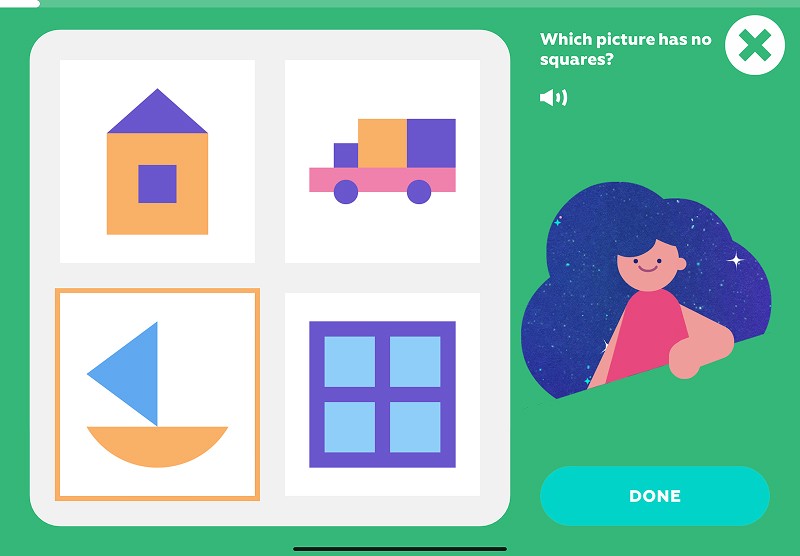
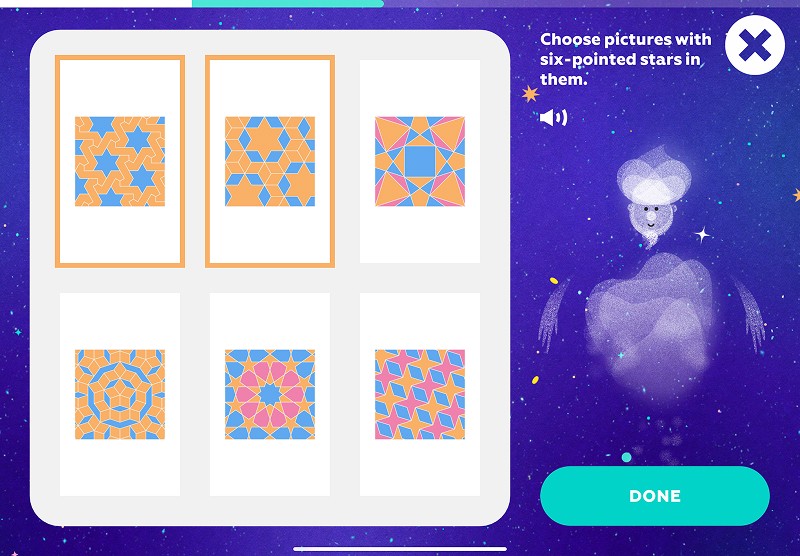
A key step is learning to pick a shape out of a full picture. Kids might look for all circles in a drawing and replace them with triangles, choose the picture where there are no squares at all, or find stars hidden in a complex pattern.
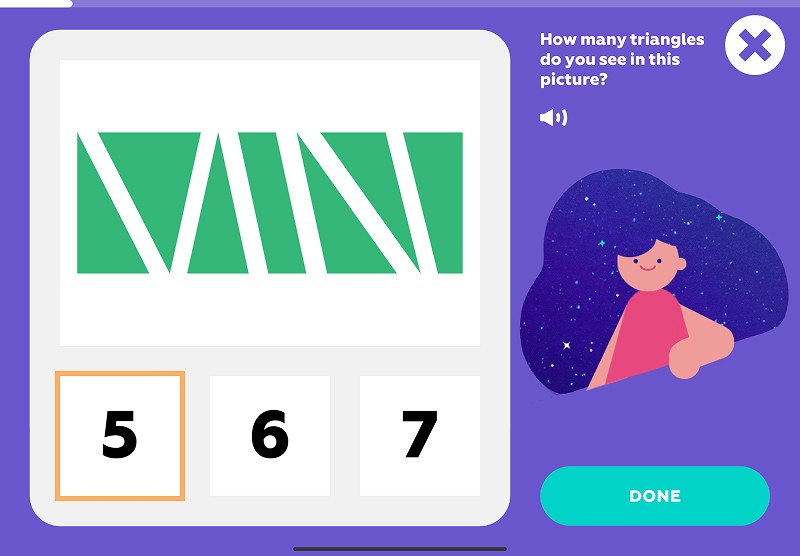
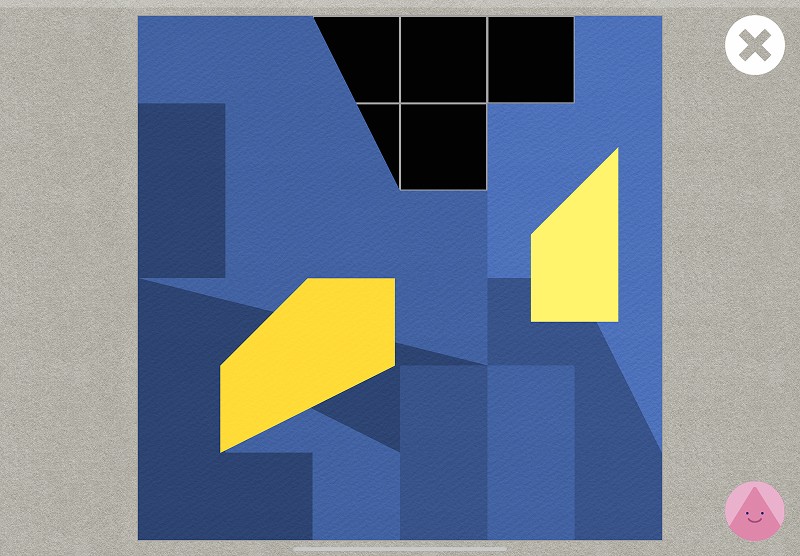
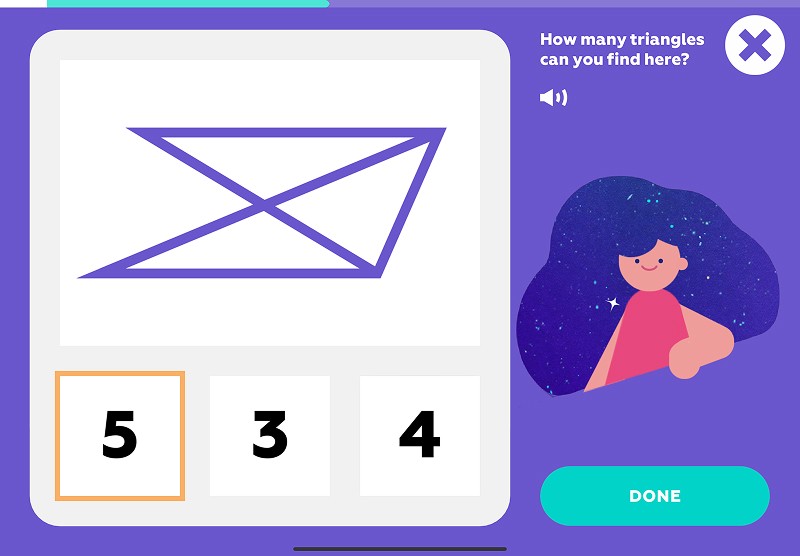
In the Skill Races game where kids have to make a square, they choose a shape that will complete a given figure to a full square. In the Tangram game, they fill a hole with several pieces, rotating them into the right positions. They learn that the same set of pieces can make very different figures. They also practice reading geometric drawings by trying to find as many triangles as possible in a diagram.
First Steps
Recognize Flat Shapes
We begin with the very simplest shapes, the circle, triangle and square. A circle does not change when you turn it, while a square or triangle can look a bit different in different positions. It is important that kids can still recognize them, no matter how they are rotated.
Later kids notice that all squares differ only in size, while triangles come in many forms, not only equilateral ones. There are low obtuse triangles, neat right triangles and equilateral triangles, which are usually the first ones kids meet.
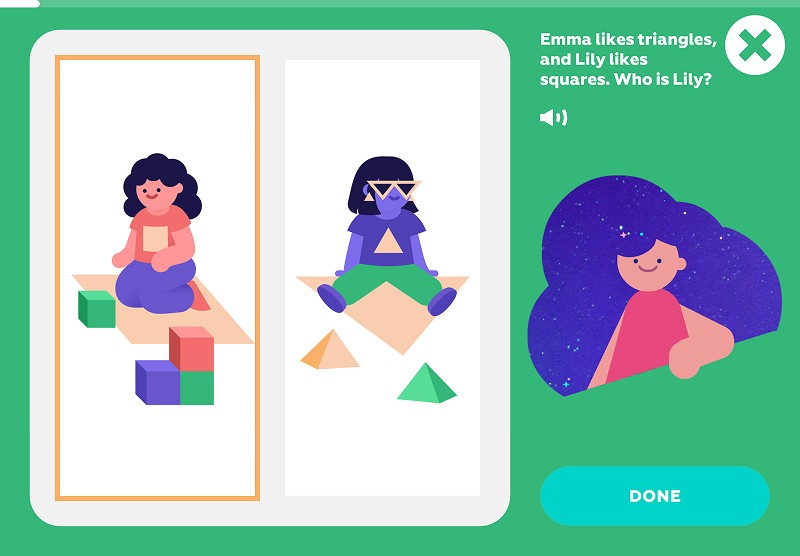
Triangle Frenzy
Shape recognition
In one of our games, a kid slices shapes of a chosen type with a samurai sword. All the other shapes have to stay safe, they are off limits. First we show clean, abstract shapes. Then we ask kids to find those same shapes inside everyday objects. It is helpful if kids also cut shapes out of paper or dough in real life, for example when you bake pentagon cookies together.
Sometimes we let a kid look at a set of shapes for a short time, then hide them. The task is to remember on which tiles the triangles were. This trains both memory and attention to shape.
Later kids learn about different kinds of quadrilaterals, such as rectangles, rhombuses, squares and even trapezoids.
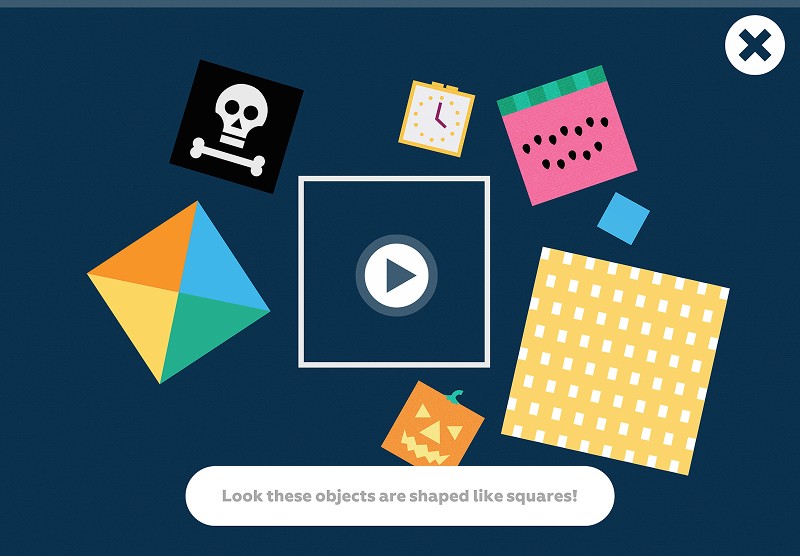
Shape recognition
Recognize basic flat shapes in real-life objects
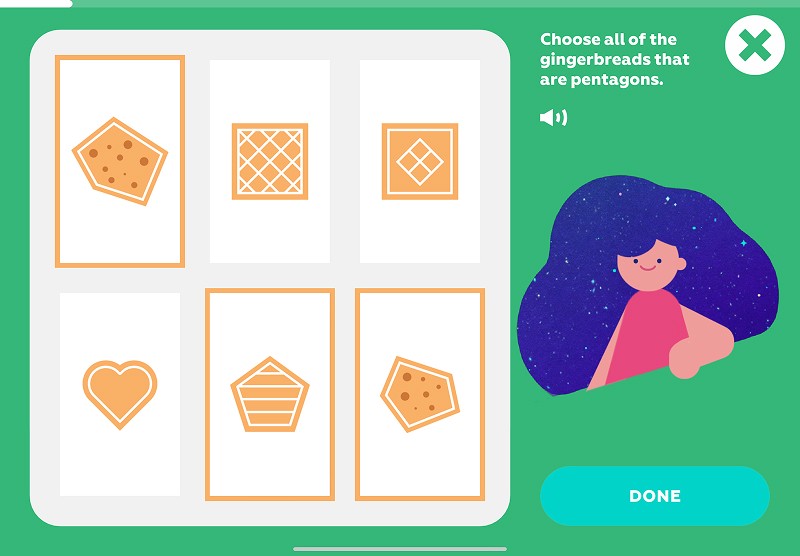
Recognize basic flat shapes in real-life objects
Shape recognition
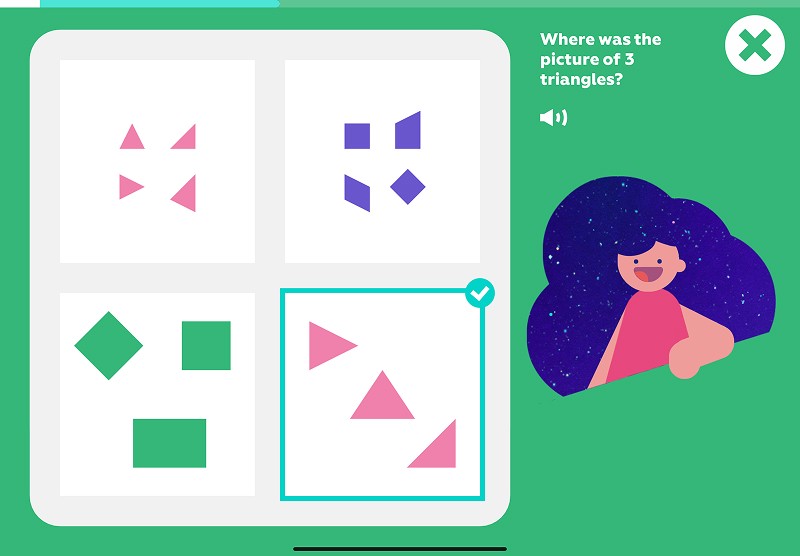
Shape recognition
Triangles
Reason with shapes and attributes
Identify rectangles
Deep Understanding
Picking a Shape Out of Context
In some pictures there are many different shapes at once. It is important that a kid can pick out the target shape from the whole picture. For example, we might ask them to choose the picture that has no squares at all.
Squaremania
Shape recognition
One of the simplest ways to highlight a shape is to match the shape of a hole and the shape of a piece that fits into it. Triangles can be very different. Some of them are so long and thin that they almost look like quadrilaterals, yet we can still tell them apart by counting the corners.
In one of the games, a kid colors in shapes of a given type, and together they turn into a picture of an animal.
In patterns and ornaments, shapes repeat again and again. It is useful for kids to search for shapes there too, for example octagons, irregular quadrilaterals or stars.

Composing shapes
Fill the gap with the right shape
Reason with shapes and attributes
Shape recognition
Polygons
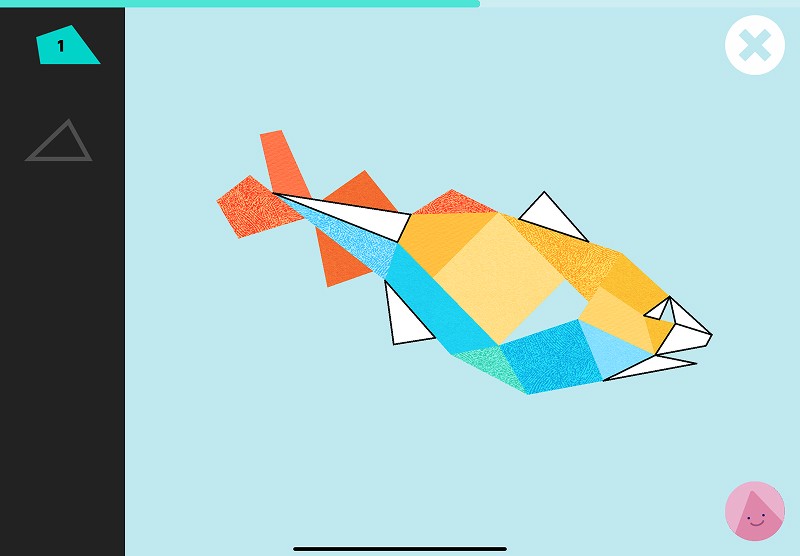
Recognizing forms: triangle, quadrilateral, pentagon (picture “Codfish”)
Shape recognition
Composite triangles
Confident Mastery
Composed Figures
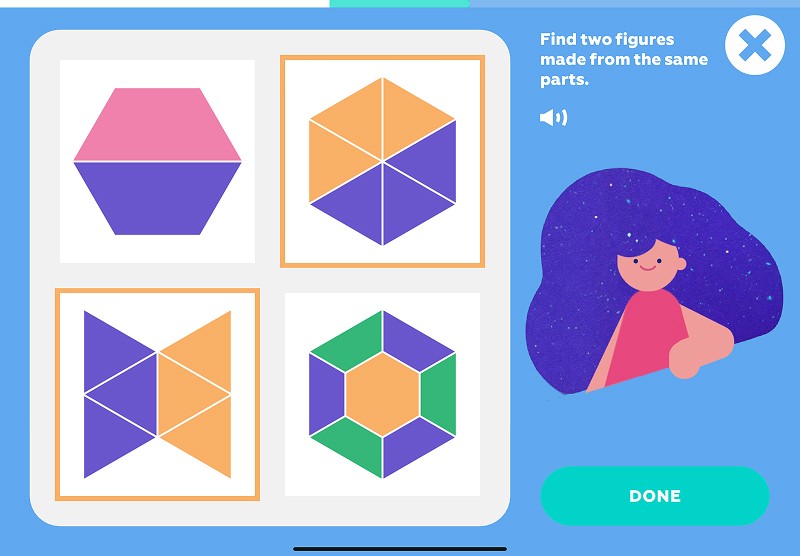
Step by step, kids learn to see what happens if we join two shapes together or, on the contrary, cut a shape into parts.
In a Skill Races timed challenge where kids have to make a square, a kid chooses the shape that will complete a given one to make a full square.

Compose shapes
Compose a square: simple cuts, big differences
In the Tangram game, the task is to build a figure out of several parts, sometimes rotating the parts to make them fit.
It is helpful to draw kids’ attention to the fact that the same parts can make completely different shapes, depending on how they are arranged.
In some tasks, kids have to decide which sets of parts can be used to build a given figure and which ones cannot.
A separate goal is teaching kids to read a geometric drawing. For example, they might try to find as many triangles as possible in a diagram.
Tangram
Identify and place 2 shapes into the given space without rotation (square grid)
Assemble pictures
Composing shapes

2D shapes
Composing shapes
2D shapes
Composite triangles
Graphs in Action
Sometimes a problem does not mention graphs at all, but drawing one can make the problem much easier to solve.
A good example is a puzzle about fitting pieces. Kids often solve this kind of puzzle by trial and error, but let’s look at a mathematical solution using a directed graph, where the points are connected by arrows rather than plain lines.
Big Ideas
Flat shapes are one of the first places where a kid learns to ignore color, size and orientation and to see the essence. A triangle is “three sides and three corners.” The ability to focus on some properties of an object and ignore others is a basic tool of scientific thinking.
The idea that a shape stays the same while its position changes leads to the notion of an invariant, something that does not change under a movement of the plane. Later, kids meet this idea again in geometry when they study translations, rotations and reflections. They also learn about similarity transformations that keep the shape and proportions of a figure but change its size.
The broader idea that certain properties of an object can stay unchanged while others vary becomes very fruitful in topology and in programming. In computer science, many algorithms rely on invariants that must remain the same while the program runs.
Experience with cutting shapes apart and composing new ones from the pieces prepares kids for the study of area. When they can rearrange pieces without changing the total area, formulas for area become meaningful instead of mechanical.
The skill of reading diagrams and geometric drawings is indispensable later in school geometry. Many middle school teachers assume that “geometric vision” is already in place and do not devote much time to developing it. Early, playful work with flat shapes helps kids build that vision in advance.


