Angles
What Is an Angle?
Take a short walk with a kid. The street bends at the corner, and there it is: an angle. A twig snaps in one spot and a tiny angle appears at the crack. Bend a bit of wire, and you make an angle right where it folds.
In our app, angles most often show up in shapes. A rectangular table has four corners. A triangular road sign has three. Corners feel sharp, you could almost poke a finger on them. A circle has no corners at all. A star is different. It shows two kinds of angles: acute angles at the tips, sharp and pointy, and reflex angles tucked into the indents, opening so wide they feel like little spaces you could step into.
There is another way to feel an angle, as a turn. Push a toy car and make a crisp right turn, 90°. Give it a gentle nudge so it keeps almost the same direction, a small acute turn. Or swing it around so it is headed almost back the way it came, a wide obtuse turn.
Why Does It Matter for Kids?
Research shows that the abstract idea of angle does not appear all at once. It grows from everyday experiences, like a bend in the road, a straw creased at the bend, or the slope of a slide. At first, kids see these moments separately and do not connect them. Gradually they notice the common action, a turn, and start to transfer that sense of turning to drawings and maps. It helps to begin with this dynamic view of angle as a turn, then bring in other definitions.
Only after that is it useful to introduce the more formal picture of an angle as two rays with a common endpoint and to measure angles with a protractor. If measurement comes too early, kids often focus on the numbers and miss the big idea. A child may call the angle with longer sides “bigger” on a drawing, or may not count concave angles as angles at all and call them “holes.”
At the same time, thinking of angle as the amount of turning is within reach for preschoolers. In studies with an interactive board like The Geometer’s Sketchpad, kids steered a “car,” set the size of the turn, and watched the path. As they worked, their gestures, words, and understanding shifted step by step. A “quarter turn” began as a broad sweep of the arm, then became a clear phrase, and later turned into a number in degrees. Working together, stopping, and replaying moments helped the group align gestures, words, and symbols. A shared vocabulary took shape fast: “a quarter steeper,” “another 90 degrees,” and so on.
How Do We Teach?
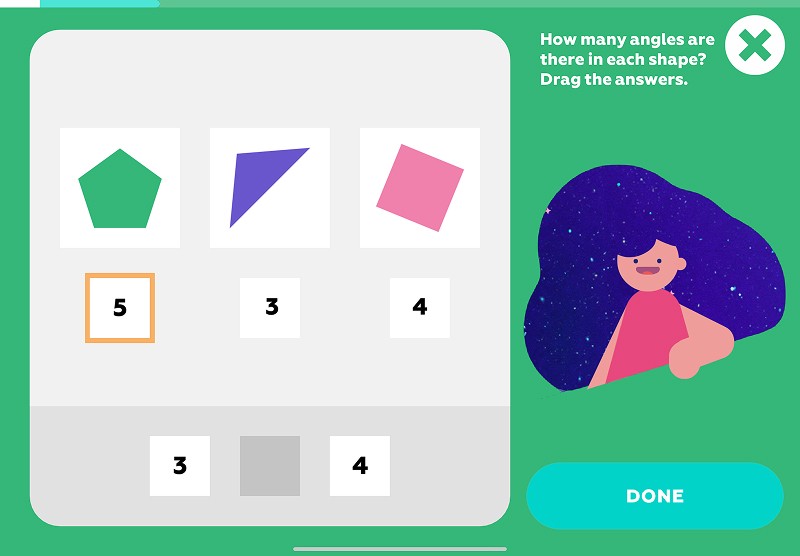
It is easy to count angles in simple convex polygons when kids know what to look for. We talk about the “pointy places,” and we notice how a path around the figure turns at each corner.
Reason with shapes and attributes
Explore angles and sides in flat shapes
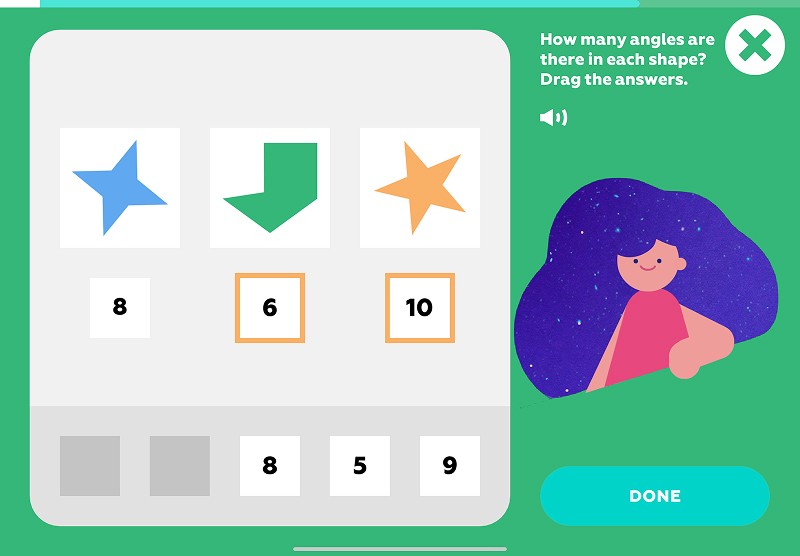
Sometimes, though, the path turns away from the center and makes a dent instead of a bulge. Those angles count too. On a star, for example, convex and concave (reflex) angles alternate.
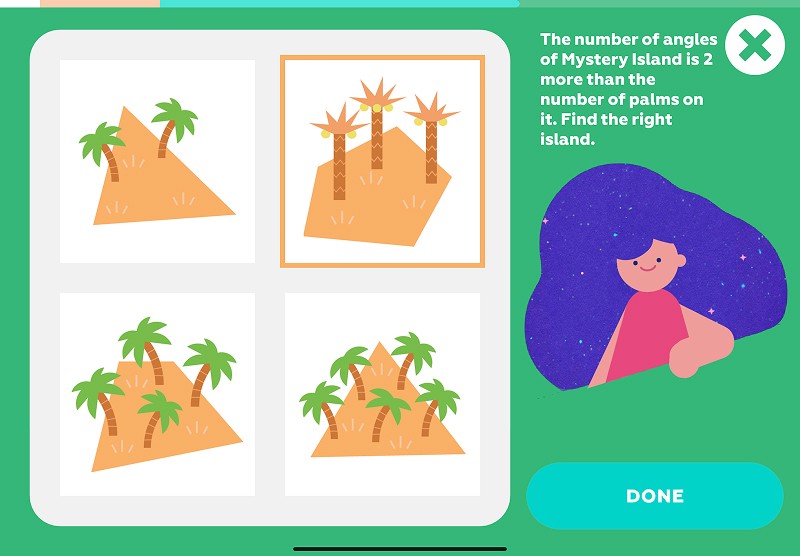
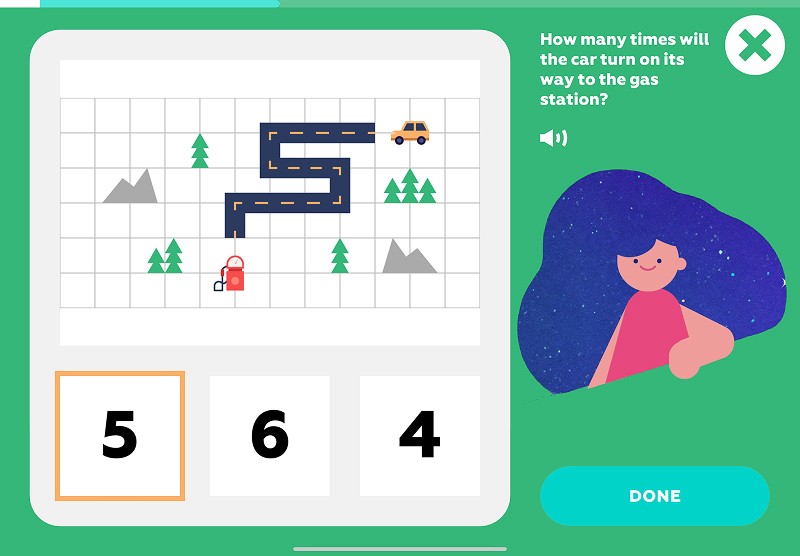
We treat an angle as the moment a car turns. On a simple map we ask how many times the car turned on its way. We also ask playful questions, like which island has more angles than palm trees.
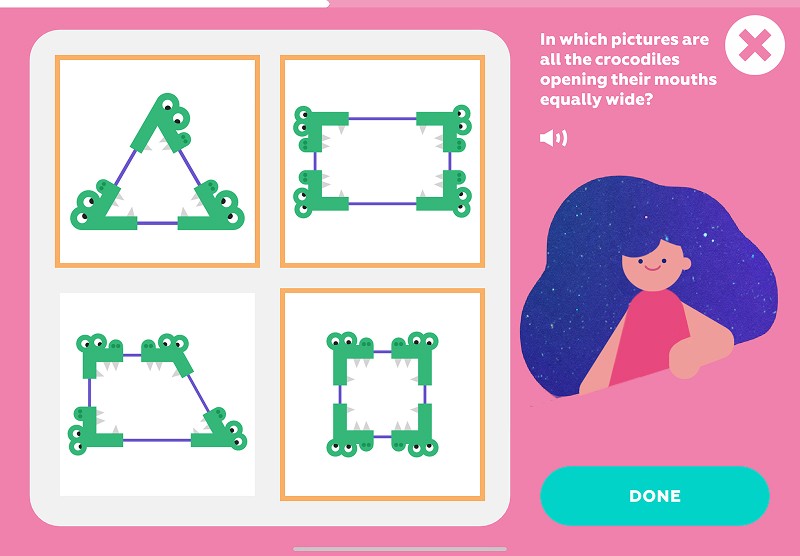
At an intuitive level, we explore equal angles by imagining each angle as a crocodile’s open mouth. Some mouths open wider, some narrower. When all the mouths along a shape open by the same amount, the angles are equal. In a rectangle, all four corners are right angles, so they match. There are triangles where all three angles are equal as well.
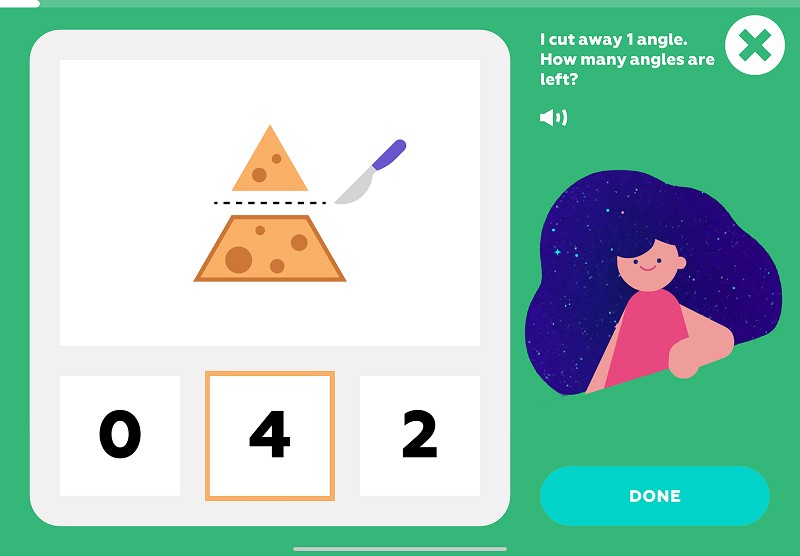
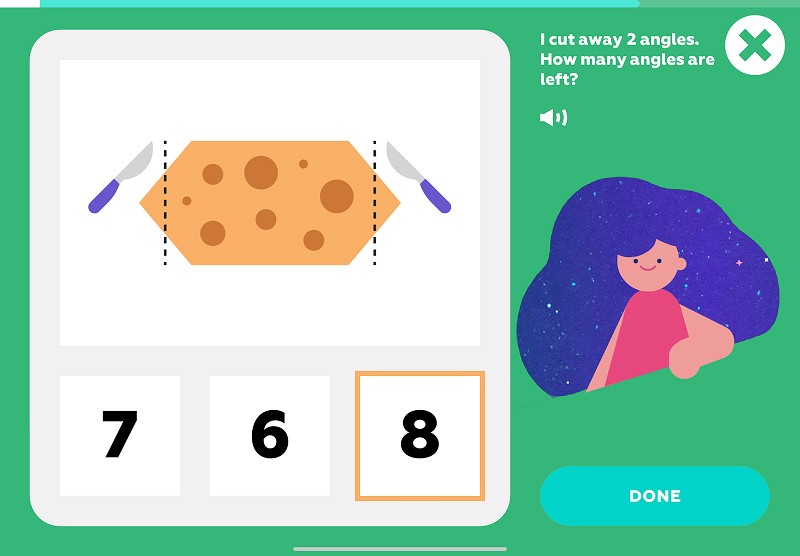
Cutting corners off shapes leads to a delightful set of problems. If you cut 1 inch off a ribbon, you have one inch less of ribbon. But cut off a corner from a shape and you get one more angle than before. A triangle becomes a quadrilateral. Cut two corners off a hexagon and you get an octagon.
Reason with shapes and attributes
Explore angles and sides in flat shapes
Reason with shapes and attributes
Angles
Reason with shapes and attributes
Movement with multiple turns
Reason with shapes and attributes
Angles
Reason with shapes and attributes
Explore angles and sides in flat shapes
Reason with shapes and attributes
Explore angles and sides in flat shapes
Big Ideas
The concept of angle is fundamental in mathematics. At school, kids learn that we measure angles in degrees, how to use a protractor, and that the angles in any triangle add up to 180°. In everyday life they will hear phrases like “turn 90 degrees left” or “make a 180”.
Later they meet sines, cosines, and tangents, which describe how sides and angles relate. These ideas power mapmaking, computer graphics, architecture, and robotics. On the plane we can also use polar coordinates, where each point is set by its distance from the origin and the angle a radius makes with the horizontal axis.
Geography relies on angles too. Seasons change because the Sun’s rays strike the ground at different angles. In winter they arrive at a smaller angle than in summer, so the surface warms less. A point on Earth can be described by angular coordinates. For example, north latitude is the angle between the line from Earth’s center to that point and the plane of the equator.
In physics, kids encounter the rule angle of incidence equals angle of reflection. It explains the path of a billiard ball off the cushion and the way a sunbeam reflects from a mirror.


