Simple Operations
What Is an Operation?
An operation is an action we perform on some object. For example, we can color a little square blue or rotate it by 45 degrees. A rotation is easy to undo. We can simply turn the square back again. But some operations cannot be reversed. If you boil an egg, you cannot make it liquid and raw again.
So, an operation is any change we make. Some changes can be undone, and some cannot.

Why Does It Matter for Kids?
Classic work by Swiss psychologist Jean Piaget shows that kids’ logical and mathematical abilities are built on internal “operations.” At first, kids carry out actions with real objects. Later they learn to perform the same actions in their minds. This includes understanding that an action can be “undone” so that things go back to how they were at the start.
Modern research confirms how important it is for kids to see the link between an action and its result. For example, “nothing was taken away, so nothing has changed,” or “if something was removed, there is less now.” This understanding usually develops in the preschool years.
When a kid can work out what things looked like before an operation, based on what they see after it, it becomes easier to understand how addition and subtraction are related. When we deliberately show kids how these inverse operations connect to each other, their results in math tend to improve.
Studies of early algebraic thinking show that watching everyday operations and changes in the world around them plants the seeds of algebraic thinking. Kids start to notice how “doing something” changes a situation, and how you might get back to where you started.
Finally, simple transformations of shapes help kids develop spatial thinking and the idea of invariants: “it is the same shape, even though it has turned.” This prepares them for school geometry and for working with geometric transformations such as slides, flips, and turns.
How Do We Teach?
Kids begin interacting with the world of objects very early in life. They shake a rattle, throw things on the floor, bang a spoon on the table. It is important that the same action on the same object usually brings the same result. Later, they discover that not every operation can be undone. For example, once a slice of bread is cut off, you cannot stick it back as if nothing happened.
In our tasks, we invite kids to predict the result of a given operation. What will happen if you remove the top sticker, fold a sheet of paper, or pull on a string? This trains an important skill, imagining a process and foreseeing how things will change without actually performing the action.
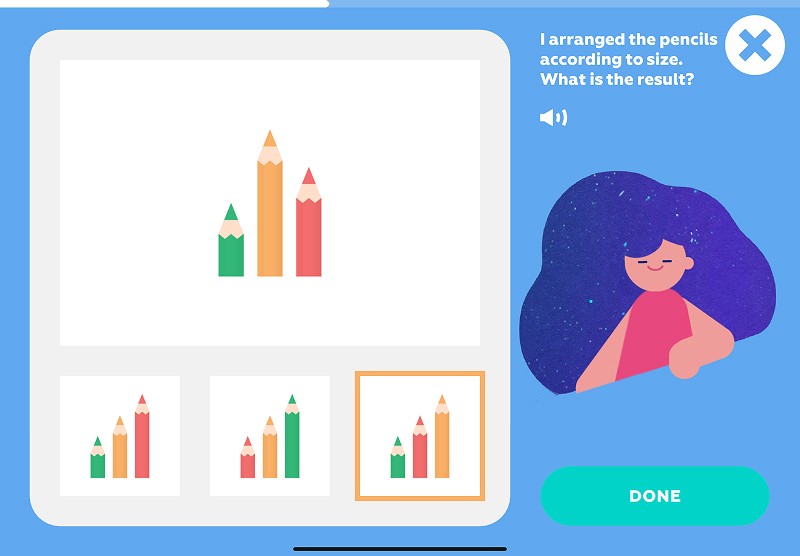
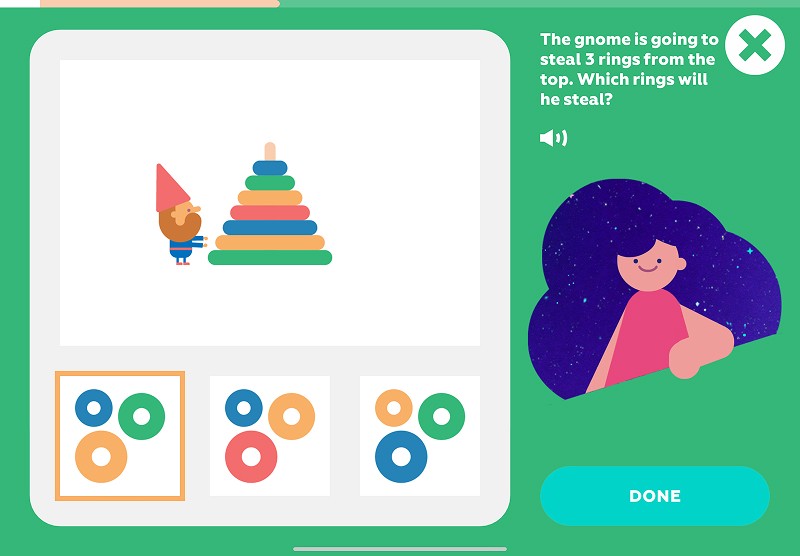
Then we apply the same operation to many objects at once. What will happen if we line up colored pencils by length, or if we replace every red pencil with a blue one? What will the rings of a stacking toy look like if we take them off the pole? The kid learns to apply the same operation to all (or to some) objects and to keep track of what changes and how.
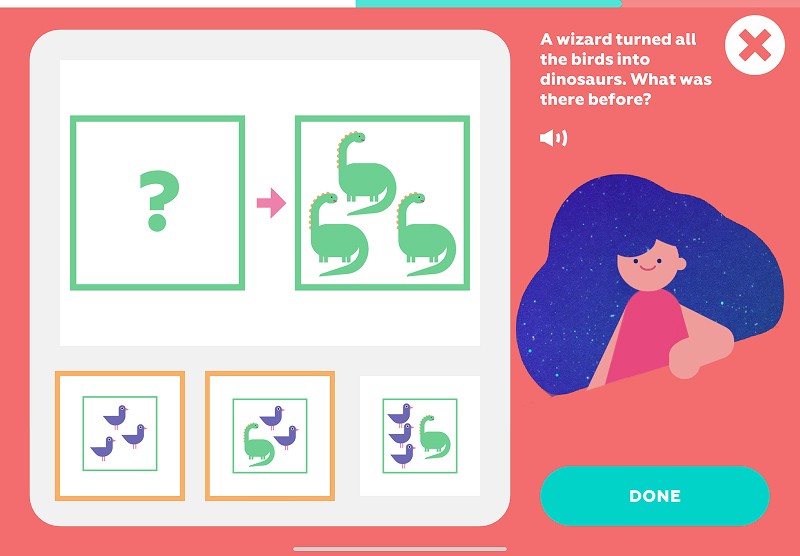
Some tasks focus on reverse actions. The goal is to figure out what the situation looked like before an operation was carried out. For example, if all birds turned into dinosaurs and we see only the result of this transformation, how many birds might there have been before? If a robot followed a chain of steps, say it moved right and then down, where was it before those commands?
First Steps
Simple Actions
Operations can be very different.
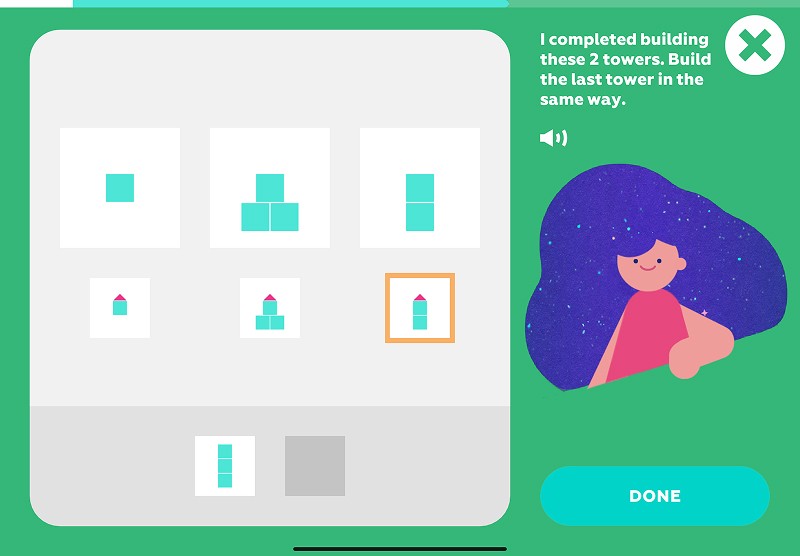
For example, a kid might put a triangular roof on top of a tower. There are a couple of examples that show this for two other towers. The task is to figure out what the same operation will do to the last tower.
Operations
Simple operations
In many tasks, kids need to predict the result of a particular operation.
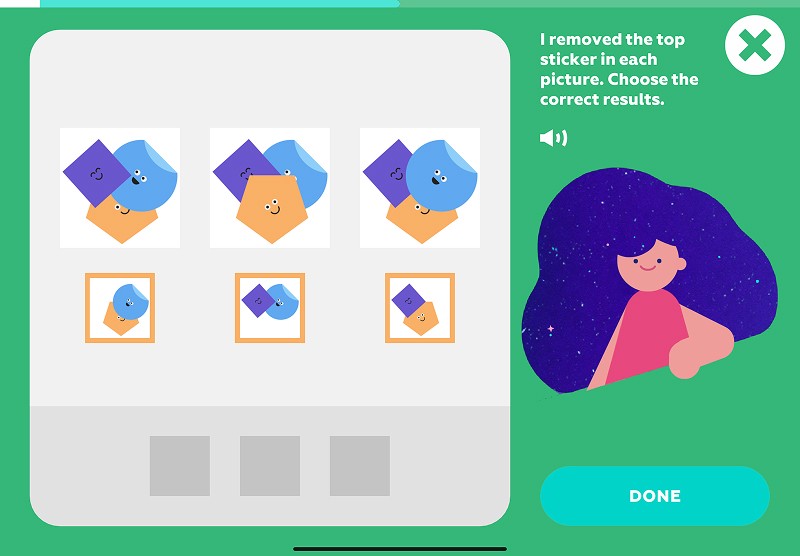
What will happen if we peel off the very top sticker from a collage?
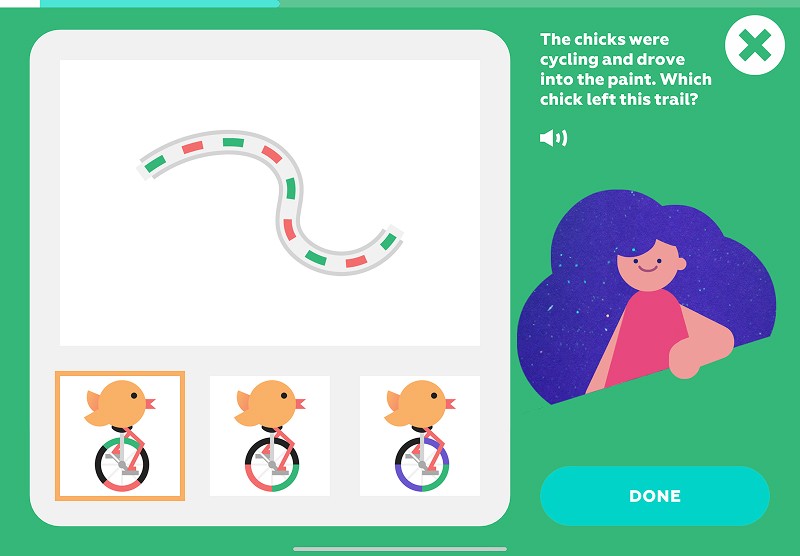
If we roll a painted bicycle wheel along a path, what kind of track will it leave?
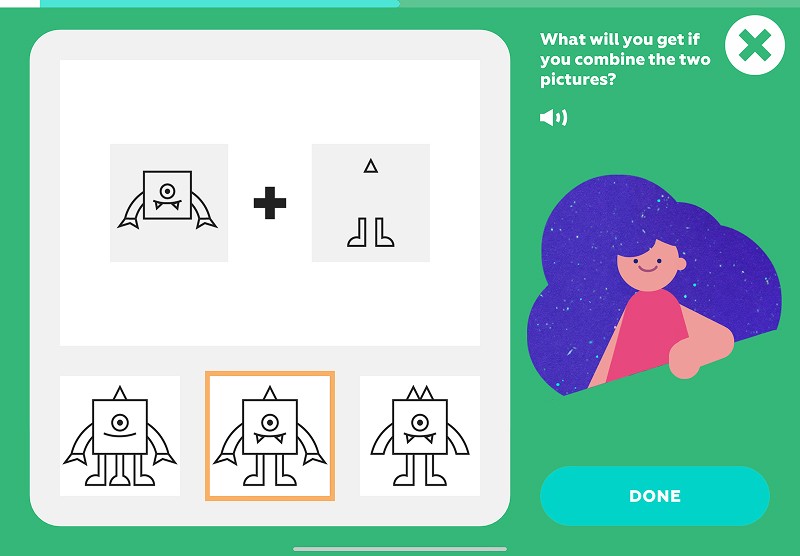
What will you get if you combine the two pictures?
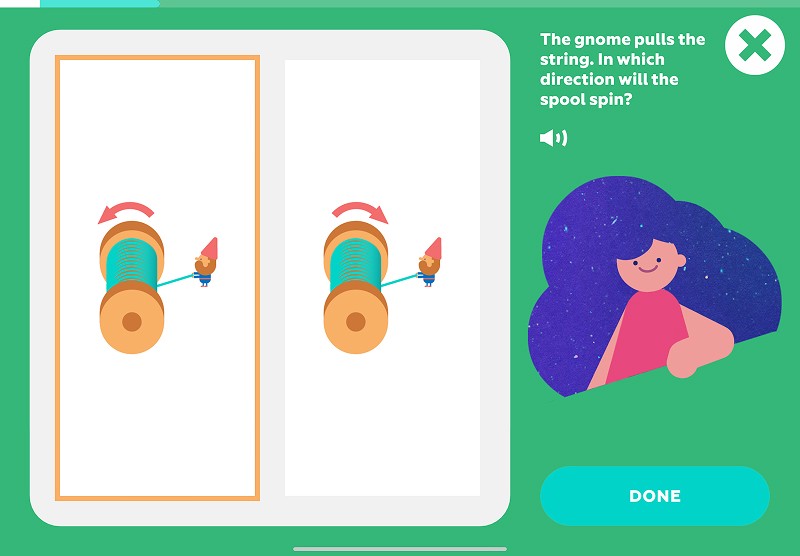
Which way will a spool roll if we pull on the thread?
In these first games, kids try out very simple actions and see what they lead to. They begin to notice that even small operations, like peeling a sticker or pulling a string, follow clear rules and produce predictable results.
Order of operations with stickers
Remove the top sticker
Operations
Trace
Operations
Combine pictures
Transformations
Operations
Deep Understanding
Operations Within the Set
Another group of tasks works with a whole set of objects.
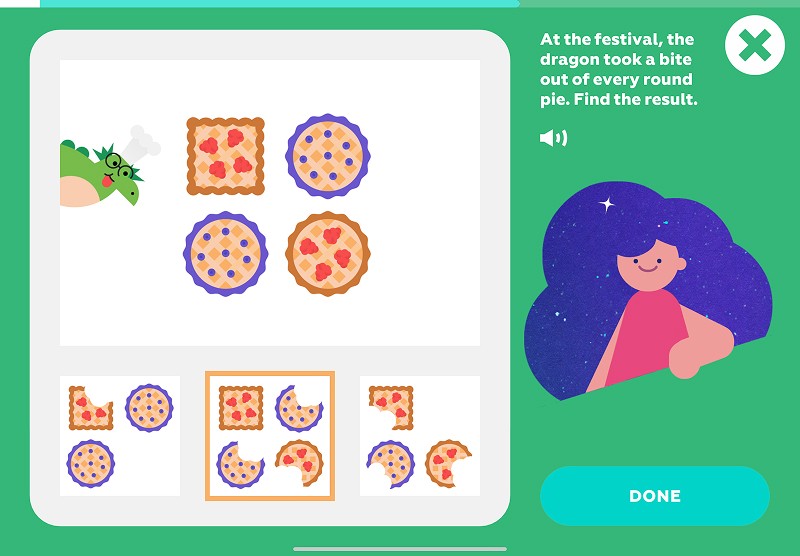
For example, what will be left if we take a bite out of every round pie but leave the square pies untouched?
Operations
Find all
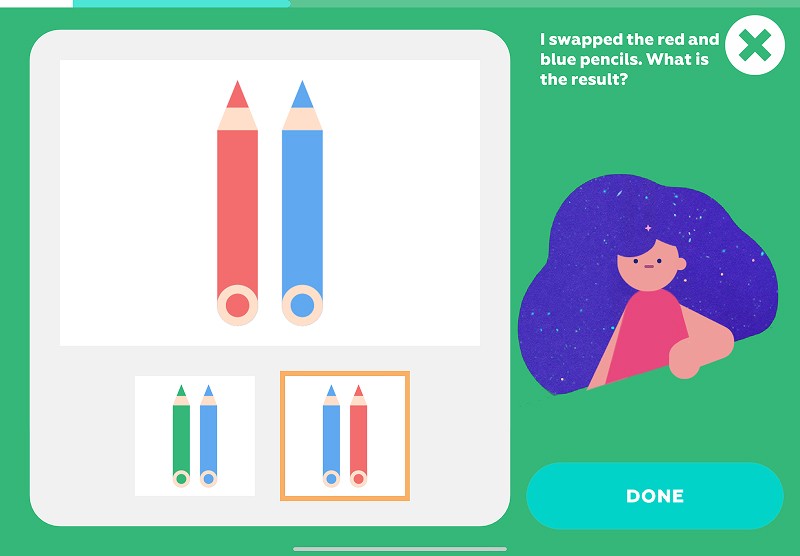
What will happen if we swap the red pencil with the blue one?
What will the set of pencils look like if we arrange them in order from shortest to longest?
What will happen if we remove the top three rings from a stacking toy?
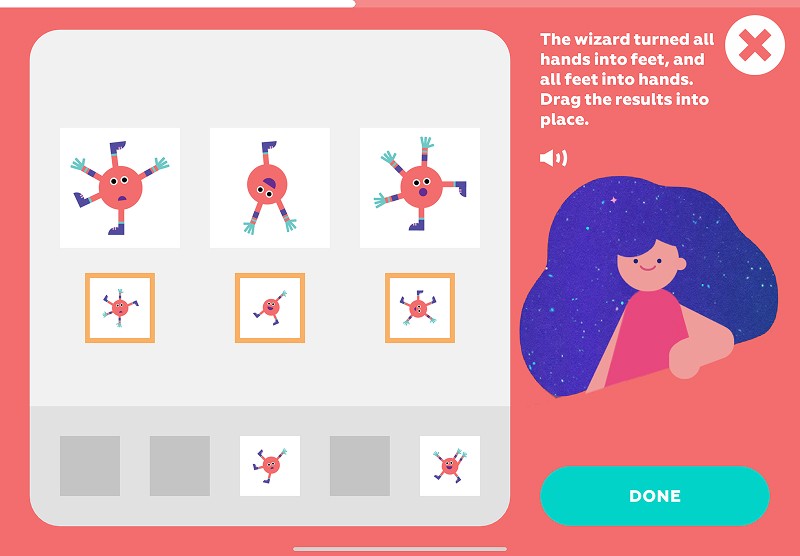
What will happen if, in a picture, we replace all arms with legs and all legs with arms?
In these tasks, kids learn to look at a whole set as something that can be transformed by one clear rule. They see how one operation can change many objects at once and how the entire set looks before and after the change.
Operations
What's the order?
Measuring length
Order by size
Transformations
What's the order?
Transformations
Functions
Confident Mastery
What Was Before?
Thinking about the reverse operation is especially interesting. If we know that all red objects in a picture were painted blue, it is easy to say what the picture looked like at the beginning.
But if there are several blue objects, how do we know which ones used to be red and turned blue, and which ones were blue from the start?

Transformations
Backwards reasoning
If all birds turned into dinosaurs and we now see three dinosaurs, how many birds could there have been at the beginning? There might have been three birds. Or there might have been no birds at all and only three dinosaurs. But three birds and one dinosaur would give us four dinosaurs after the transformation, and we only see three.
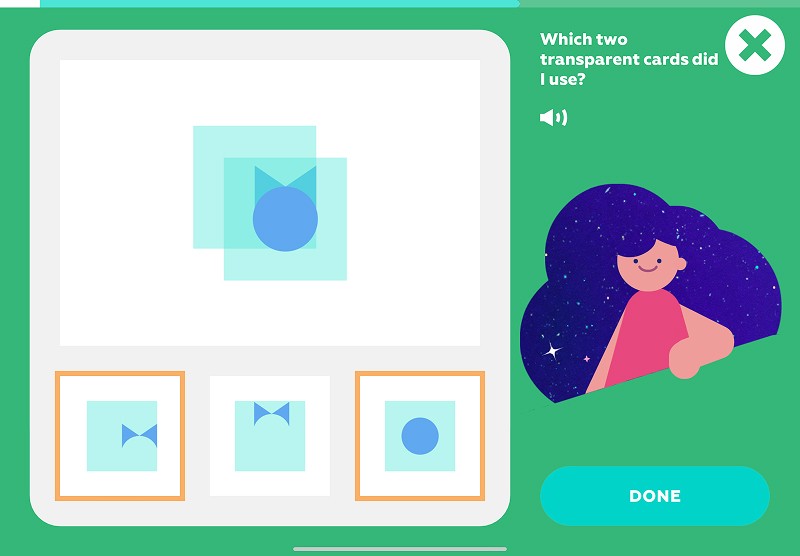
Two transparent pictures were placed on top of each other and together they make a cat. What could those pictures have been? To answer this, a kid can imagine what would happen if we pulled the pictures apart again. Where would the cat’s ears end up?
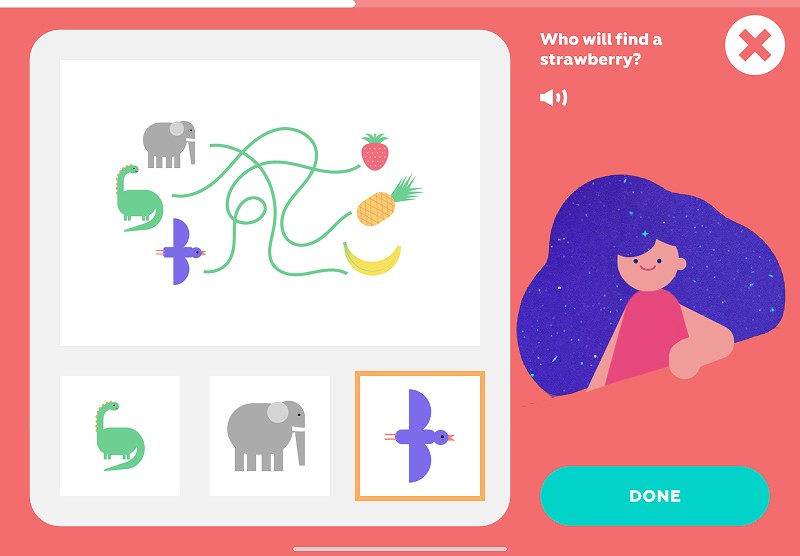
If the elephant walks along the path, it will eat the banana. Who will eat the strawberry? The simplest way to find out is to start from the strawberry and follow the path backwards.
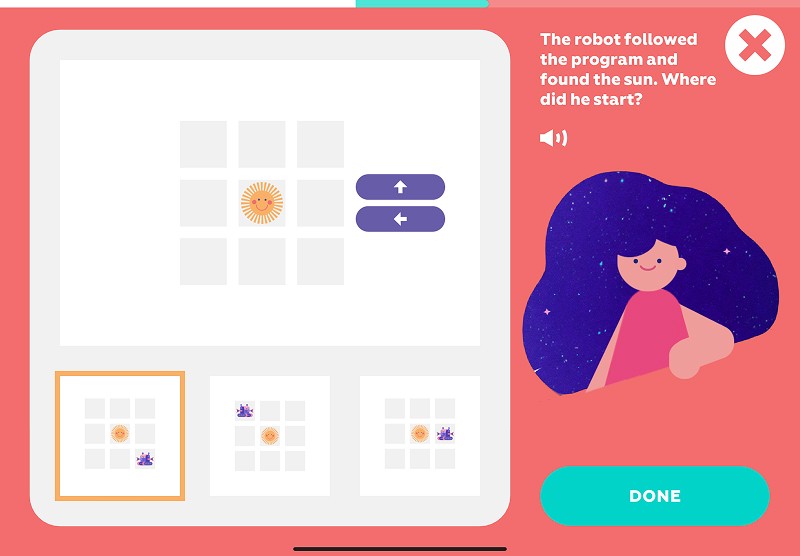
If the robot moved right and then down and found the sun, where was it before these commands? To work this out, we imagine the reverse path. First it should move up, then left. Now we know where the robot started.
Tasks like these help kids get comfortable with “undoing” operations, tracing processes back to their starting point, and reasoning flexibly about possible starting situations.
Transformations
Backwards reasoning
Transformations
Backwards reasoning
Algorithms
Backwards reasoning
Backwards reasoning
Simple route programs
Big Ideas
The idea of an operation lies at the heart of mathematics. In elementary school, kids work with basic operations on numbers: addition, subtraction, multiplication, and division. They also start to meet the logical operation of negation, the “not” in a statement. In algebra, they study exponentiation and its inverse operation, taking a root. Some functions are invertible, such as f(x) = x − 3. Others are not. For example, f(x) = sin x takes the value 1 many times, so it is not clear what the value of an inverse function at 1 should be. In geometry, shapes undergo transformations such as reflections and translations. These are reversible operations.
In programming, every command is an operation. It is important to understand what result a single command will give and what result a whole program, a chain of commands, will lead to. It also matters to know when an action can be undone and when it cannot.
The irreversibility of many physical processes is connected to the idea of entropy. Chemical reactions can also be irreversible, for example when they produce insoluble compounds or gas.


