Spatial Language
What is Spatial Language?
Spatial language is the set of words we use to talk about where things are in space. These words answer different kinds of questions:
where: above, below, in front of, behind, between, next to, inside, outside
where to: up, down, forward, back
how: closer, farther, higher, lower, around, through
Right and left depend on your point of view, so we cover them in a separate article: Left and Right.
Why Does It Matter for Kids?
Classic work by psychiatrist Margaret Mahler traces how a baby gradually separates from the mother, begins to feel like a person with clear boundaries, and learns to tell “inside” from “outside.” Building a strong spatial vocabulary is closely tied to forming a body schema, an internal map of the body and its parts in space. Research by neuropsychologist A. R. Luria shows that naming directions and locations, like “between,” “left,” or “inside,” strengthens these body-in-space ideas and makes them available for abstract thinking.
Current studies back this up. A well-developed body schema, and especially finger gnosis, a precise sense of finger position and movement, predicts early math skills, including quantity and arithmetic.
The ability to understand spatial prepositions, judge distances, shift point of view, and analyze spatial layouts is consistently linked to growth in number sense and in understanding magnitudes, length, and measurement in preschool.
Spatial thinking and vocabulary grow both in conversation with adults and in free play. During ordinary block play, kids naturally use spatial words. The more a kid talks about position and shape, the more their geometry skills and early arithmetic develop. The amount and variety of spatial language kids hear from adults predicts their spatial thinking and their capacity for mental rotation, a strong predictor of math success in the early grades. Kids who command spatial language can hold and manipulate spatial relations in mind, not only through action. That mental work supports later skills like reading diagrams, solving word problems, and understanding geometric objects.
How Do We Teach?
In any language, even in a native language, spatial prepositions need special attention. Parents might ask the kid to climb onto the slide or to look for the ball under the bench, then see how precisely a kid follows the instruction. If you notice again and again that a kid gets confused without a model, consider talking with a speech therapist.
We start with simple tasks where, based on a short description, the kid finds the monster hiding on different sides of a box.
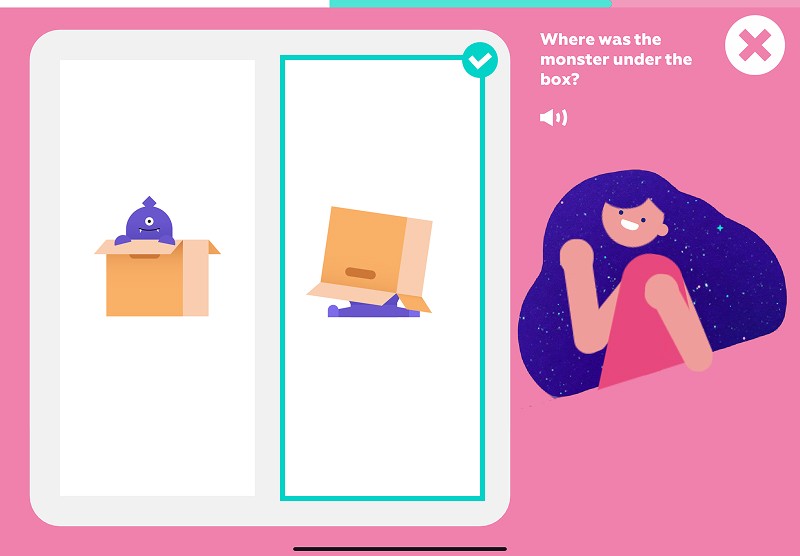
Vanishing geometry
Spatial prepositions
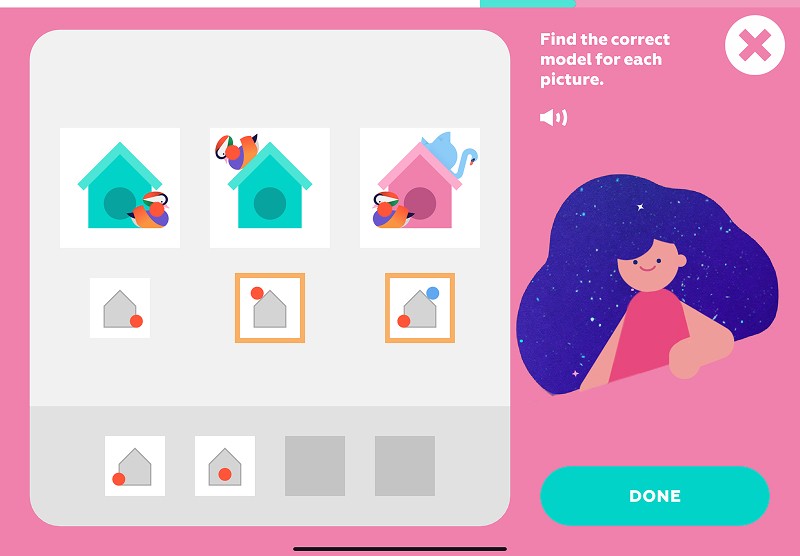
To keep the focus on the preposition rather than on extra details in a pretty picture, we use simple diagrams. In the model-matching task, the bird appears as a small red dot, which makes it easier to recall the word: the bird is in the house, on the house, in front of the house.
We pay special attention to the words inside and outside.
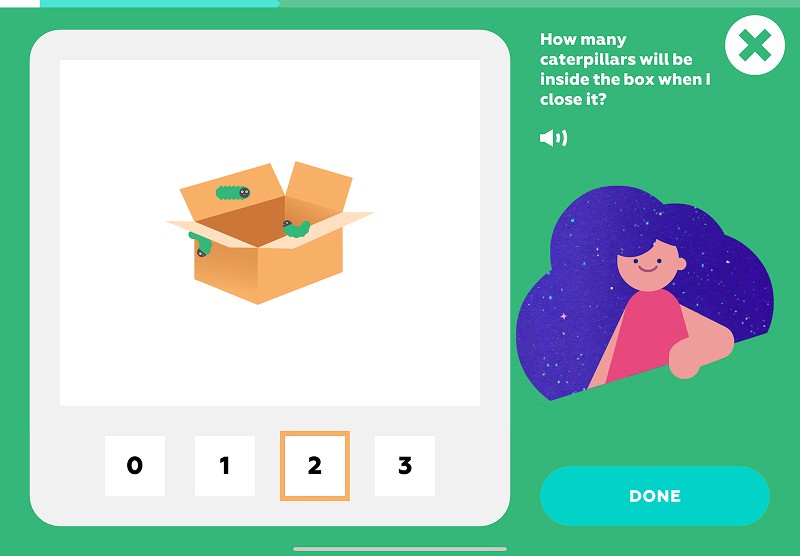
We ask a kid to imagine the box closing and count how many caterpillars will be inside.
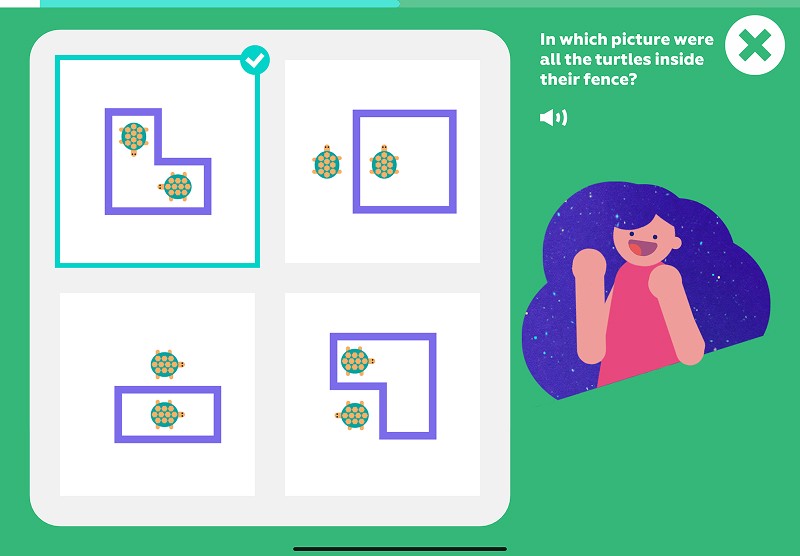
Or to look from above and decide how many turtles are inside the maze and how many are outside.
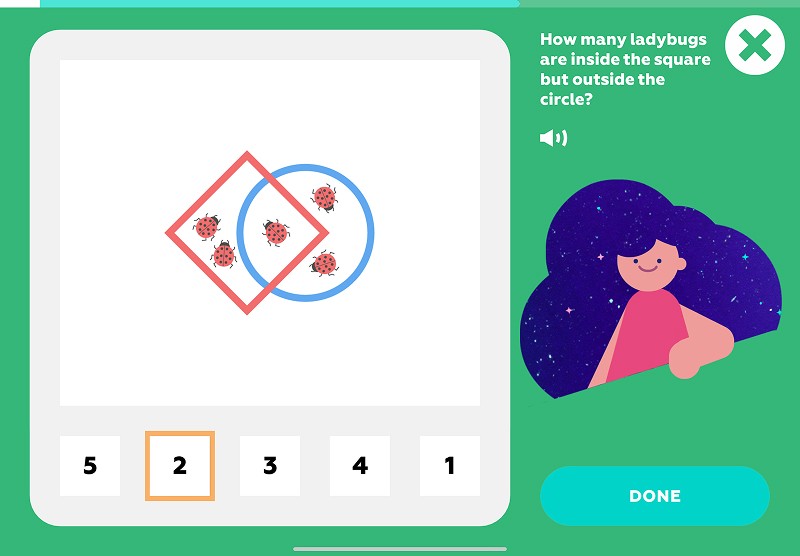
If two outlines overlap, a kid can count ladybugs that are inside the circle but outside the square. This is a step toward sets and Venn diagrams.
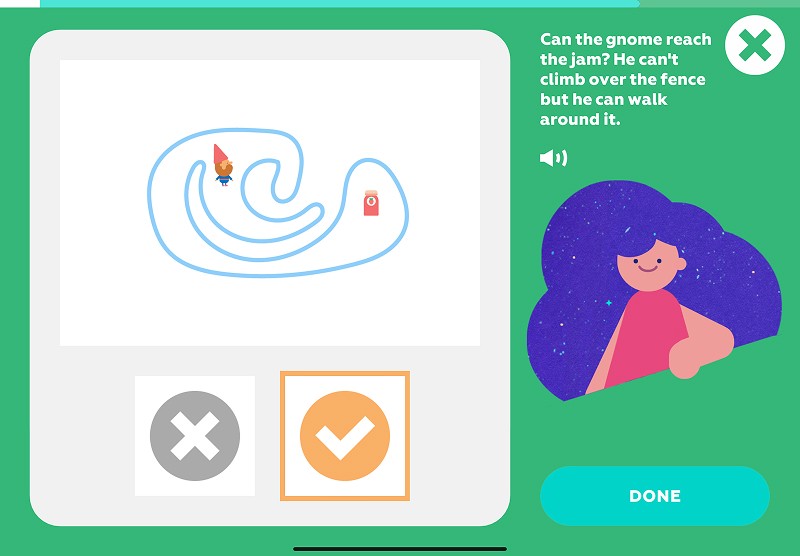
If an outline is very tangled, there is a simple way to decide whether one character can reach another without crossing it. Draw a path between them and count how many times the path crosses the outline. If the number of crossings is odd, for example 1 or 3, reaching is impossible without crossing. If it is even, for example 2 or 6, there is a way to get there without crossing.
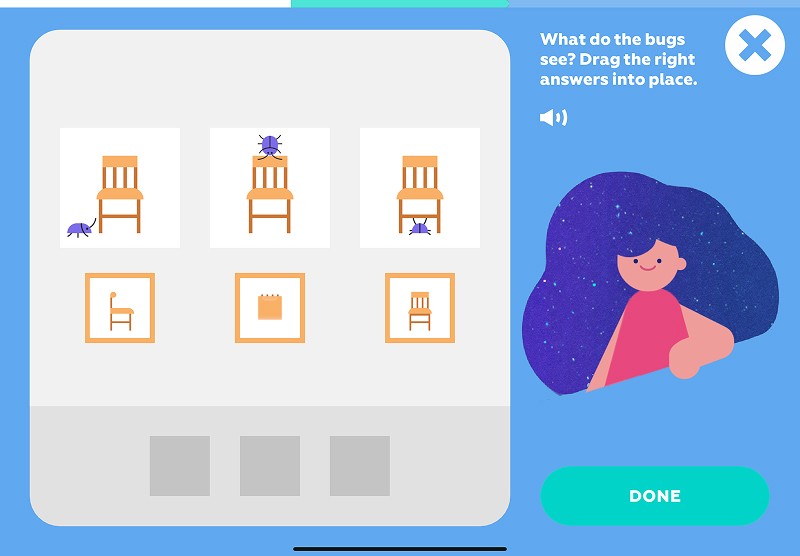
It is also useful to look at familiar things from different sides. From above, a chair looks like a square seat, and nothing else. From the side or from below, it has a completely different look.
Schemes
Spatial prepositions
Spatial prepositions
Inside and outside
Spatial prepositions
Inside and outside
Spatial prepositions
Inside and outside
Inside and outside
Even & odd
Points of view
Views from different perspectives
Big Ideas
Understanding spatial prepositions is essential for navigating real space, describing relations between objects, and building a body schema. In geometry, statements such as a ray lies between the sides of an angle and a point is at the center of a circle appear again and again.
Directions and their descriptions form an early path to vectors, which play a major role in geometry and solid geometry. Later they appear in linear algebra and multivariable calculus. Tasks that ask kids to change point of view, for example to imagine the camera in a new place or to see from someone else’s position, connect with projections. These skills help reconstruct a part from a technical drawing in drafting, 3D modeling, and engineering design, and they point toward projective geometry, the study of how shapes change when the viewpoint changes. Following spatial instructions and taking another agent’s perspective are also important in programming robots.
Inside and outside show up across mathematics. A key idea in topology is the winding number, which tells how many times a curve wraps around a point. In kids’ tasks we use a simple version: to decide whether you are inside or outside, you do not need to see the whole picture. Cast a ray from the point and count how many times it crosses the outline. This is a kid-friendly form of the point-in-polygon test used in computer graphics, robotics, navigation, and mapping.
In analysis, complex integrals can be used to compute the volume of space enclosed by a two-dimensional surface. In manifold theory, mathematicians study surfaces that have no interior at all. A classic example is the Klein bottle. You cannot mark one side as the inside, and it does not bound any region of space. Placing a Klein bottle without self-intersections in three-dimensional space is impossible, which is why it needs a fourth dimension.


