How to Help Children Understand Abstract Concepts in Early Math Learning
Early Childhood Education
Sep 18, 2026
Use objects, pictures, and short routines to teach number sense, place value, operations, and patterns to ages 3–7.

Young children do better in math when they can see and touch ideas before they work with symbols. If a child learns “14” as just two digits, math can feel like guessing. But if they first build 1 group of ten and 4 ones, the number starts to make sense.
Start with objects, move to pictures, then move to numbers and equations. That simple path helps children ages 3–7 make sense of quantity, addition, subtraction, place value, and patterns. It also matters long term: early numeracy at school entry predicts about 39% of the difference in fourth-grade math performance[1].
Here’s the short version of what to do:
Teach quantity first with blocks, fingers, egg cartons, and ten frames
Usedaily routines like snacks, steps, and setting the table for counting and comparing
Build part-whole thinking so children can see how numbers split and join
Teach additionand subtraction with objects first, then drawings, then equations
Showplace valueclearly with tens and ones, not just spoken rules
Usepatterns to help children notice what stays the same and what changes
Keep practice short - about 7 to 12 minutes
Usedigital toolsafter hands-on work, not instead of it
A few points stand out. Place value is hard because the meaning of a digit depends on its position. Pattern work also matters more than many adults think: children with stronger repeating-pattern skills at the end of pre-K were 4.27 times more likely to count to 100 by the end of kindergarten[2]. And throughout all of this, the goal is the same: help children explain what they see, not just give the right answer.
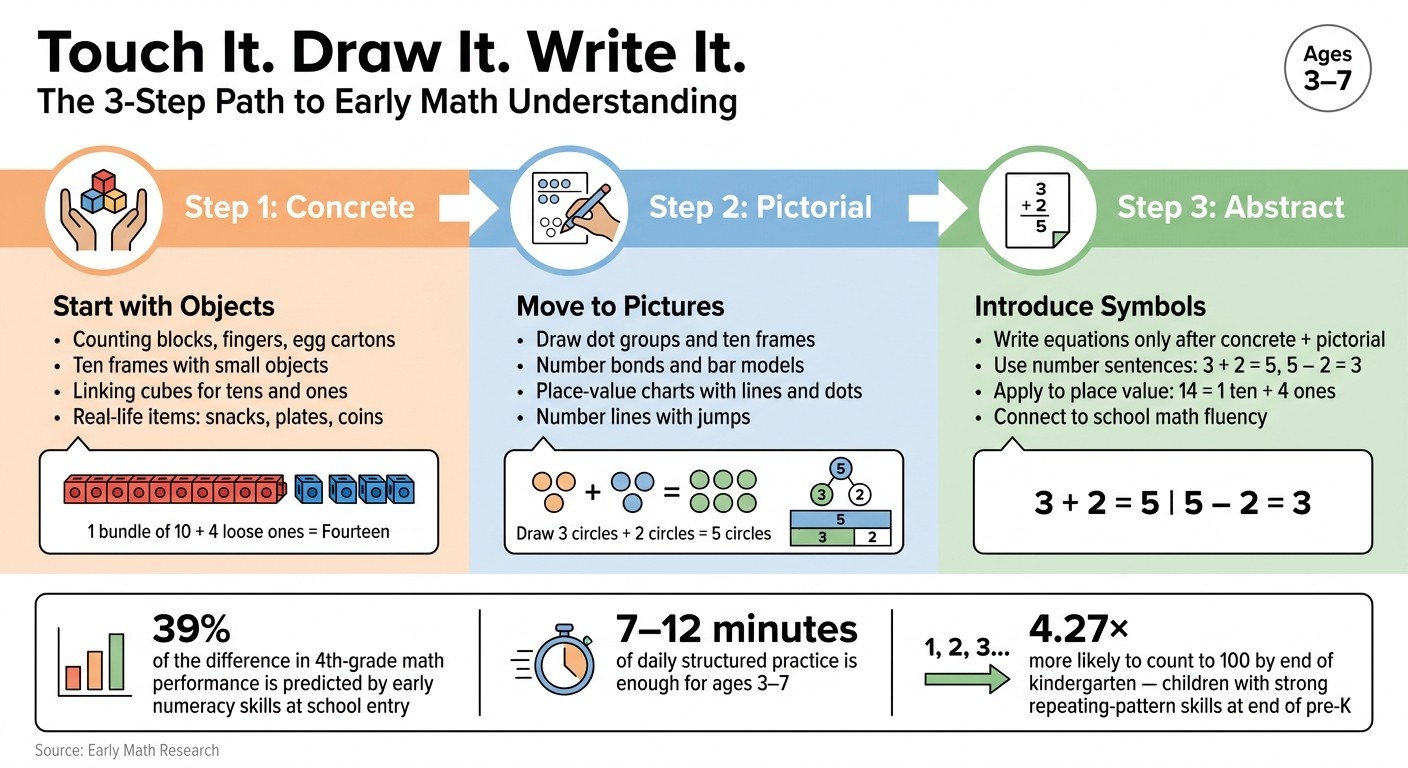
Concrete to Abstract: The 3-Step Path for Teaching Early Math
From Concrete to Abstract: The Montessori Math Approach
Build Number Sense with Objects, Pictures, and Daily Routines
Strong number sense means a child knows that 5 stands for five things, that 7 is more than 4, and that adding one more changes the amount. That’s the base early math grows from. Research shows that early numeracy skills at school entry predict about 39% of the variance in fourth-grade math performance.[1] So this isn’t small stuff.
A good way to teach it is to make numbers easy to see. Start with objects children can touch, then move to pictures, and then to number words and numerals. That CRA (Concrete-Representational-Abstract) strategy gives kids something solid to hold onto.
Make Quantity Visible with Counting Blocks, Ten Frames, and Fingers
One-to-one counting means saying one number word for each object. A simple way to practice is with 5 toy cars and a pretend parking lot. Each time you say a number, move one car. The child moves one car per count until all five are parked. It’s hands-on, clear, and easy to repeat.
Egg cartons and ten frames are also great for groups up to 10. Put small objects in the spaces and ask how many the child sees. When the top row of a ten frame is full, children start to notice that pattern as 5 without having to count every object again. That skill is called subitizing, and it helps with mental math later on.
Fingers matter too. Showing 3 with a thumb, index, and middle finger, or 5 with an open hand, gives children a built-in reference they can use anywhere. Try showing a finger pattern for 2 to 3 seconds and ask how many they saw and how they knew. That tiny follow-up matters. It nudges children to look for patterns instead of counting finger by finger.
Use Number Lines and Picture Models to Show How Numbers Grow
A number line on the floor or on poster board can make numbers feel like places, not just names. You don’t need much - 0 to 10 is enough at first. Have a child stand on 3, then hop forward 2 spaces to land on 5. Ask which number is farther right, 4 or 7, and which one is larger. The movement helps show order, distance, and size in a way kids can feel.
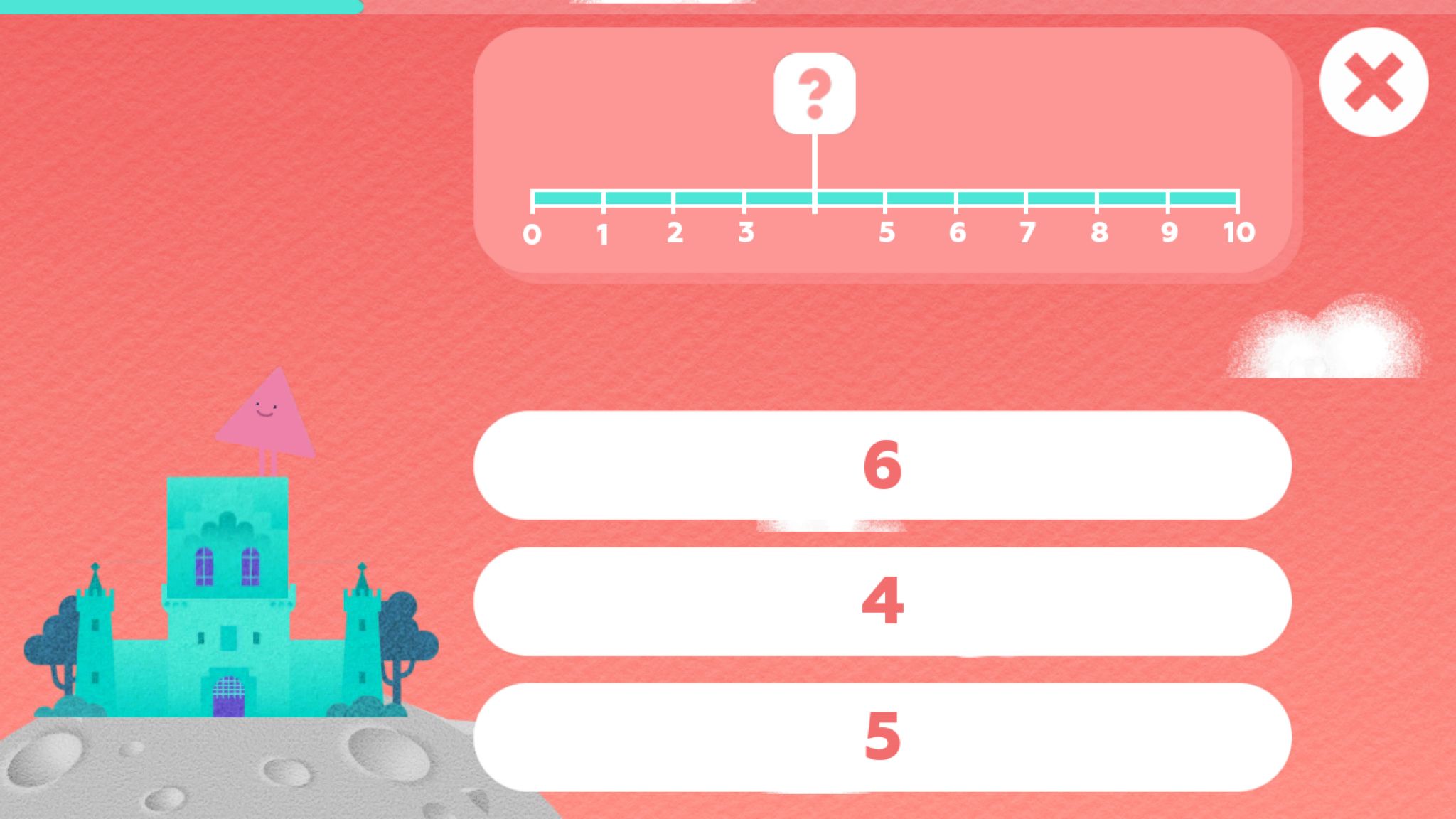
Practicing numeracy on the number line in the Funexpected Math app
At a table, a small toy car can do the same job on a paper number line. Count out loud together as the car moves. Then start linking spoken numbers to written ones. Say, “Go to six,” and let the child find the 6 on their own. Bit by bit, the spoken word, the written numeral, and the amount start to click together.
You can carry that same number language into meals, chores, and reading time, so math doesn’t stay stuck in one activity.
Turn Daily Moments and Storybooks into Math Talk
Daily routines give you math practice again and again without setting up anything fancy. Setting the table works well for one-to-one counting: there are 4 people eating dinner, so can you put out 4 plates? Sharing 8 crackers between 2 children opens the door to talk about equal shares and who has the same amount. Counting 7 steps up to the porch or noticing 3 apples in the fruit bowl keeps numbers tied to amounts children can see and touch.
The best part is the talk around it. Instead of stopping at “Count them,” try prompts like these:
Who has more, and how can we check?
What happens if we add 1 more cracker to your plate?
Those kinds of questions push children to think about amount, comparison, and simple adding.
Storybooks can help too. Ten Black Dots and Chicka Chicka 1, 2, 3 build counting into stories and pictures. In Ten Black Dots, different groups of dots become pictures, like 1 dot for a sun and 5 dots for buttons on a coat. Chicka Chicka 1, 2, 3 uses a playful story about numbers climbing an apple tree.
Pause on a page and ask how many dots the child sees and what number would come next if one more dot were added. After reading, let children remake the dot pictures with buttons or stickers. That links the story, the picture, and the amount in front of them. It also keeps building that path from picture to object to number meaning, which sets children up for equations later.
Teach Number Relationships and Simple Operations Step by Step
Once children can count and compare amounts, the next step is helping them see that numbers can break apart and come back together. Before a child can make sense of 3 + 2 = 5, they need to see that 3 and 2 join to make 5. This is part-whole thinking, a core early math skill.[3]
Teach Part-Whole Thinking with Counters, Cubes, and Real Objects
Start with a target number. 5 works well. Then grab two colors of counters or linking cubes.
Put down 2 red and 3 blue, count them all, and say: 2 red and 3 blue make 5. Then switch the groups to 4 and 1, then 5 and 0. Each time, ask the child to count and tell you what they notice.
The point is simple: 5 stays 5, even when the parts change.
As children make and remake these combinations, use the same short sentence frames again and again:
__ and __ make __
__ is made of __ and __
That repeated language helps kids hold onto patterns like 2 and 3 make 5. Later, those patterns turn into the mental shortcuts behind fact fluency.
Move from Joining and Taking Away to Drawings and Equations
Use the same object-to-picture-to-equation path here.
Concrete: Give the child 3 toy cars, then add 2 more and count 5 altogether.
Pictorial: After the child can build the set, move to drawings. On paper, the child draws 3 circles, then 2 more, and counts all 5.
Abstract: Only after the child can point to the 3, 2, and 5 in the drawing, write 3 + 2 = 5.
Use that same path for subtraction. Start with 5 cubes, take away 2, draw the crossing-out, then write 5 − 2 = 3.
If a child can’t explain what happened, stay with objects and drawings longer.[4] That’s not a setback. It just means the symbols came too soon.
Work comparison words into the talk as you go: more, less, how many left, how many more. Those words help children build relationship-based thinking alongside calculation skills.[5]
Compare Manipulatives, Visual Models, and Symbols Side by Side
Level | Examples | Best Use | Strengths | Limitations | When to Move On |
|---|---|---|---|---|---|
Concrete (Hands-on) | Counters, linking cubes, snacks, coins | Introducing joining, taking away, and part-whole ideas | Tactile; makes math visible and touchable | Can become a distraction; hard to use for larger numbers | When the child can explain the math action without needing to touch the objects |
Pictorial (Visual) | Number bonds, ten frames, dot drawings, bar models | Bridging objects to symbols; showing part-whole structure | Makes relationships easy to see; easy to record | Some children need support reading diagrams | When the child can explain the picture without the physical objects present |
Abstract (Symbolic) | Equations like 3 + 2 = 5 or 5 − 2 = 3 | Recording and communicating math efficiently | Fast; aligns with school math; handles larger numbers | Can feel meaningless without prior concrete and visual work | N/A - this is the goal |
If an equation throws a child off, go back a step. Return to the picture or the objects. That same part-whole idea will show up again when children start working with tens and ones.
Teach Place Value and Patterns Through Structure Children Can See
Place value builds on the same part-whole idea children use in addition. The difference is that now the parts are tens and ones. A two-digit number is made of groups of ten and single ones, and children need to see and build that idea before writing numerals.
Use Grouped Objects and Base-Ten Models to Explain Tens and Ones
The big idea is simple: each two-digit number is made of groups of ten and single ones. If a child hears “fourteen,” they should first see 1 bundle of ten and 4 loose ones. Keep your wording steady and plain: “Fourteen means 1 ten and 4 ones. Twenty-three means 2 tens and 3 ones.”
Linking cubes work well here. Ask the child to build a train of 10 cubes, then place it next to 4 single cubes and say, “1 ten and 4 ones makes fourteen.” Do this again and again with numbers from 10 to 99 so the structure starts to feel familiar.

Moving from pictorial objects to abstract 2-digit numbers in the Funexpected Math app
A Tens and Ones mat helps too. Children can place ten rods in the tens column and single cubes in the ones column, then say the number out loud before writing it. Early on, skip shortcut phrasing like “the 2 is in the tens place.” Instead, say, “This 2 means 2 tens.” That small shift matters. It ties the numeral to an amount children can picture.
Connect Place Value to Drawings, Charts, and Number Lines
Once children build a number with objects, ask them to draw what they made. Use a quick ten or a straight line for each ten, and a dot for each one. So for 23, a child draws 2 lines and 3 dots in a labeled place-value chart, then writes the numeral below.
Next, move to the number line. Start at 0, make two jumps of 10 to land on 20, and then three jumps of 1 to land on 23. Say it in plain language: “Two tens moved us to 20. Three ones moved us to 23.”
That link matters. The mat, the drawing, and the number line are all showing the same number in different ways. Later, that makes addition and subtraction with tens much easier to grasp.
Build Early Algebra Thinking with Repeating and Growing Patterns
Once children can see tens and ones, patterns give them another way to notice structure. They start to look for what stays the same and what changes.
Patterning isn’t just a fun add-on. Research shows that children with stronger repeating patterning skills at the end of pre-K were 4.27 times more likely to successfully count to 100 by the end of kindergarten. [6]
The main job here is to help children notice the pattern and say what they see. With a red-blue-red-blue block line, ask: “What’s the rule? What comes next? How do you know?”
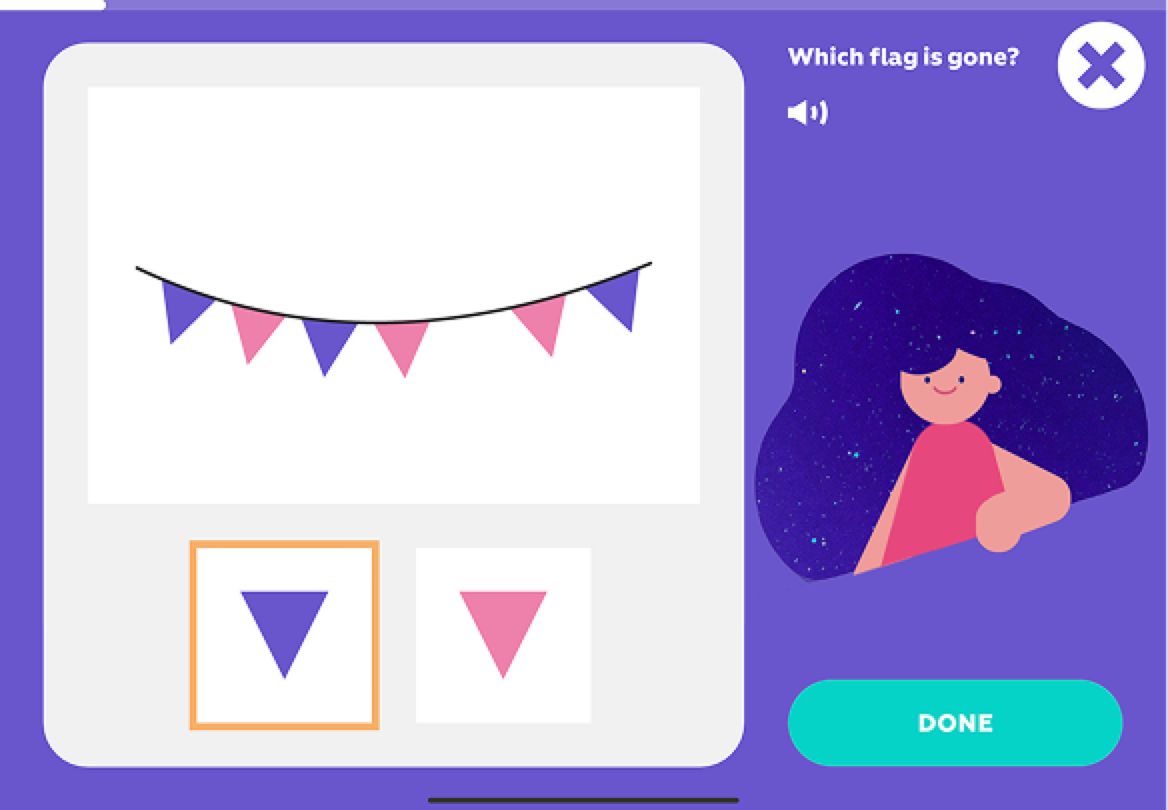
A simple pattern task in the Funexpected Math app
Let children explain it in their own words first. After that, you can bring in terms like repeating and unit.
For growing patterns, build block staircases: 1 block, 2 blocks, 3 blocks. Then ask, “How many blocks will the next tower need? What changes each time?”
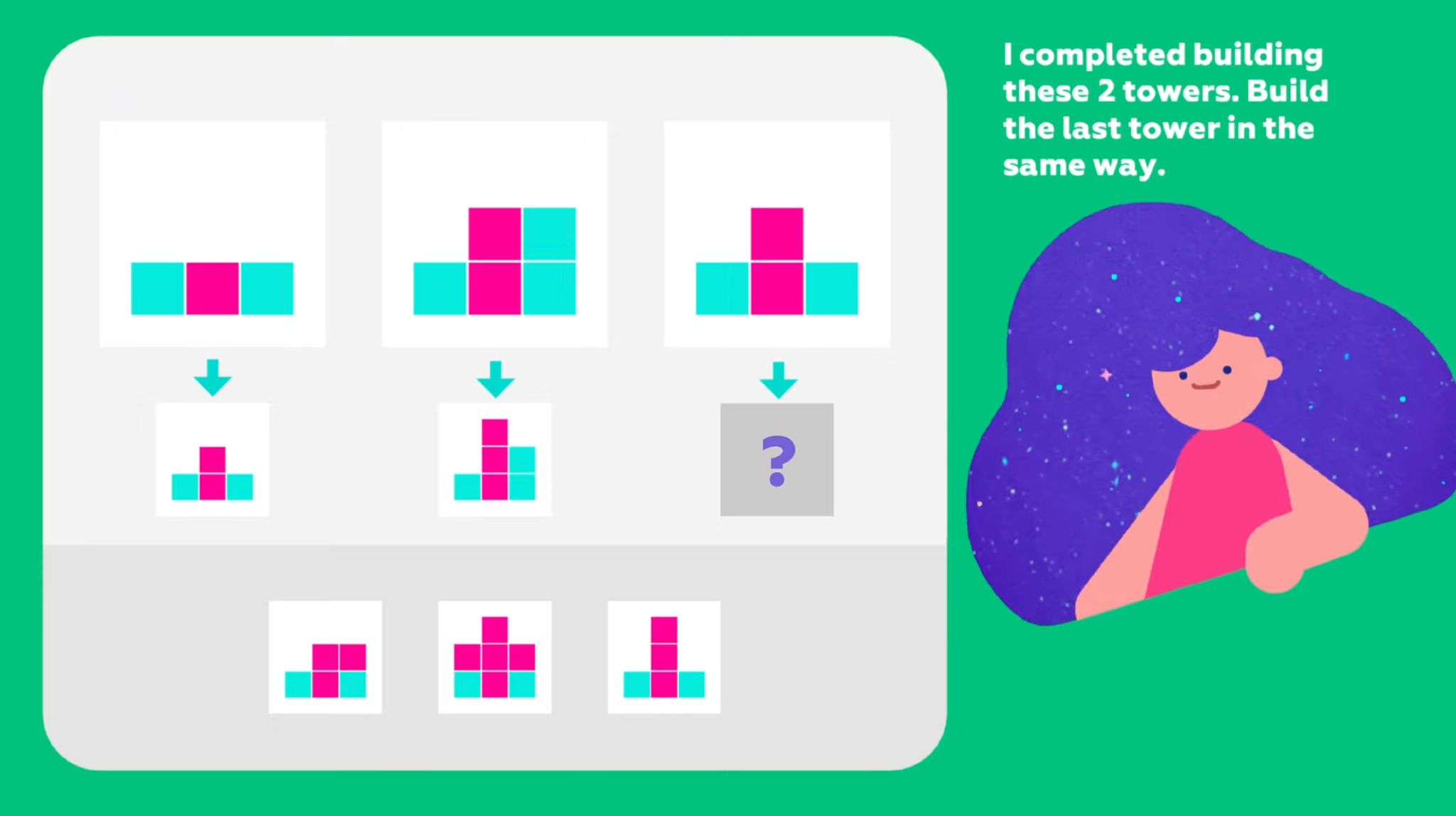
An advanced pattern task in Funexpected Math app
That question - what changes each time? - is where rule-finding begins.
Pattern Type | Example Activity | Skill Built |
|---|---|---|
Repeating AB | Continue red-blue-red-blue. | Sequencing, identifying repetition, basic rule-finding |
Repeating ABC | Continue clap-tap-jump. | Recognizing longer cycles, memory for ordered steps |
Growing by +1 | Build staircases: 1-block, 2-block, 3-block, 4-block towers | Understanding change, predicting "what comes next" |
Growing by +2 | Place 2, 4, 6, 8 stickers in a row; child predicts the next number | Recognizing constant increase, verbalizing rules ("add 2") |
Plan Simple Math Experiences at Home or School
Create a Short Daily Routine That Follows the Concrete-to-Abstract Path
To turn these ideas into habits, keep the routine short and repeatable. You don't need a formal lesson. Seven to 12 minutes in three parts is enough.
Start with children touching or moving objects. Then have them draw or model the idea. After that, write the symbol or solve a short story problem. That simple path matters: touch, draw, then write.
This can happen almost anywhere. Circle time works. A car ride works. Snack time works too. The point isn't the setting. It's using the same path again and again so the idea starts to stick. After children touch and draw the idea, digital practice can give that same concept one more quick round.
Use Digital Practice to Support Learning with Funexpected Math
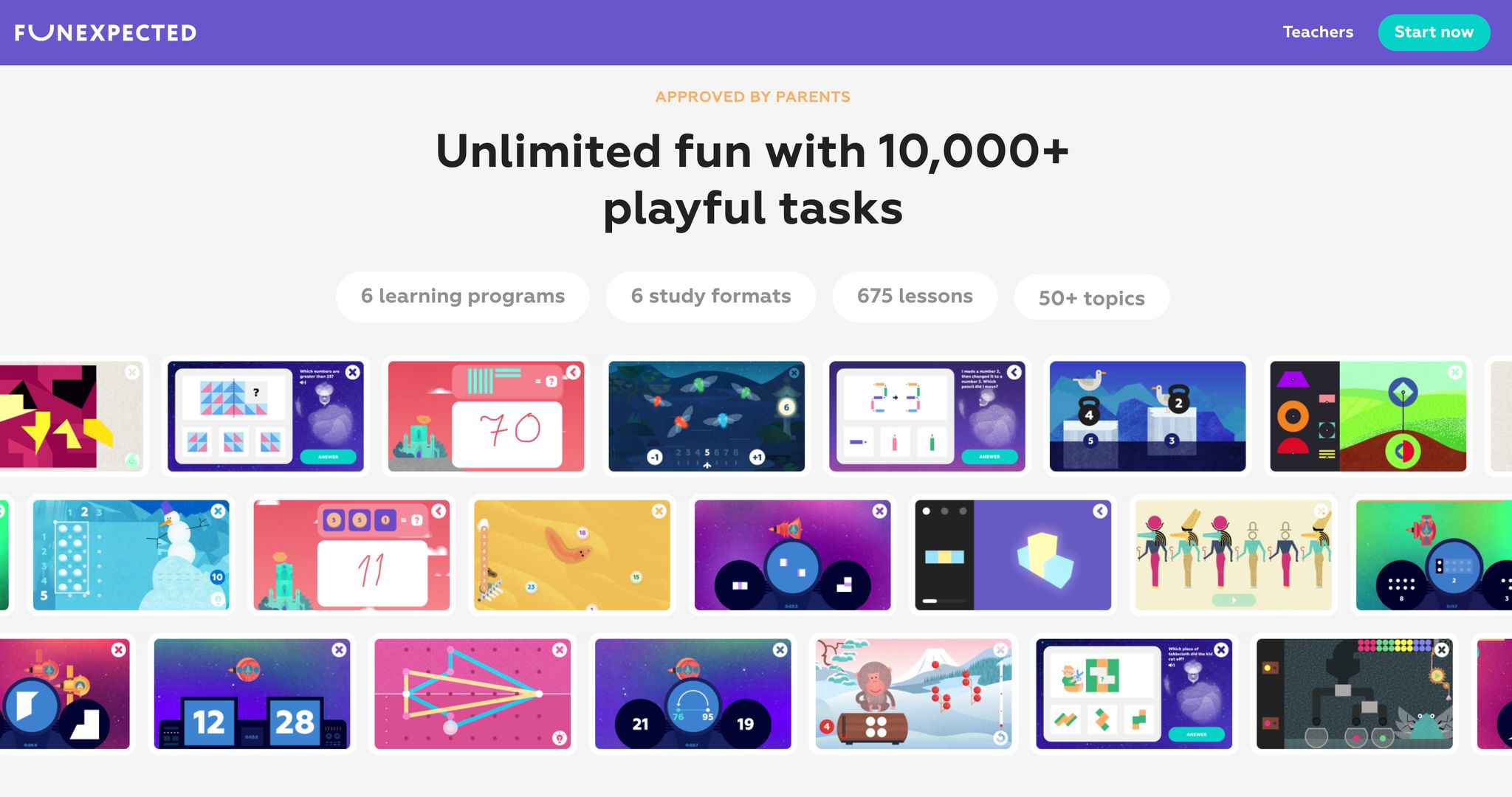
Once a child has worked with objects and drawings, a short digital activity can reinforce the same idea in a new format. Funexpected Math is built for children ages 3–7 and covers number sense, operations, place value, and patterns through interactive tasks across 50+ topics.
It adjusts to each child's level and gives immediate feedback, so children can use it on their own or with an adult nearby. For parents, it includes progress tracking, which helps you see which concepts a child is gaining confidence in. For educators, it offers classroom tools such as easy rostering, statistics and reports, and ELL support. It is also COPPA and FERPA compliant.
Use it after hands-on work so children practice the same idea in a new format. Used this way, digital practice supports - not replaces - hands-on learning.
Conclusion: Keep Math Concrete, Visual, and Connected to Real Life
The same pattern works at home and at school. Abstract math feels easier when children can see it, touch it, draw it, and then name it.
Brief daily routines, math talk during ordinary moments, storybooks, visual models, and guided digital practice all play a part. No single method does the whole job on its own. What matters most is consistency: coming back to the same learning path so children build understanding instead of just memorizing steps.
A five-minute counting game at breakfast or a short app session after block play can help a child move forward.
FAQs
How do I know if my child is ready for math symbols?
Your child is ready for math symbols when they’ve built a strong base through the Concrete-Representational-Abstract (CRA) approach. That means they’re at ease using physical objects like blocks or counters first, then moving to drawings or simple diagrams to show those same amounts.
One clear sign: they can explain their thinking with confidence during hands-on and visual work. That tells you they understand how quantities, pictures, and symbols connect.
What if my child can count but doesn’t understand quantity?
If your child can recite numbers but doesn’t grasp quantity, they may be relying on rote counting. A simple way to build one-to-one correspondence is to have them touch or move each item as they count.
Start with physical objects like blocks, beads, or snacks. As they count, make sure each number matches one object. You can also group items to show how amounts connect, or use a ten-frame so they can spot larger quantities at a glance. That helps turn number ideas into something they can see and feel.
How can I teach place value without worksheets?
Use hands-on tools so children can build numbers as groups of tens and ones. Base-ten blocks, bundles of craft sticks, and connecting cubes all work well. For example, snapping 10 cubes together is a simple way to show one ten.
Then have children sort objects into tens and count the leftover ones. Coins, place-value cards, hundreds charts, and skip-counting games can help link that physical grouping to written number symbols.
Related Blog Posts
Transform Math Learning for Kids
Explore Funexpected's interactive math program designed for children aged 3-7. Build math fluency, logic, and problem-solving skills through engaging, hands-on activities and a personalized digital tutor.