Best YouTube Math Channels for Kids by Age
Early Childhood Education
May 20, 2026
Explore top YouTube math channels tailored for kids by age, covering essential topics through engaging formats for effective learning.

Looking for engaging YouTube math channels for kids? Here's a quick guide to the best options by age group, their unique formats, and the math topics they cover:
Funexpected Math (Age 3+): This channel offers lessons, stories, and songs led by a virtual tutor for young children. It focuses on counting, spatial skills, logic, and problem-solving.
Numberblocks (Age 3+): Animated block characters teach counting, addition, subtraction, and basic multiplication in short, entertaining episodes.
Numberjacks (Age 3+): This show mixes live-action and animation to teach counting, patterns, shapes, and basic math through problem-solving adventures.
Homeschool Pop (Age 5+): Lively videos use animation and real-life examples to teach arithmetic, measurement, and basic geometry.
Mathantics (Age 8+): Clear and funny animated lessons cover topics such as fractions, decimals, geometry, and pre-algebra.
These channels use visuals, songs, and interactive elements to make math enjoyable for kids at every developmental stage. Pairing these videos with hands-on activities can additionally enhance learning. Below is a quick comparison to help you choose the best fit.
Quick Comparison
Channel | Age Group | Format | Topics Covered |
|---|---|---|---|
3+ | Lessons, tales, songs | Counting, spatial skills, logic, problem-solving | |
3+ | Animated short episodes | Counting, addition, subtraction, basic multiplication | |
3+ | Interactive AI lessons | Counting, geometry, logic, problem-solving | |
3+ | Live-action + animation | Patterns, shapes, basic arithmetic | |
5+ | Animated + real-world demos | Arithmetic, measurement, beginner geometry | |
8+ | Animated lessons | Fractions, decimals, geometry, pre-algebra |
Pick a channel that suits your child’s age, skills, and learning style for the best experience.
1. Funexpected Math (3-7 years)

Funexpected Math supplements traditional math education by offering extra learning in a supportive digital format [1].
The channel content covers topics and skills from areas like counting, basic operations, geometry, logic, and problem solving. Each video is dedicated to a single topic and features problems that a tutor solves together with a child.
This way Funexpected Math turns passive screen time into active learning. Each video also features a catchy song to help kids remember the topic.
The channel also offers "Funexpected Tales," where math topics are taught through engaging stories:
The videos feature the most essential math concepts with topics like “Subitizing“, “Place Value“, “Addition Strategies“, “What is a pattern?“, and more.
For the parents’ convenience, the content is sorted into playlists for each age.
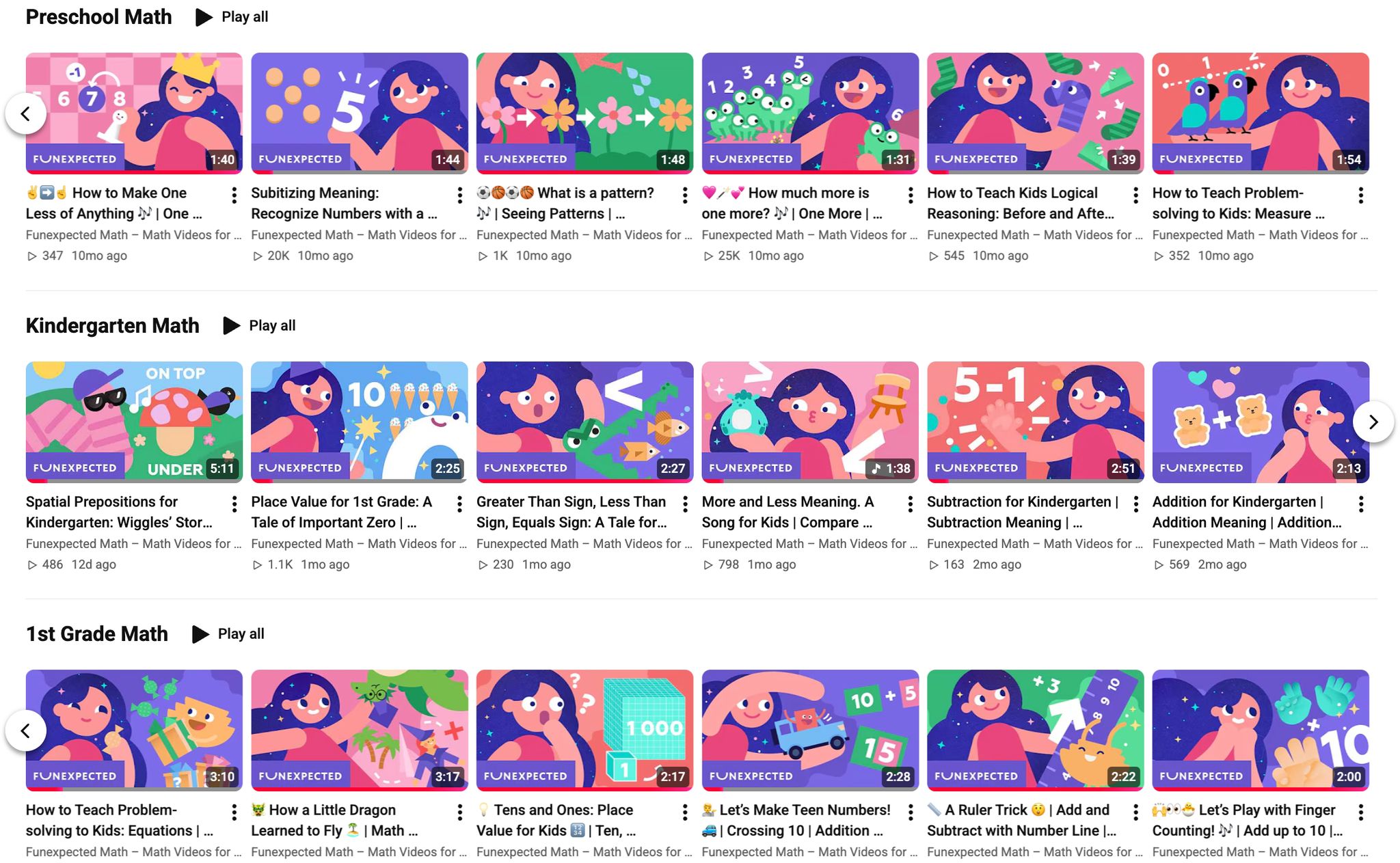
This YouTube channel is a natural extension of the award-winning Funexpected Math mobile app, using a similar approach and educational principles.
Funexpected Math creates an engaging and interactive environment for children aged 3–7, making abstract math concepts more accessible through hands-on learning activities.
At the heart of the app is an AI-powered tutor named Aika, who adapts to each child individually. Aika is also a host and the main hero of the YouTube channel.

Aika gives personalized help by offering hints, explaining math terms, and asking questions that build on what your child knows. Friendly animated characters cheer kids on and celebrate their progress, helping them feel confident and positive about math.
Funexpected Math app has earned multiple international awards, including Best Original Learning App (Kidscreen Award 2025) and Best Math Learning Solution (EdTech Breakthrough Award).
2. Numberblocks

Numberblocks makes math an adventure for kids ages 3 and up by turning numbers into animated characters. This British series, found on Netflix and YouTube, uses a visual style where each character is built from blocks that correspond to its number.
For example, the character Three is built with three blocks. To reinforce the concept, a floating black "Numberling" above each character’s head displays their numerical value, making it easier for children to grasp what numbers represent [2].
The animation encourages hands-on learning. Characters join together to make new numbers, showing addition in a fun way. Each number has its own personality—One is bold, Four loves squares, and Seven is colorful—making math feel like a story [2].

Episodes come in different lengths, from short number songs to longer explorations and hour-long compilations. They cover counting, number recognition, addition, subtraction, and early multiplication, starting with simple ideas and building up to more advanced math.
Numberblocks has been praised by teachers, earning a 2017 BAFTA nomination in the "Learning" category and partnering with the NCETM. Its creative style makes math fun and encourages kids to explore more educational content [2].
3. Numberjacks

Numberjacks makes math fun and interactive for kids ages 3 and up by mixing live-action and animation. This British series also turns numbers into characters who solve everyday problems with simple math. The mixture of real-life scenes and animated adventures helps kids explore basic math skills.
The show introduces ten colorful number characters (0 through 9), each with an individual personality. Together, they go on missions to solve puzzles and fix mathematical mishaps in their world. Every 15-minute episode follows the same format: the Numberjacks receive a call about a "math emergency" and jump into action to set things right.
Episodes switch between live-action scenes, where kids see math in daily life, and animated parts showing the Numberjacks solving problems together. This approach connects math ideas to real situations, making them easier for kids to understand.

The show covers topics like counting, number recognition, basic addition and subtraction, patterns, sequences, shapes, spatial awareness, and problem solving. By making numbers friendly and relatable, it helps kids see math as something fun and approachable.
Each episode uses engaging scenarios and interactive call-and-response moments to bolster essential math concepts, keeping kids actively involved. This combination of story and hands-on learning supports early numeracy skills while complementing other educational methods.
4. Homeschool Pop

Homeschool Pop makes fun, educational videos for elementary kids ages 5 and up. The channel teaches key math concepts through short, easy-to-follow lessons on topics like addition, division, and fractions. You’ll also find hour-long math compilations for each grade.

Their videos mix lively animation with real-world examples, covering basic arithmetic, measurement, and beginner geometry. This approach makes math easier to understand and adds variety to early math learning.
5. Mathantics

Mathantics is a great resource for students ages 8 and up, covering math topics usually taught from 3rd to 8th grade. Its clear, step-by-step explanations help kids understand tough concepts.
Mathantics stands out for its funny animations, which make math lessons more enjoyable. The channel offers two types of videos: "Video Lessons" for detailed explanations and "Extras" for focused topics. Lessons are grouped by subject, not grade, so students can easily find what they need.

The channel covers many topics, starting with basics like place value and rounding. It also teaches arithmetic skills such as order of operations, factoring, and advanced ways to solve multi-digit problems. Mathantics goes further with lessons on fractions, percentages, ratios, geometry, statistics, measurement, and beginner algebra.
Some of the main topics include:
Points, lines, angles, and polygons
Area, perimeter, and the Pythagorean theorem
Mean, median, mode, and probability
The metric system, telling time, and solving equations
Exponents, polynomials, and graphing on coordinate planes
The creators want to make math less stressful by keeping lessons simple and fun. Mathantics is great for building calculation skills, but it doesn’t focus much on word problems or broader strategies. For a complete math education, try using it with other resources. Its friendly, animated style gives students a strong base for harder math later on.
How Math Skills Develop by Age
Kids learn math step by step, starting with number recognition and moving to harder problems. Understanding how these skills develop at each age helps you choose the best YouTube channels and tools for your child.
Ages 3-4 are when kids take their first steps into mathematical thinking. They begin recognizing numbers, counting up to 10, and identifying basic shapes like circles and squares. Concepts like "more" and "less" start to make sense, laying the foundation for future math skills.
Ages 5-6 bring noticeable growth in number sense and basic math operations. Children can count beyond 20, perform simple addition and subtraction within 10, and identify patterns. They start linking numbers to quantities, moving beyond mere memorization. This is also when they begin to see math as a handy tool for solving everyday problems.
Ages 7-8 mark a big leap in understanding. Kids can now handle multi-digit addition and subtraction, grasp place value, and explore basic fractions. Their logical thinking sharpens, allowing them to follow multi-step instructions and explain how they solve problems.
Ages 9-10 introduce more abstract concepts. Multiplication and division become second nature, decimals and more complex fractions come into play, and spatial reasoning improves. Geometry topics like area and perimeter enter the mix, and problem-solving becomes more strategic as kids learn to choose the best methods for different challenges.
As kids get older, they move from hands-on, visual learning to working with symbols and abstract ideas. Younger children often enjoy colorful shows like Numberblocks, while older kids do well with the more systematic lessons in Mathantics.
Age Group | Key Math Skills | Ideal Channel Features | Example Topics |
|---|---|---|---|
3-4 years | Number recognition, basic counting, shape identification | Bright visuals, songs, simple animations | Counting 1-10, basic shapes, comparing sizes |
5-6 years | Counting beyond 20, simple addition/subtraction, pattern recognition | Interactive stories, engaging visuals, fun characters | Addition within 10, 2D shapes, simple patterns |
7-8 years | Multi-digit operations, place value, basic fractions | Step-by-step explanations, humor, clear visuals | Place value, multiplication tables, basic geometry |
9-10 years | Advanced operations, decimals, geometry concepts | Structured lessons, problem-solving strategies, real-world examples | Long division, fractions and decimals, area and perimeter |
Matching content to a child's developmental stage is key for effective learning.
Cognitive development plays a huge role in how kids grasp math. Younger children think concretely - they need to see or touch objects to understand concepts. As they grow, they develop abstract thinking, which allows them to work with numbers as symbols instead of just physical representations.
Language skills matter too. As math gets harder, kids need to know terms such as "sum," "difference," "product," and "quotient." Channels that teach math vocabulary along with lessons help kids connect these words to the ideas they represent.
Kids’ attention spans change as they grow. Preschoolers can focus for only 3–5 minutes, while older kids can watch for 15–20 minutes. That’s why some channels use short, song-based videos, and others offer longer lessons.
Every child is different—some learn advanced math early, while others need more time with basics. YouTube lets you choose videos that fit your child’s understanding, not just their age.
Math skills build on each other, so a strong foundation is important. Missing early concepts can make harder topics tough later on. That’s why channels like Funexpected Math and Mathantics are made for certain age groups. Knowing your child’s stage helps you pick the best resources for their math journey.
How to Pick the Right Channel for Your Child
To find the best math channel for your child, match the videos to their learning style and current skills. This way, the content will be both fun and helpful, building on what we’ve covered above.
Begin by looking at your child’s math skills, not just their age. For instance, a 5-year-old who knows addition might be ready for older content, while a 7-year-old still learning to count may need younger lessons. Ask yourself: Can they count to 20? Recognize numbers? Solve simple addition in their head? Your answers will help you pick the right videos.
Think about how your child learns best. Do they like animations and bright visuals? Or do they learn better with songs and spoken explanations? Some kids need hands-on activities or movement. Once you know their style, choose videos that fit their preferences and attention span.
Pick video lengths that match your child’s focus. Younger kids usually do better with 5–10 minute videos, while older kids can watch for 15–20 minutes. If your child loses interest, try shorter videos or break longer ones into parts.
Explore different channels with your child. Watch a few videos together to see what they enjoy. Some kids love the songs and characters in Funexpected Math, while others prefer the clear teaching in Homeschool Pop. As your child grows, their tastes may change, so check in regularly.
Notice how your child reacts to the videos. Are they asking questions, explaining ideas, or trying problems on their own? These are good signs. If they just watch without much interest, try other channels. Remember, the wrong content can add to math anxiety, so keep things positive.
Align with school learning. While YouTube channels are great for supplementing classroom material, they shouldn’t contradict what your child is learning at school. If their teacher uses specific methods or terminology, look for channels that reinforce those approaches to avoid confusion.
Prioritize quality and accuracy. Well-produced videos with clear visuals, good audio, and, most importantly, reliable information obviously work better than poorly made content. Platforms such as Funexpected Math and Numberblocks, with positive feedback from parents and educators, as well as a solid track record, are usually safer choices.
Think about your family’s screen time rules. Some channels use autoplay for endless videos, while others offer structured lessons. Decide if you want math videos to be a quick daily activity or part of a longer session, and pick channels that fit your plan.
Try using more than one channel. Mixing options can work best. For example, you could combine Numberblocks’ visuals with Homeschool Pop’s detailed lessons, or add Funexpected Math’s interactive features to keep things interesting.
The best channel is the one that keeps your child interested and helps them learn. If something isn’t working, try different options until you find what fits your child best.
Conclusion
The right YouTube math channel can make math exciting instead of stressful. Each channel we’ve covered has its own style, from the colorful stories in Numberblocks and Funexpected Math to the clear, simple lessons in Mathantics for older kids.
Experts agree that visual and interactive content can greatly improve how young learners grasp concepts [4] [6]. For instance, preschoolers might love watching animated problem-solving adventures on Numberjacks, while older children could gain clarity on fractions and other topics through Mathantics. This kind of age-specific content helps lay a firm foundation for future learning.
One big advantage of these channels is that they’re free - no subscription required for the basic content on YouTube. This makes quality math education accessible to most families. Many parents have observed that consistent viewing not only sparks enthusiasm for math but also sharpens problem-solving skills and improves confidence in the classroom [5] [6].
Since every child learns differently, it’s worth exploring a mix of channels to find what resonates. While one channel might engage your child, another might not click as well. Combining resources ensures you can tailor the experience to fit your child’s unique interests and learning style.
FAQs
How can I choose the best YouTube math channel for my child's age and learning needs?
To choose the best YouTube math channel for your child, start by thinking about their age and current math abilities. For younger children (age 3+), channels like Numberblocks and Funexpected Math offer fun, captivating content to introduce basic concepts. For older kids (age 8+), Mathantics provides clear and simple explanations that suit more advanced learners.
Pay attention to the style and topics of the videos on each channel to ensure they fit your child's study preferences. Some channels use storytelling or animated characters to make learning fun for younger viewers, while others focus on detailed, step-by-step instructions that work well for older children. By matching the channel’s approach to your child’s interests and needs, you can turn math into an enjoyable and productive experience.
How can I use YouTube math channels to support my child's understanding of math concepts in their daily routine?
To make the most of YouTube math channels in your child's daily routine, dedicate a regular time each day to watch short, age-appropriate videos that fit their current learning level. Keeping these sessions brief ensures their attention stays focused and the experience remains enjoyable.
After watching, build on what they’ve learned by discussing the concepts or engaging in related activities. For example, you could solve simple math problems together or play interactive math games. These follow-up activities help bridge the gap between the videos and real-world applications, keeping the learning process more meaningful. The combination of consistency and active participation can turn math into a fun and rewarding part of their day!
How do the math topics on these YouTube channels support what my child is learning in school, and can they be used to complement classroom lessons?
The math topics featured on YouTube channels like Numberblocks and Mathantics closely mirror what kids learn in school, while Funexpected Math covers the core curriculum and goes beyond it. Anyway, these channels teach essential skills like addition, subtraction, fractions, geometry, and other core concepts that match well with elementary-level curriculum.
What makes these channels stand out is their ability to complement classroom learning. Through appealing visuals and interactive explanations, they make math more approachable and enjoyable for kids. Whether it's for extra practice, help with homework, or presenting new topics, these videos can trigger curiosity while improving confidence in math.
Related Blog Posts
Transform Math Learning for Kids
Explore Funexpected's interactive math program designed for children aged 3-7. Build math fluency, logic, and problem-solving skills through engaging, hands-on activities and a personalized digital tutor.