Teaching Children a General Concept of Time: Why, When and How
Early Childhood Education
Sep 25, 2026
Practical guide to teaching time through routines, sequence, timers and age‑appropriate activities for young children.

The biggest misconception in teaching the time concept to kids is assuming it starts with learning the clocks. It’s much better to start with daily routines, simple order words, and short waiting activities.
Here’s this article idea in a nutshell: time learning grows in 6 parts - sequence, duration, change, recurrence, measurement, and clock/calendar time. Most young children grasp what comes first and next before they can tell how long something takes or read 8:30 AM on a clock. And one key point stands out: children often find “after” harder than “before.”
To help a child build a better sense of time, focus on:
Order first: first, next, last
Daily patterns: meals, bath, bedtime, school days
Waiting practice: short timers, turn-taking, cleanup races
Time words: yesterday, today, tomorrow, soon, later
Concrete tools before abstract ones: pictures before clocks, routines before calendars
A child’s progress often follows this path:
Time skill | What it means | Early example |
|---|---|---|
Sequence | Knowing event order | Socks before shoes |
Duration | Sensing short vs. long | Waiting 2 minutes feels different from 20 minutes |
Change | Seeing things change over time | A plant gets taller |
Recurrence | Noticing repeated patterns | Bedtime happens every night |
Measurement | Using number-based time words | 5 minutes, 2 days, 1 week |
Clock/calendar time | Using formal time tools | Reading a clock or finding a date |
Age matters, but not in a strict way. In many cases, toddlers notice routines, preschoolers can sort simple sequences, ages 5–7 begin clock and weekday work, and older children handle planning and elapsed time. That said, children do not all move at the same pace.
The main idea is simple: move from lived experience to symbols. First the child does something, then pictures it, then measures it. That makes time less confusing and more usable in daily life.
What It Means for a Child to Understand Time
Time understanding doesn’t arrive all at once. It builds piece by piece.
A child might know what happens next in a routine long before they understand how long that step takes or how far away it is. So before a child can read a clock, they’re often already building a sense of time in other ways.
The 6 Parts of Time Understanding
These parts usually show up in daily life before children use formal time words or tools:
Sequence is knowing the order of events - first, then, last. A child who knows socks come before shoes understands sequence.
Duration is the sense of how long something takes - the difference between a short wait and a long one.
Change is noticing that things become different over time - a plant grows taller, a baby sibling gets bigger, hair needs another haircut.
Recurrence is seeing patterns that repeat - bedtime happens every night, Saturday follows Friday, birthdays come once a year.
Measurement means using numbers to talk about time - minutes, hours, days, weeks.
Clockand calendar time is the formal system: linking a familiar event to a specific time or finding a birthday on a calendar.
These skills don’t all grow at the same pace. A child can notice recurrence, like bedtime happening every night, well before they understand measurement.
Why These Parts Develop at Different Rates
Children often learn some parts of time by memory before they grasp what those parts mean. For example, a child may recite the days of the week in order without understanding how far apart those days are. They may know the sequence, but not the spacing between events.
There’s another wrinkle too: children usually find “before” easier than “after.” [1] And predicting what comes next often takes more effort than recalling what already happened. That uneven pattern shapes how children deal with routines, waiting, and planning in daily life.
Why Time Matters and Why It Is Hard for Young Children
How Time Supports Routines, Communication and Planning
When a child understands sequence, everyday routines get a lot easier. Getting dressed is a simple example: socks come before boots, and that order matters. Once children start to grasp that, they can move through multi-step tasks with less help. They can also plan ahead a bit more and act on what comes next instead of waiting for an adult to step in.
Time sense also shapes how children communicate. Words like yesterday, tomorrow, and soon help them talk about things beyond the present moment, which is a big step in language growth. Practice with event order also feeds into later math thinking, including the idea of reversing steps.

A task on order of events in the Funexpected Math app
If the sequence is socks, then boots, undoing it means the boots have to come off first. [1]
Even with that, time is still hard to learn because children can’t see it or touch it. They have to figure it out from the events around them.
How Is the Concept of Time Connected to Math Learning
Time is not just a practical skill children need to learn before they can read a clock. It is an important part of early mathematical thinking because it gives children opportunities to order, compare, measure, count, and recognize patterns.
When children understand that one event happens before another, they are learning about sequence and order — ideas that also underpin number sequences and mathematical reasoning.
Understanding these concepts, children can acquire ordinal numbers much easier. Words like “first“, “second“, “third“, “next“, “last“ are crucial for early math learning. And these terms are often connected with the time concept.
When children compare which activity takes longer — getting dressed or brushing their teeth, for example — they are learning to compare quantities.
Time also gives children a natural introduction to measurement. Concepts such as a minute, an hour, or a day connect numbers to real-world quantities. Children gradually learn that numbers can describe not only how many objects there are, but also how long something lasts.
Talking about time also develops estimation. Questions like “How long do you think this will take?” or “Which will take longer?” encourage children to make predictions, compare them with what actually happened, and develop an intuitive sense of quantity and duration.
Recurring events — weekdays and weekends, day and night, or the changing seasons — introduce children to patterns and cycles, which later become important in mathematical reasoning.
Finally, understanding time provides a foundation for more complex math skills, including calculating intervals, working with units of time, adding and subtracting durations, and solving elapsed-time problems.
That is why learning about time is not an isolated topic. It is a natural context for developing several core mathematical skills: number sense, comparison, measurement, estimation, sequencing, pattern recognition, and problem-solving.
Why Time Is Abstract for Preschool and Early Elementary Children
That’s the core problem: time is invisible. Young children have to infer it from change, routines, and what people say.
Different parts of time sense are hard in different ways. Duration is tough because it doesn’t feel steady. A few minutes can seem long or short depending on what’s happening, so judging how much time has passed is hard for young children. Clock and calendar time bring another layer of difficulty. They’re human-made systems, and they stack several ideas at once - days, dates, weeks, months, seasons, and years. That’s a lot for a young mind to keep straight.
There’s also a big mental jump between past and future. Talking about the past leans on memory. Talking about the future asks a child to imagine something that hasn’t happened yet. Predicting future events takes more mental effort than remembering past ones. [1]
Those uneven skills help explain why age plays such a big part in learning about time.
What Children Can Understand at Different Ages
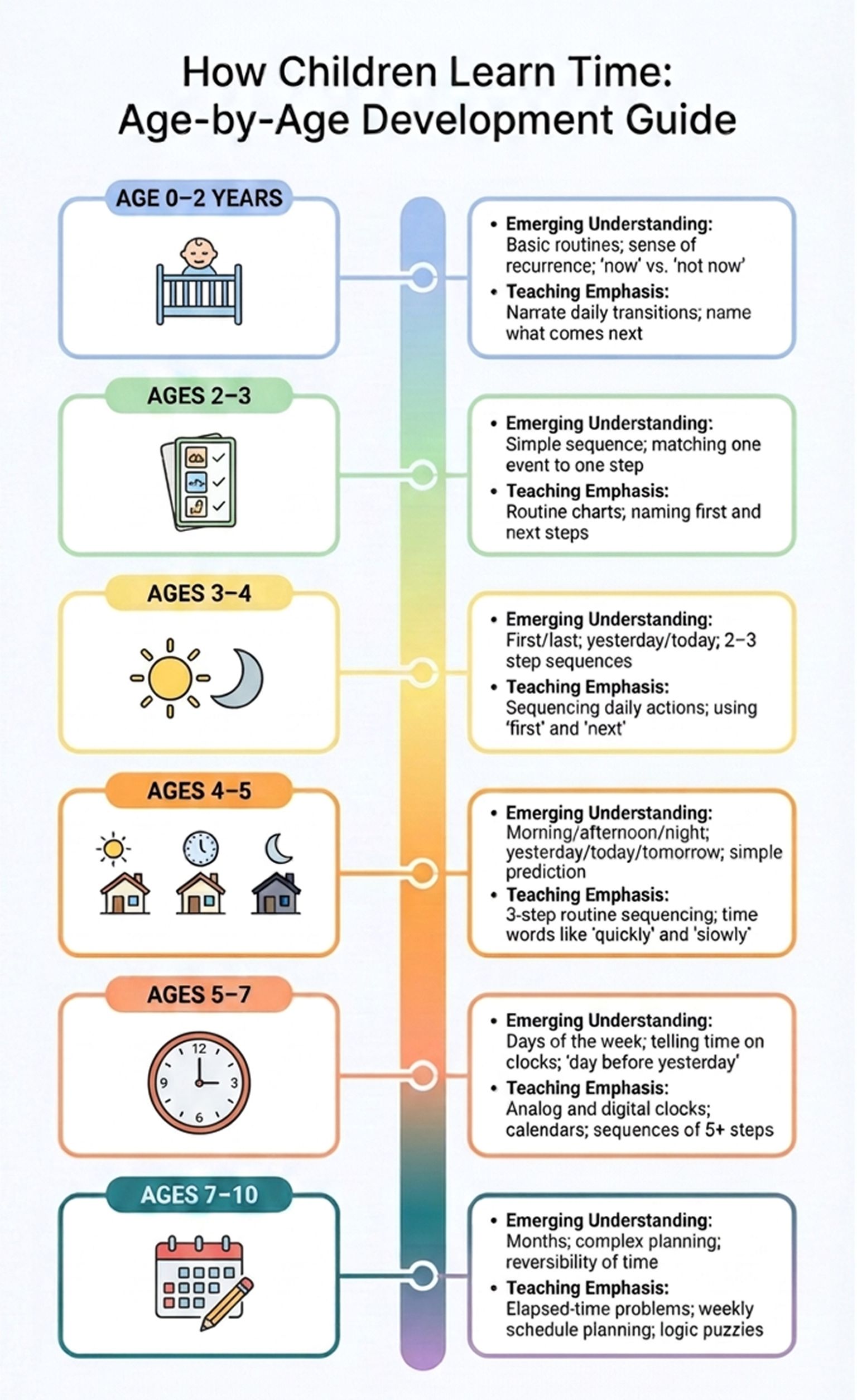
How Children Learn Time: Age-by-Age Development Guide
Age has a big effect on how children make sense of time, but the path isn’t smooth. A toddler who knows one thing happens before another is already laying groundwork for later skills, like following routines or learning to read a clock. Still, that growth can be uneven, and it rarely sticks to a neat timetable.
Age-by-Age Overview: From Routines to Clocks and Calendars
These stages follow the same path described above: sequence and recurrence come first, then duration, measurement, and clock/calendar time. The table below gives a rough picture of what children are often ready to grasp at each stage, along with the kind of help that tends to fit best. Think of it as a guide, not a pass/fail chart.
Age Range | Emerging Understanding | Teaching Emphasis |
|---|---|---|
0–2 Years | Basic routines; sense of recurrence; "now" vs. "not now" | Narrating daily transitions; naming what comes next |
Ages 2–3 | Simple sequence; matching one event to one step | Routine charts; naming first and next steps |
Ages 3–4 | First/last; yesterday/today; 2- to 3-step sequences | Sequencing daily actions; using "first" and "next" |
Ages 4–5 | Morning/afternoon/night; yesterday/today/tomorrow; simple prediction | Sequencing 3-step routines; using time-related words like "quickly" and "slowly" |
Ages 5–7 | Days of the week; telling time on clocks; "day before yesterday" | Using analog and digital clocks; calendars; long sequences of 5+ steps |
Ages 7–10 | Months; complex planning; reversibility of time | Elapsed-time problems; planning weekly schedules; logic puzzles |
How to Use Age Guidance Without Setting Unrealistic Expectations
A common mistake adults make is treating age ranges like hard cutoffs. That usually backfires. It helps more to watch what the child already handles in daily life. For example, a child who can answer, "What happened first?" but gets stuck on "What happened after we went to the park?" may need more practice with concrete sequences before moving on to abstract tools [1].
Children usually learn routine order before they learn hours, days, and months.
That’s where the next step comes in: using routines, waiting, visual schedules, and simple games to teach these ideas in ways children can actually use.
How to Teach Time Through Everyday Experiences and Play
Start With Routines, Waiting, Sequence, and Visual Supports
Mornings, bedtime, meals – these moments give children a hands-on sense of sequence before clocks or calendars mean much. As things happen, say them out loud: first we put on a t-shirt, then a jacket. That kind of simple narration ties time words to actions the child can see and feel right away.

A task on order of events in the Funexpected Math app
After a child can put steps in order, you can use waiting and timers to teach duration.
One small idea can go a long way: use reverse sequences in daily tasks. That helps children see that sequences follow a pattern - and that the pattern can flip. You can do the same thing with putting on and taking off a backpack or stacking and unstacking rings [1].
It also helps to give advance notice before transitions. A sand timer or picture schedule makes waiting easier to grasp because the child can see time passing instead of just hearing, “We’re leaving soon.”
Moving From Concrete Experience to Abstract Tools
A simple way to teach time is this: do it, picture it, then measure it.
Match each tool to the time idea the child is ready to learn.
Learning Stage | Child's Task | Adult Language | Prerequisite Understanding |
|---|---|---|---|
Doing | Getting dressed; following a 2–3 step routine | First t-shirt, then jacket. | Basic cause and effect; following simple instructions |
Picturing | Ordering photos of a past event; using a picture schedule | What happened first in these pictures? | Understanding that a symbol/photo represents a real action |
Measuring (Early) | Identifying parts of the day; using yesterday/tomorrow | What did we do yesterday? | Memory of past events; sense of now vs. not now |
Measuring (Advanced) | Telling time on analog/digital clocks; using a calendar | We have three weeks until your birthday. | Number recognition to 60; understanding of repeating cycles (weeks/months) |
Activities and Tools That Build a Sense of Time
Not every activity teaches the same part of time. Some help with order. Others help with waiting, memory, or matching daily events to symbols. So it makes sense to pick the activity that fits the child’s current stage.
A few options work well at home and in the classroom:
Routine sequence cards show pictures of morning or bedtime steps, which lets preschool children practice ordering without reading.
Sand timer activities help children feel duration by trying to finish something before the sand runs out.
Matching routine cards to clock faces links symbols to daily events.
Storybooks about routines build sequence and repetition through familiar stories. Reading the same book at bedtime each night also teaches time in a quiet, steady way.
Simple timing games like clapping a beat, racing to finish before a timer goes off, or guessing how long something will take help children build a gut-level sense of duration through play.
Conclusion: Build Time Understanding Step by Step
Time understanding grows one step at a time, from daily routines to clocks and calendars. Since time is invisible, children learn it through everyday patterns, waiting, and hearing the same kinds of time words again and again. That move from lived experience to formal tools is the simplest way to help time understanding stick.
Children grasp time best when adults tie daily life to tools that get a little more abstract over time. For parents and educators, that means keeping the focus on what children already know and building from there.
Key Takeaways for Parents and Educators
Start with daily routines and simple time words like first, next, before, and after. Those words give children a basic map of what happens and when.
Match the tool to the stage. Strong use of before and after can show that a child is ready for more formal time tools. Identifying what happened first is the easiest time skill for children, while identifying what happened after an event is the most demanding [1].
Expect gradual progress: first/last comes before clock reading. The aim is steady growth, not early mastery.
FAQs
How do I know if my child is ready to learn clock time?
Your child may be ready to learn clock time if they already understand basic time words and the order that things happen.
For example, they can put events in sequence using ideas like first, next, and last. They may also understand words such as yesterday, tomorrow, the day before yesterday, and the day after tomorrow.
You might also notice that they can:
understand the days of the week and days on a calendar
use these ideas in everyday conversation
follow simple routines in a predictable order
What should I do if my child mixes up yesterday, today, and tomorrow?
Use simple before/after routines and plain language. Talk about what happened yesterday, what is happening today, and what you’ll do tomorrow.
Keep it concrete and stick to the same pattern each time. Start with the easiest questions, like “What happened first?” and then “What happened last?” A daily routine chart or picture schedule can help a lot. You can also have your child put 2–3 events in order.
Can I teach time without using a clock or calendar first?
Yes. You can teach time concepts before introducing a clock or calendar by tying them to everyday routines and sequence.
For example, you might say, “Snack comes after circle,” and use words like “first,” “next,” “before,” and “after.” That gives children a simple way to make sense of what happens during the day.
Kids can learn parts of the day and the order of 2–3 events before they make sense of clock or calendar time. After that, you can slowly bring in simple tools like timers or hourglasses.
Related Blog Posts
Transform Math Learning for Kids
Explore Funexpected's interactive math program designed for children aged 3-7. Build math fluency, logic, and problem-solving skills through engaging, hands-on activities and a personalized digital tutor.