Parent Guide: Building Critical Thinking in Children Ages 5–12
Early Childhood Education
May 17, 2026
Everyday steps, prompts, puzzles and games to help kids ages 5-12 think clearly, solve problems, and reflect on choices.
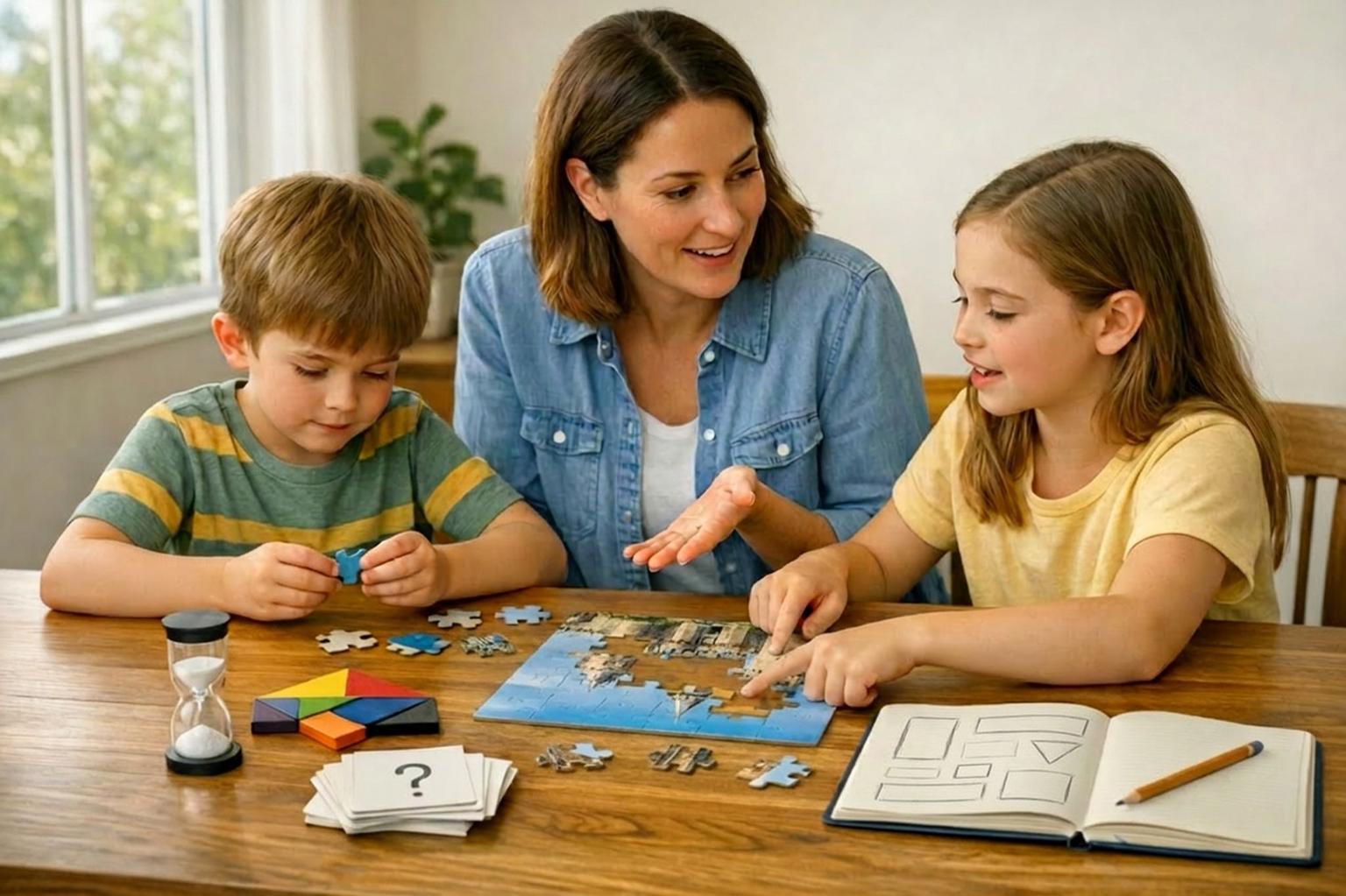
Want to help your child solve problems, analyze situations, and think independently? Critical thinking is a skill kids can develop with practice, and it’s easier than you might think. Here’s a quick breakdown of what works:
Follow 8 Key Steps: Start with BBC Bitesize’s framework to guide your child from identifying main ideas to evaluating evidence and reflecting on their thought process.
Make It Fun: Use puzzles, logic games, and open-ended questions to turn learning into play. Activities like playing "Two Truths and a Tall Tale" work wonders.
Ask the Right Questions: Daily conversation prompts like "What makes you think that?" or "What are your other options?" encourage kids to think deeper.
Play Problem-Solving Games: From board games like Connect 4 to group challenges like scavenger hunts, these activities teach reasoning and teamwork.
Critical thinking doesn’t happen overnight, but with consistent practice and engaging activities, your child will build skills that last a lifetime. Let’s dive into the steps and tools to get started.
Critical Thinking Skills and Examples for Kids | Solve a problem using critical thinking!
8 Steps to Develop Critical Thinking (BBC Bitesize Method)
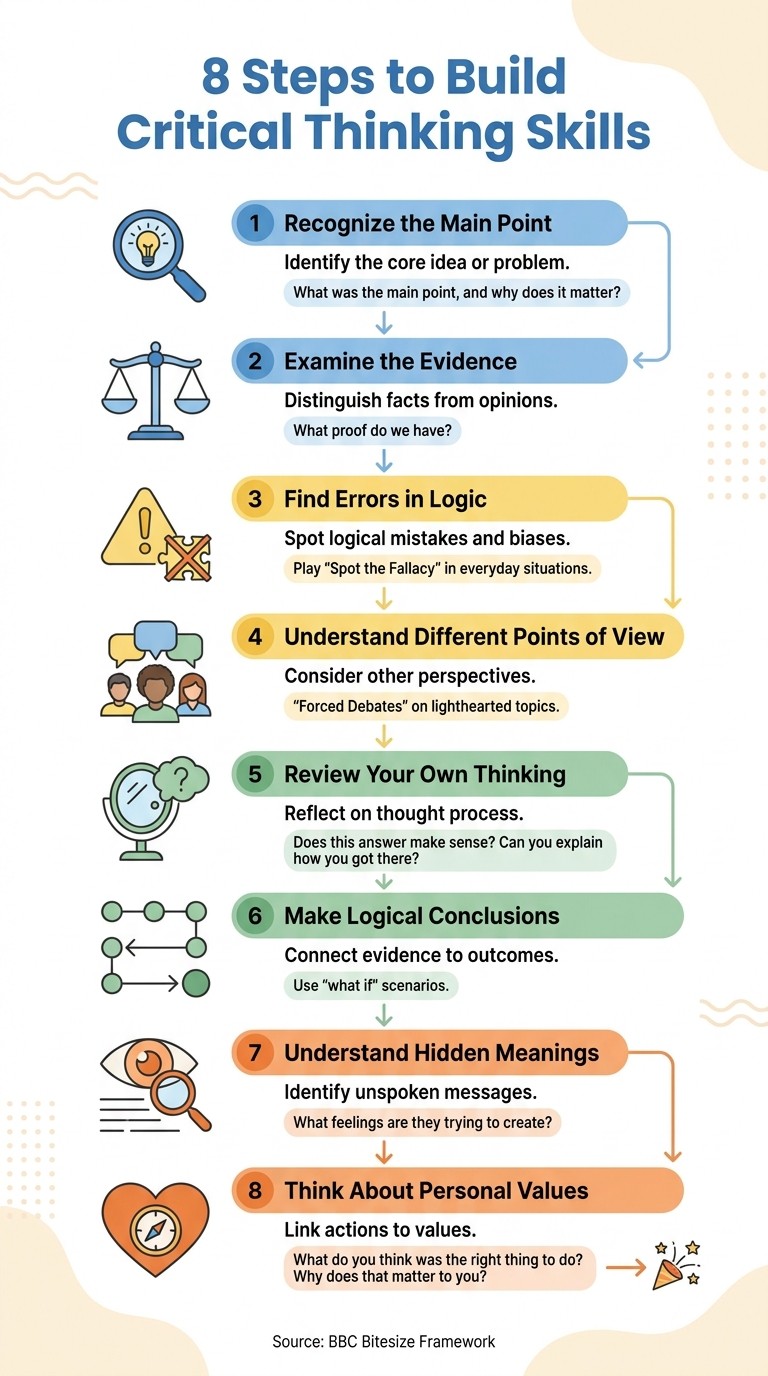
8 Steps to Develop Critical Thinking in Children Ages 5-12
The BBC Bitesize framework breaks critical thinking into eight easy-to-follow steps that parents can practice with their kids at home. Each step builds on the last, guiding children from simple observations to deeper reflection. Here's how to apply these steps in your daily routines.
Step 1: Recognize the Main Point
Understanding the main point means identifying the core idea or problem. After reading a story together, ask your child, "What was the main point, and why does it matter?" [1]. This helps them zero in on what’s truly important. Similarly, if they finish a project or solve a puzzle, ask, "What problem did you solve?" [2].
For older kids, encourage them to separate the claim (the main idea) from the proof (the evidence backing it up) in conversations [1]. This habit teaches them to focus on what’s essential and filter out distractions.
Step 2: Examine the Evidence
Once kids can identify main points, the next step is evaluating the evidence. Teach them to distinguish between facts (objective information) and opinions (personal beliefs) [1]. For example, if your child says, "This is the best game ever", ask them why they think so. Are they basing it on specific features, or is it just how they feel?
Use everyday decisions to model this skill. For instance, explain your thought process when choosing between walking or driving: "Walking saves gas money but takes longer, while driving is quicker but costs more. Since we have extra time today, let’s walk." [3]. This shows how to weigh options logically.
A fun way to practice is with the game "Two Truths and a Tall Tale." Share two true facts and one made-up story, then have your child figure out which one isn’t true [1]. You can also analyze media together by asking questions like, "Who created this? What do they want you to do? How are they trying to make you feel?" [2].
Step 3: Find Errors in Logic
Help your child spot logical mistakes by playing "Spot the Fallacy" in everyday situations. For example, if they claim they didn’t eat a cookie while having chocolate on their face, point out how the evidence doesn’t match their statement [1].
Introduce older kids to common biases like bandwagon thinking (believing something because everyone else does) or confirmation bias (only noticing evidence that supports their current beliefs) [1]. When watching ads or reading headlines, ask, "Are they trying to make us think everyone agrees?" or "What information might they be leaving out?"
Once they learn to recognize flawed reasoning, encourage them to think about alternative perspectives.
Step 4: Understand Different Points of View
Understanding other perspectives helps kids develop empathy and critical thinking. Try "Forced Debates" on lighthearted topics like "Are cats better than dogs?" [2]. Assign them the side they disagree with and have them find three reasons to support it. This exercise pushes them to consider other viewpoints.
After reading a story with conflicting characters, ask your child to role-play each perspective [4]. During discussions, prompt them with questions like, "How might someone else see this differently?".
"Critical thinking also means listening, empathizing, and respecting other views." –
Give them time to process their thoughts before jumping in with your own ideas. A silent pause of 60 seconds can encourage deeper reflection [3].
Step 5: Review Your Own Thinking
Encourage your child to reflect on their thought process. After finishing homework, especially math problems, ask, "Does this answer make sense? Can you explain how you got there?" This builds confidence and helps catch mistakes early.
In daily activities, guide them to think about their choices. For instance, if they build a tower with larger blocks at the bottom, ask, "Why did that work better than putting them on top?" Reflection helps them understand the reasoning behind their actions, not just the results.
Step 6: Make Logical Conclusions
Drawing conclusions involves connecting evidence to outcomes. Practice with simple "what if" scenarios. For example, ask, "If we leave ice cream out of the freezer, what will happen? Why?" Follow up with, "What clues helped you figure that out?"
When your child faces a decision, help them predict possible outcomes. For instance, ask, "If you do homework now instead of playing, what do you think will happen?" This encourages them to think ahead and consider consequences.
Once they’re comfortable drawing logical conclusions, it’s time to explore hidden messages.
Step 7: Understand Hidden Meanings
Hidden meanings are the unspoken messages in stories, conversations, or media. After reading a story, ask your child, "The character smiled, but do you think they were really happy? What clues give you that idea?" This helps them pick up on subtle details.
When watching ads, teach them to spot persuasive tactics like scarcity ("Only a few left!") or social proof ("Everyone has one!"). Ask, "What feelings are they trying to create?" [2]. Recognizing these methods helps kids become more media-savvy.
Step 8: Think About Personal Values
Reflecting on values means understanding what’s important and why. During daily decisions, ask your child to explain their reasoning. For example, "You shared your snack with a friend - what made you decide to do that?" This links actions to values like kindness or fairness.
Family discussions are a great way to explore values in action. When talking about a news story or a character’s choice in a book, ask, "What do you think was the right thing to do? Why does that matter to you?" These conversations help kids develop their own beliefs and articulate them clearly.
Activities That Build Critical Thinking Skills
Turning theoretical critical thinking skills into everyday practice can be fun, especially with the right activities. Games and exercises provide an engaging way to develop reasoning and problem-solving abilities naturally.
Puzzles and Logic Games for Ages 5–7
Younger kids thrive when learning through hands-on activities. For example, traffic jam puzzles like Rush Hour encourage sequential thinking by requiring kids to plan multiple moves to free a blocked car on a grid [2]. It’s a fun way to build problem-solving skills.
Construction games using Legos or building blocks challenge children to think spatially. Ask them to build the tallest tower they can in ten minutes using household items. This teaches them to think creatively under time constraints while learning from their mistakes [5].
Memory and pattern games - like Picture Bingo, memory card games, or Battleship - help improve focus and pattern recognition [4]. Another fun activity is "The Alien Explanation", where you ask a 6-year-old to explain a simple object, like a fork, to an "alien" who knows nothing about Earth. This encourages them to rethink assumptions and describe everyday items in creative ways.
"Puzzles promote logical thinking and patience as children learn to manipulate pieces to achieve a specific outcome." - Sekolah Pelita Harapan [5]
For kids aged 7 and up, code-breaking games using basic substitution ciphers (like A=1, B=2) are a fantastic way to practice systematic thinking. Start with short words and gradually increase the challenge as they become more confident [2].
Open-Ended Questions for Ages 8–12
Older children are ready for deeper discussions and analytical challenges. Instead of giving direct answers, spark their curiosity with questions like "What ideas do you have?" or "What do you think is happening here?" These guide them toward forming their own conclusions [3].
Perspective-taking questions such as "How might someone else see this differently?" encourage empathy and analytical thinking. You can also try "forced debates", where your child argues for a side they don’t agree with, finding three reasons to support that stance. This helps them consider multiple viewpoints.
To build evidence evaluation skills, ask questions like "What proof do we have?" or "Where could we find more information?" When watching media together, guide their analysis with prompts like "Who made this? What do they want you to feel or do?" This fosters media literacy and critical analysis [3].
Metacognitive questions help children reflect on their thought processes. After a task, ask "How did you decide to do it that way?" or "What would make you change your mind?" To give them time to think, use the "pause and wait" method: count silently to 60 (or 120 for older kids) before stepping in.
"Learning to think critically may be one of the most important skills that today's children will need for the future." - Bright Horizons [3]
Interactive and digital games can also play a big role in sharpening these skills.
Interactive Problem-Solving Games
Collaborative challenges like "Human Knot" are great for teaching teamwork and strategic thinking. Similarly, scavenger hunts with specific tasks and time limits encourage decision-making under pressure [4].
For digital options, apps like Funexpected Math combine logic-based challenges with spatial reasoning tailored to your child’s skill level. These interactive games make learning feel less like homework and more like play.

A logic task in the Funexpected Math app
If you prefer tabletop games, logic grids with clear, story-driven puzzles are excellent for developing deductive reasoning. Start with simpler grids and increase difficulty as your child becomes more adept [4].
"The real goal is to build agency: a child's capacity to make decisions, solve open-ended problems, and reflect on their own growth." - Kubrio [2]
Encourage your child to explain their reasoning as they solve puzzles, focusing on experimentation rather than perfection. These activities not only sharpen their logic but also nurture a love for problem-solving that will last a lifetime.
Daily Conversation Starters for Critical Thinking
Incorporating critical thinking into everyday conversations can be surprisingly simple. Ordinary moments, like family dinners or car rides, offer great chances to encourage deeper thinking. The trick? Move away from questions with a single "right" answer and focus on open-ended prompts. These kinds of questions help kids analyze, explain, and even rethink their ideas, turning casual chats into meaningful learning experiences.
Questions That Build Reasoning Skills
Asking evidence-based questions helps kids shift from quick reactions to thoughtful analysis. For example, when your child makes a claim, you might respond with: "How do you know?" or "What clues make you think that?" Making these questions a regular part of family discussions can spark curiosity while keeping the tone supportive.
Another fun idea is "reverse engineering." At dinner, ask your child to figure out all the steps that went into preparing the meal. Or try a "So What?" chain: start with an observation like, "It's raining," and keep asking "So what?" until you uncover a practical implication, such as needing an umbrella. During car rides, you could ask, "How long do you think this trip will take? What factors might change that?"
"Real critical thinking happens when your child faces a question with multiple defensible answers and has to choose, defend, and revise their position." - Kubrio [6]
Questions That Teach Perspective-Taking
Helping kids see things from another point of view builds empathy and fairness. You might challenge their perspective with questions like, "Would this ad work for Grandma? Why or why not?"
The "Switch Sides" exercise is another great tool. Have your child argue the opposite of their opinion for three minutes, then identify the strongest point from the opposing side. This can be both challenging and eye-opening.
You can also try the "Convince Me" game when your child wants something. Ask them to give three logical reasons for their request and address one possible objection. For example, if they want a later bedtime, they might need to explain how they’ll still get enough sleep and tackle concerns about waking up tired.
Questions That Improve Decision-Making
Helping kids understand trade-offs is key to making better decisions. Ask questions like, "What are your other options?" or "What’s the downside of that choice?" Afterward, conduct a "Decision Audit" by discussing what alternatives they had, what risks existed, and whether they’d make the same choice again.
You can also spark creative thinking with "What if" scenarios during meals. For example: "What if we didn’t have electricity for a day?" or "What if animals could talk?" These questions encourage kids to map out consequences and think beyond the obvious. If open-ended questions feel too tricky, start with forced choices like, "Do you think A or B happened?" to help them ease into reasoning.
Games and Tools for Problem-Solving Practice
These games and tools are excellent for nurturing problem-solving skills while encouraging collaboration. Activities can be adjusted for various age groups, helping kids progress from basic reasoning to tackling more complex challenges.
Board Games for Ages 5–8
Board games are great for sparking strategic thinking, especially when paired with thoughtful prompts. For instance:
Connect 4: Helps kids recognize patterns as they plan vertical, horizontal, or diagonal sequences while predicting their opponent’s moves.
Battleship: Develops pattern recognition and logical thinking as kids track and anticipate moves[4].
20 Questions: Encourages deductive reasoning by guiding kids to form logical arguments and evaluate evidence with each guess[1].
You can make these games even more effective by asking questions like, “How did you figure that out?” or by modeling your thought process aloud. This helps children see reasoning in action[6].
"Board games are a fun way to strengthen children's critical thinking skills by encouraging teamwork as well as planning and communication skills." - Michael Vallejo, LCSW, Mental Health Center Kids[4]
Digital Apps for Logic and Spatial Skills
For younger learners, apps like Funexpected Math combine interactive play with problem-solving.

The app offers over 10,000 tasks across 50+ topics, using engaging, hands-on activities to build logic and spatial reasoning. It even includes a digital tutor to personalize lessons, ensuring concepts are approachable for preschoolers and early elementary kids.
What sets quality tools apart is their focus on the thinking process - they encourage kids to explain their reasoning instead of rewarding quick answers.

A logic task in the Funexpected Math app
For older kids, digital platforms with collaborative challenges add a layer of teamwork to their problem-solving practice.
Group Activities for Ages 9–12
As kids grow, group activities become an excellent way to build communication and persistence. Here are a few ideas:
Team Relay Challenges: Teams work together to complete a series of puzzles or physical tasks in stages, promoting strategic planning and coordination[4].
Minefield: In this activity, teammates verbally guide a blindfolded player through an obstacle course, enhancing leadership and trust[4].
Egg-drop Challenge: Teams use limited materials to design a device that protects an uncooked egg from breaking. This activity encourages creativity and resourcefulness[2].
These activities not only sharpen problem-solving skills but also teach kids the value of teamwork and perseverance.
Conclusion: Creating Lifelong Critical Thinkers
Helping your child develop critical thinking skills doesn’t require pricey programs or rigid schedules. What matters most is consistency. For instance, just five minutes of thoughtful questioning during dinner can have a bigger impact than sporadic, lengthy sessions[7].
Small, everyday actions can go a long way. Turning "How do you know?" into a family mantra encourages curiosity and analysis. Simple activities like involving kids in grocery budgeting naturally build reasoning skills[1].
The eight steps from BBC Bitesize, combined with age-appropriate puzzles, open-ended questions, and problem-solving games, provide a practical starting point. But the real game-changer is your home environment. A space where mistakes are seen as learning opportunities, rather than failures, helps nurture the growth mindset children need to thrive[4].
Another powerful habit? Think out loud. Share your reasoning process with your child and practice the "wait time" rule - giving them 60 seconds to think before you respond[3]. And always focus on praising their effort rather than their natural abilities.
"Critical thinking skills don't just happen overnight. They are a result of continued effort and continuous growth through learning opportunities." - Michael Vallejo, LCSW[3]
Kids develop their best reasoning abilities through consistent, low-pressure practice over time. Whether it’s a morning chat about what they’re curious about, a dinner discussion about a challenge you faced, or a bedtime reflection on what made them think deeply that day, these small habits add up. The goal isn’t to teach them what to think, but how to think independently.
To see their progress, keep a simple notebook of the interesting things they say each week. You’ll be amazed at how much their reasoning evolves when they’re given the time, space, and encouragement to grow naturally[7].
FAQs
How can I tell if my child is improving at critical thinking?
You can spot improvements in your child's critical thinking by observing how they tackle problems on their own, ask meaningful and open-ended questions, and apply reasoning in practical ways. Pay attention to how they handle challenges, articulate their thought process, and weigh different viewpoints in daily interactions.
What should I do if my child shuts down when I ask open-ended questions?
If your child tends to shut down when faced with open-ended questions, try creating a calm and supportive atmosphere. Give them a moment to think before expecting a response, as this can ease the pressure they might feel. Focus on building a space where they feel at ease to explore ideas and even make mistakes without fear. Engaging them in activities like puzzles or playful problem-solving can help spark their interest in a way that feels safe and enjoyable. Remember, patience and gentle encouragement go a long way in helping them build both confidence and critical thinking skills.
How much screen time is okay for critical-thinking apps and games?
The Funexpected Math app states that two 15-minute sessions a week are enough for progress. However, there isn’t a set rule for how much time kids should spend on critical-thinking apps and games. What matters more is keeping a healthy balance between screen-based activities and other types of play and learning. Make sure the screen time they do have is purposeful, suitable for their age, and contributes positively to their growth and development.
Related Blog Posts
Transform Math Learning for Kids
Explore Funexpected's interactive math program designed for children aged 3-7. Build math fluency, logic, and problem-solving skills through engaging, hands-on activities and a personalized digital tutor.