Why Making Mistakes is a Great Way for Young Children to Learn
Early Childhood Education
May 20, 2026
How children's mistakes build stronger brain connections, boost learning in the ZPD, and how parents can give constructive feedback.

Mistakes are not setbacks - they’re opportunities for growth. Research shows that children learn better when they make and correct mistakes. Here's why:
Brain Activity: Errors trigger signals in the brain that help strengthen neural pathways, making learning more effective.
Confidence Building: Low-stakes mistakes teach kids persistence and problem-solving.
Zone of Proximal Development(ZPD): According to classic psychology, learning happens best when tasks are challenging but achievable with guidance.
Feedback Matters: When guiding questions and hints help a kid to reason, they foster resilience, curiosity, problem-solving skills, and critical thinking.
Growth Mindset: Encouraging effort instead of praising intelligence helps kids stay motivated.
Parents play a crucial role in shaping how children see mistakes. By staying calm, offering constructive feedback, and modeling how to handle errors, you can help your child turn challenges into valuable learning experiences. Tools like interactive apps can also support this process by providing instant, supportive feedback.
The key takeaway: mistakes are precious as they’re stepping stones to success.
What Happens in the Brain When Children Make Mistakes
How the Brain Responds to Errors
When a child makes a mistake, their brain reacts almost instantly - faster than they can even process it. Within just 100 milliseconds, the brain generates a signal called Error-Related Negativity (ERN). This signal comes from the cingulate cortex, a part of the brain located deep in the front that acts like an internal alert system. It flags the mistake and shifts attention toward it [1].
Then, about 200 milliseconds later, another signal called Error Positivity (Pe) follows. This is the moment when the child becomes consciously aware that something went wrong. Cognitive neuroscientist Knut Overbye explains:
"The brain is very sensitive to mistakes and it produces a specific type of electrical activity when we make errors, called the ERN." [1]
Interestingly, even toddlers as young as 2.5 years old show a similar response. Their brains emit a signal known as Feedback-Related Negativity (FRN) when they receive feedback about an error. This signal is slightly slower than in adults - by about 0.1 seconds - but it shows that their brains are already working to adapt and learn [2].
These quick reactions set the foundation for strengthening brain connections, especially when errors are addressed and corrected.
How Correcting Mistakes Builds Stronger Brain Connections
When children correct their mistakes, their brains go beyond just acknowledging the error - they physically strengthen neural connections. As Carol Dweck explains, every mistake creates an opportunity for a new synapse to form [3]. This process also boosts the development of myelin, a substance that coats neural pathways. Myelin improves the speed and efficiency of brain signals, making learning more durable and effective [4].
Studies on memory provide further evidence of this. Research has shown that people are more likely to remember words they initially guessed incorrectly than those they got right on the first try [5]. This suggests that the effort involved in correcting mistakes plays a key role in forming stronger, longer-lasting memories.
Why Productive Struggle Matters in Early Childhood
Early childhood is a crucial time for brain development. The cingulate cortex, which is responsible for detecting errors and triggering learning signals, continues to mature well into a person's late 20s [1]. By practicing and strengthening this system during childhood, kids become better prepared to handle challenges as they grow.
However, fear of making mistakes can interfere with this process. When children feel anxious about errors, the brain's amygdala - the fear center - activates. This response reduces activity in areas of the brain responsible for problem-solving. As Jo Boaler, a professor at Stanford University, explains:
"As the fear center of the brain becomes activated, activity in the problem-solving centers of the brain is diminished." [3]
This means that when a child is afraid of making mistakes, they’re not just emotionally overwhelmed - their brain is also less capable of learning in that moment. That’s why creating a supportive environment where mistakes are seen as a natural part of learning is so important. It helps children build the neural resilience they need, not just for immediate learning, but for developing long-term problem-solving skills.
What to say to a Child When They Make a Mistake
The Zone of Proximal Development: Finding the Right Level of Challenge
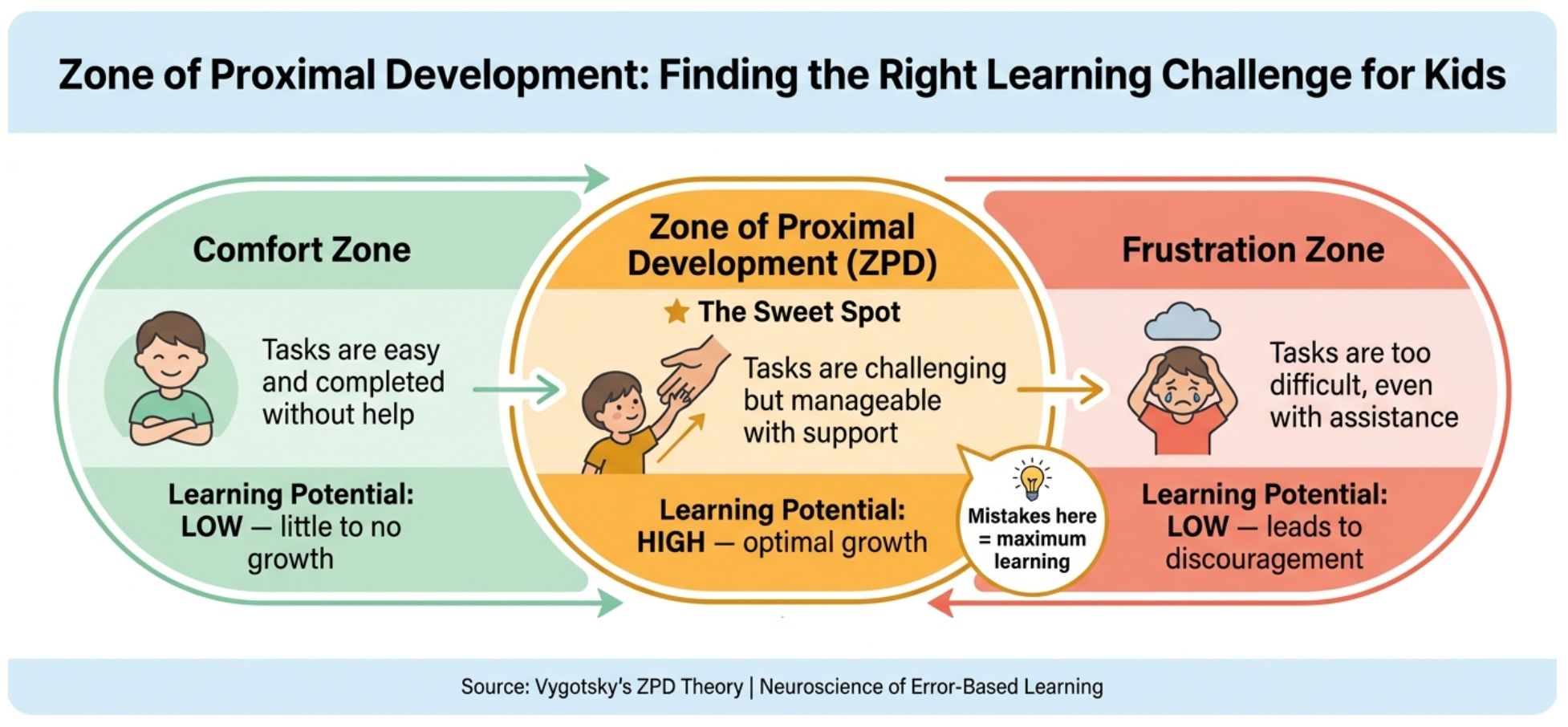
Building on the brain's quick ability to learn from mistakes, the next step is figuring out the right level of difficulty to encourage growth.
What the Zone of Proximal Development Means
Not every mistake is a learning opportunity. The key lies in making sure the challenge is just right. This idea was central to Soviet psychologist Lev Vygotsky’s concept of the Zone of Proximal Development (ZPD).
"The zone of proximal development is the distance between the actual developmental level as determined by independent problem solving and the level of potential development as determined through problem-solving under adult guidance, or in collaboration with more capable peers." - Lev Vygotsky [6]
In simpler terms, the ZPD is the gap between what a child can do alone and what they can achieve with help. Tasks in this zone encourage learning without overwhelming the child.
Zone | What It Looks Like | Learning Potential |
|---|---|---|
Comfort Zone | Tasks are easy and completed without help | Low - little to no growth |
ZPD (Learning Zone) | Tasks are challenging but manageable with support | High - optimal growth |
Frustration Zone | Tasks are too difficult, even with assistance | Low - leads to discouragement |
Identifying the right zone is just the first step. Creating the right environment for learning is equally important.
The Right Conditions for Learning from Mistakes
For the ZPD to work, you need more than just the right challenge level. Emotional safety, clear goals, and proper guidance are critical for turning mistakes into opportunities to learn. Children need to feel safe making errors, understand the task at hand, and have a More Knowledgeable Other (MKO) - a teacher, parent, or peer - who can provide just enough help to move them forward [7].
As NWEA explains:
"Instruction focused within each student's ZPD is neither too difficult nor too easy; it is just challenging enough to help them develop new skills by building on those that have already been established." [7]
This approach aligns well with earlier insights on how confidently making and correcting errors strengthens learning [8].
Adjusting Task Difficulty to Match a Child's ZPD
A child’s ZPD isn’t static - it evolves as they grow and master new skills. As their neural pathways strengthen through guided corrections, keeping the challenge level adjusted ensures continued progress.
One effective strategy is contingent support: tailoring the level of help based on the child’s needs in the moment. If they’re stuck, provide more guidance; as they improve, gradually reduce the support to encourage independence [6]. This gradual reduction, or "fading", is crucial for helping children move from assisted learning to independent success.
Personalized digital tools can also play a role. Adaptive platforms that analyze a child’s errors can pinpoint misunderstandings and respond with targeted questions. This approach creates productive cognitive conflict - encouraging children to think more deeply instead of just marking answers as wrong [8]. By keeping tasks within their ZPD, these tools make it more likely that mistakes will lead to meaningful learning.
Feedback, Scaffolding, and Building a Growth Mindset
Once you've found the right level of challenge for your child, the next step is all about how you respond when they stumble. Your feedback and support can make the difference between a child who bounces back and one who gives up.
How to Give Feedback That Actually Helps
Praising intelligence might seem like a good idea, but research shows it can have the opposite effect. In a 1998 study by Claudia M. Mueller and Carol Dweck, fifth graders who were praised for being smart ("You must be smart") actually performed worse on later tests after experiencing failure. On the other hand, kids praised for their effort ("You must have worked hard") improved their performance and showed more willingness to tackle challenges [9].
Why does this happen? It’s because the brain grows through correcting errors, and feedback focused on effort and strategies helps reinforce those neural connections. Instead of saying, "You're so smart", try something like, "I love how you tried different strategies until you figured it out." This kind of feedback gives kids a clear roadmap for how to approach challenges in the future.
Another simple but powerful tool is adding the word "yet". When a child says, "I can't do this", responding with, "You can't do this yet", shifts the focus from failure to progress. It turns a roadblock into an opportunity for growth.
"Just the words 'yet' or 'not yet,' we're finding, give kids greater confidence, give them a path into the future that creates greater persistence." - Dr. Carol Dweck, Professor of Psychology, Stanford University [10]
Using Scaffolding to Help Children Succeed
Effective feedback is just the beginning. Scaffolding is the next step - it’s about guiding without taking over. The idea is to provide enough support to help your child move forward, then gradually step back as their confidence and skills grow.
"Scaffolding isn't providing answers or just doing the task yourself. The assistance you offer should be aimed at developing the child's skillset so they can eventually transition to independence." - Lindsay Katz, PsyD, Pediatric Neuropsychologist [11]
For instance, if your child is stuck on a puzzle, resist the urge to place the piece for them. Instead, break the task into smaller steps or ask guiding questions like, "What if we tried turning this piece a different way?" This approach keeps frustration at bay while encouraging problem-solving [4].
What Jo Boaler and Other Educators Say About Mistakes
Feedback and scaffolding are essential, but leading educators also stress that struggling is a natural - and necessary - part of learning.
"If you aren't struggling, you aren't really learning. When we're struggling and making mistakes, those are the very best times for our brains." - Jo Boaler, Professor of Education, Stanford University [12]
Jo Boaler’s organization, youcubed.org, has impacted over 230 million students in 140+ countries [12]. Her work, along with Carol Dweck’s research on mindset, highlights that understanding how the brain grows through challenges can motivate children to persevere. For example, in a growth mindset program for junior high students, teachers noted a motivational boost in 27% of students, compared to just 9% in a control group [9].
Psychologist Angela Duckworth also emphasizes the importance of reframing negative self-talk:
"We have to learn to replace the thought 'I'm stupid' with another thought, which is 'I'm learning.'" - Angela Duckworth, Psychologist and Author [3]
The way adults talk about mistakes - whether at home or in the classroom - shapes how children view challenges. Up next, we’ll dive into practical ways parents can apply these ideas at home.
Practical Tips for Parents: Helping Children Learn from Mistakes
How to Respond When Your Child Makes a Mistake
Your reaction to your child's mistakes shapes how they view those moments. It’s tempting to step in and fix things right away, but pausing and acknowledging their emotions can be far more effective. A simple comment like, "That must have been tough for you," helps create a sense of emotional safety [13]. From there, guide the conversation toward effort and growth. Phrases such as, "You're putting in a lot of effort! Let's figure it out together - every time you try, you're improving," shift the focus to progress rather than perfection [4]. Staying calm and using positive body language reinforces the idea that mistakes are just part of learning.
Another powerful approach is to model how you handle your own mistakes. If you burn dinner or miss a turn while driving, acknowledge it aloud: "Oops, I messed up - let’s see what went wrong." This shows kids that mistakes aren’t something to fear but opportunities to grow. Once your child feels emotionally supported, you can guide them to reflect on what happened and explore solutions.
Guiding Children to Reflect and Try Again
Helping children reflect on their mistakes strengthens their problem-solving skills and builds neural pathways for learning. Instead of jumping in with corrections, ask open-ended questions like, "What do you think happened?" or "What could we try next?". This encourages them to think critically and take ownership of their learning.
A great way to normalize mistakes is to make reflection a regular part of your routine. For example, you could start a "mistakes of the week" conversation during dinner or on a car ride. By treating mistakes as everyday occurrences, kids learn that everyone - including adults - is constantly learning. Over time, these low-pressure discussions help children see setbacks as useful information rather than failures [14].
"Reframing mistakes as opportunities from which we can learn - rather than failures alone - can help us feel like we are capable and in control." - Making Caring Common, Harvard Graduate School of Education [14]
This habit of reflection lays the groundwork for using interactive tools that make learning from mistakes both engaging and effective.
Using Funexpected Math to Turn Mistakes into Learning Moments

Digital tools can seamlessly extend the reflection and feedback strategies you’ve already introduced. Apps like Funexpected Math are designed to transform mistakes into learning opportunities. Research shows that kids benefit from immediate, non-judgmental feedback, which encourages them to learn through trial and error [2].
Funexpected Math offers thousands of tasks and hundreds of lessons tailored for children aged 3–7. Its interactive math universe allows kids to explore, experiment, make mistakes, and try again - all in a playful environment.
The app’s instant, supportive feedback from a friendly AI tutor helps kids move through the cycle of mistake → correction → success without needing constant parental guidance.
You can enhance this experience by asking questions like, "What did you figure out while using the app?" This turns screen time into a meaningful moment of reflection and growth.
Conclusion: Seeing Mistakes as Part of Learning
Mistakes aren’t just bumps in the road - they’re stepping stones for growth, especially in young children. From the brain’s immediate recognition of errors [1] to the way neural pathways strengthen through challenges, every misstep plays a role in development. This rapid brain activity supports the idea that challenges are not obstacles but opportunities.
Beyond biology, mindset plays a crucial role. Carol Dweck’s research at Stanford highlights that children who believe their abilities can improve through effort consistently achieve more than those who don’t. And where does this belief come from? Often, it’s shaped by the adults in their lives [9]. When parents focus on the process rather than the outcome, openly acknowledge their own imperfections, and ask thoughtful questions instead of rushing to correct, they teach a powerful lesson: what matters most is the effort.
"The goal isn't to glorify failure but to make it less intimidating. Teaching little ones to embrace mistakes doesn't mean encouraging them to be careless - it means helping them see mistakes as a natural and valuable part of learning." - Edutopia
The strategies covered in this article - like understanding the Zone of Proximal Development, using scaffolding, offering feedback that focuses on effort, and encouraging reflection - are all about creating a consistent, supportive environment. Small actions, like staying calm when mistakes happen, asking open-ended questions, and reinforcing the idea that effort drives improvement, can reshape how a child approaches challenges over time.
Digital tools like Funexpected Math can complement this process by offering a safe space for kids to explore, make mistakes, and learn. While these platforms provide immediate and encouraging feedback, your role as a guide is irreplaceable. Together, these tools and your thoughtful support can turn mistakes into meaningful learning experiences.
FAQs
What should I say right after my child makes a mistake?
When your child makes a mistake, offer encouraging feedback that turns it into a chance to grow. You could say something like, "That’s okay, mistakes help us learn! What do you think we can try next?" or "Nice try! Mistakes teach us where we can get better." This kind of response shifts the focus from failure to effort and learning, helping to nurture a growth mindset.
When should I step in versus let my child struggle?
When your child encounters tasks that are too advanced for their developmental stage or becomes excessively frustrated, it’s important to step in. Prolonged frustration can impact their emotional well-being. That said, manageable challenges are essential for growth, particularly within the Zone of Proximal Development - the sweet spot where they can learn with some guidance.
Your role is to offer support only when it’s truly needed. Provide feedback and scaffolding to help them navigate difficulties, while also allowing space for them to develop resilience and problem-solving skills. Striking this balance encourages their independence and confidence over time.
Related Blog Posts
Transform Math Learning for Kids
Explore Funexpected's interactive math program designed for children aged 3-7. Build math fluency, logic, and problem-solving skills through engaging, hands-on activities and a personalized digital tutor.